
Free Health Screening Helps Indonesians Save up to Rp3 Million
Jakarta, CNBC Indonesia - The Free Health Screening programme (CKG) has reached 73.8 million participants across various age groups from 1 January to 31 July 2026. The programme not only provides access to free examinations but also helps the public identify risk factors before they develop into illnesses requiring greater treatment costs.
Deputy Health Minister Dante Saksono Harbuwono said the value of health examinations provided through CKG can reach Rp2 million to Rp3 million per person if carried out independently. He therefore urged the public not to waste the service.
“Do not waste the opportunity to undergo CKG because it will save on examination costs that would otherwise be paid out of pocket,” Dante said during a health service activity in Bandung, West Java, in May 2026.
The benefits of free health screening were felt by Susilowati Bachmid (63), a resident of Harapan Jaya, North Bekasi. Screening results showed her blood sugar was still normal, but her blood pressure had begun to rise.
The finding prompted her to control her diet, improve her lifestyle, and start exercising. For Susilowati, maintaining health is a form of savings so she can continue enjoying time with her grandchildren.
“This is like health savings but the check-up is free, so I can meet my grandchildren, stay healthy, play with and care for them, and not fall ill,” Susilowati Bachmid told CNBC Indonesia on Friday (21/8/2026).
Head of Kalibaru Community Health Centre (Puskesmas) in Bekasi City, Sulistyowati, said that throughout 2026, around 4,000 residents have been registered in the CKG programme at Kalibaru Puskesmas. Participants are predominantly adults, while screening results have identified issues including blood pressure, blood sugar, and cholesterol problems.
She said residents requiring treatment, further examination, or referral are immediately followed up. Examination facilities at the primary care level are also being equipped by the Health Office.
“If we find something, we follow up immediately. For example, if treatment or referral is needed, we act on it straight away,” she said when met by CNBC Indonesia at Kalibaru Puskesmas on Friday (21/8/2026).
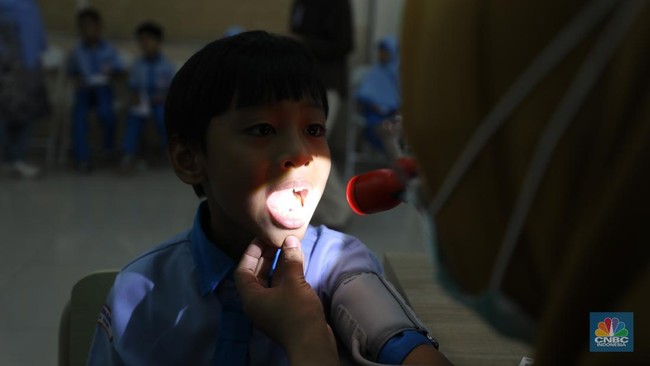
CKG in the area also targets infants, toddlers, and school-age children. To reach students, Kalibaru Puskesmas staff visit schools and conduct examinations according to age groups.
“The school CKG programme here began in early August. Today it is running at SDN Kalibaru 3, and if staff find health problems through screening, the child will receive intervention or further examination according to their needs,” she explained.
The implementation of school CKG is important given the many health problems found in children. According to Health Ministry data up to 31 July 2026, 14.64 million school-age children and adolescents have been examined. The most common finding was 3.86 million cases of dental caries, followed by 2.21 million children with above-normal blood pressure.
Nationally, the Health Ministry recorded that 7% of CKG participants were identified with hypertension, 3% with diabetes, and 20% with obesity. Among participants over 40 years old with a history of hypertension and diabetes, 79% were indicated to have dyslipidaemia.
These factors can increase the risk of diseases that absorb large amounts of funding. Based on the JKN Programme Management Report up to December 2025 presented by the Health Ministry, heart disease financing reached Rp17.35 trillion, kidney failure Rp13.38 trillion, and stroke Rp7.21 trillion.
Health Minister Budi Gunadi Sadikin recently emphasised that CKG must not stop at initial screening. Findings from screening must be followed up with education, treatment, monitoring, or referral according to patient needs.
“The goal of CKG is not just to check, but to make people healthy. After access is expanded, our focus is ensuring that problems found are immediately addressed,” Budi said during a CKG Evaluation Media Briefing in Jakarta on Tuesday (4/8/2026).
Of the 73.8 million participants up to the end of July, 62.7 million underwent screening at puskesmas and community activities, while 11.1 million were schoolchildren. The government is targeting CKG to reach 130 million residents throughout 2026.