
Free Bank Accounts for Indonesians Aged 17 and Over: A Boost for State Banks?
Jakarta, CNBC Indonesia – Coordinating Minister for Economic Affairs Airlangga Hartarto has revealed that the government will allocate approximately Rp 11 trillion to run a programme providing free bank accounts to citizens aged 17 and above.
The budget will be used to provide an initial balance of Rp 50,000 to each account holder. The funds are planned to come from the State Revenue and Expenditure Budget (APBN).
The programme forms part of the government’s efforts to expand national financial inclusion. Accounts will be opened using the National Identity Number (NIK) and linked to civil registry data.
Through this mechanism, eligible members of the public can hold an account without going through a conventional account-opening process. The government estimates the programme could reach around 200 million people.
Nevertheless, the government is still finalising the concept. The mechanism for disbursing the initial balance, the implementation timeline, the number of recipients, and the allocation of accounts to each bank have not been announced in detail.
BRI to Serve Nationally, BSI to Focus on Aceh
So far, the government has prepared PT Bank Rakyat Indonesia (Persero) Tbk (BBRI) and PT Bank Syariah Indonesia Tbk (BRIS) as the banks providing the accounts.
BRI will handle account openings across various regions of Indonesia, while BSI is being prepared to serve residents of Aceh, where sharia-based banking services apply.
The appointment has the potential to increase the customer base and third-party funds (DPK) of both banks.
The initial balance placed in the accounts could also count as low-cost funds, or current account savings accounts (CASA), particularly if booked as savings.
However, the additional DPK that the two banks will receive cannot yet be calculated. The government has not explained the number of accounts or the portion of the Rp 11 trillion budget channelled through each bank.
A Look at BRI and BSI’s DPK and CASA Strength
Before receiving the potential additional funds, BRI and BSI already held strong funding positions. BRI leads in nominal terms, while BSI has recorded higher growth in DPK and CASA.
The following is a comparison of the two banks’ funding performance based on their second-quarter 2026 financial reports.
BRI’s consolidated DPK reached Rp 1,580.68 trillion, growing 6.65% year-on-year (yoy). BRI’s CASA stood at Rp 1,068.67 trillion, up 10.10% yoy, with a CASA ratio of 67.60%.
Meanwhile, BSI booked DPK of Rp 393.34 trillion, growing 21.81% yoy. BSI’s CASA reached Rp 238.30 trillion, up 19.46% yoy, with a CASA ratio of 60.58%.
BRI’s DPK and CASA scale is roughly four times that of BSI. However, BSI leads in growth rate. This difference in scale means an additional fund of the same nominal amount could have a relatively greater impact on BSI.
Other Himbara Banks Still Have a Chance
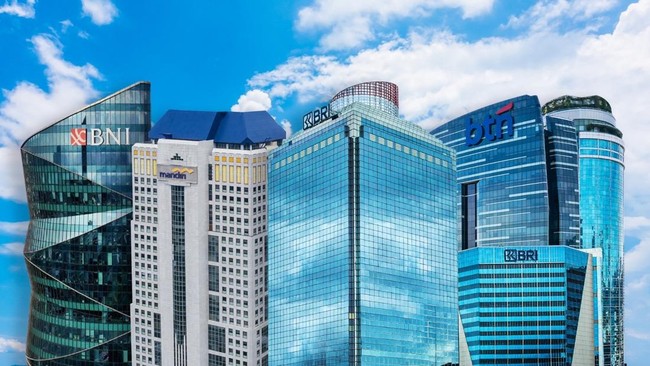
So far, the government has only named BRI and BSI as the banks prepared to run the programme. There is no confirmation yet on the involvement of PT Bank Mandiri (Persero) Tbk (BMRI), PT Bank Negara Indonesia (Persero) Tbk (BBNI), and PT Bank Tabungan Negara (Persero) Tbk (BBTN).
Even so, the opportunity for these three banks to be involved has not been entirely closed off. The government is still finalising the concept, so the range of implementing banks could change if needed to widen the programme’s reach.
Below are the DPK and CASA positions of Mandiri, BNI and BTN in the second quarter of 2026.
Mandiri has the largest DPK, at Rp 1,763.17 trillion, with CASA of Rp 1,219.91 trillion. BNI booked DPK of Rp 1,100.19 trillion and CASA of Rp 719.97 trillion. Meanwhile, BTN recorded DPK of Rp 433.00 trillion with CASA of Rp 212.79 trillion.
Among the three, BNI posted the highest CASA growth at 11.18% yoy. Mandiri has the highest CASA ratio at 69.19%, followed by BNI at 65.44% and BTN at 49.14%.
Additional DPK Cannot Yet Be Confirmed
As an illustration, the Rp 11 trillion budget could be assumed to be split evenly between BRI and BSI. Under this simple assumption, each bank would receive Rp 5.50 trillion.
If all the funds remained in the accounts, BRI’s DPK could mathematically rise to Rp 1,586.18 trillion, while BSI’s DPK would rise to Rp 398.84 trillion. This calculation is not an official projection, as the actual distribution is unlikely to be equal.
Moreover, the Rp 50,000 balance may be used or withdrawn by account holders. This means the funds disbursed by the government will not necessarily remain as DPK in the long term.
The programme’s impact can only be calculated once the government determines the number of recipients, the budget disbursement mechanism, the allocation of accounts, and the banks involved in its implementation.
Source: jawawa.id (https://jawawa.id/newsitem/free-bank-accounts-for-indonesians-aged-17-and-over-a-boost-for-state-banks-1789462405)
Originally published by CNBC Indonesia (https://www.cnbcindonesia.com/research/20260914121611-128-767699/rekening-gratis-untuk-wni-usia-17-tahun-jadi-angin-segar-himbara), translated from Indonesian