
Frans Seda Praised for His Contributions as Indonesia's Economic Architect
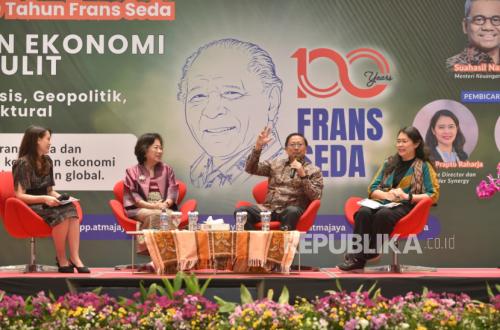
The intellectual legacy of Frans Seda is increasingly viewed as relevant in facing pressures on the national economy. This sentiment emerged during the Special Edition Memorial Lecture for the 100th Anniversary of Frans Seda, organised by the Frans Seda Foundation in collaboration with the Atma Jaya Institute of Public Policy (AJIPP) at the Atma Jaya Catholic University of Indonesia, Jakarta, on Thursday (1/10/2026).
The event was held ahead of the centenary of Frans Seda’s birth on 4 October 2026. As Minister of Finance from 1966 to 1968, Frans Seda led Indonesia’s economic stabilisation following a period of hyperinflation. He also played a key role in restructuring foreign debt through the Paris Club and opened foreign investment in a measured manner amidst a critical period of political transition.
The Chairman of the Frans Seda Foundation, Steve Ginting, stated that the 100th anniversary serves as a momentum to reflect on the importance of integrity and courage in making difficult decisions amidst uncertainty. “The centenary of Frans Seda is a significant moment for the nation today, where in our current situation of uncertainty, we need examples of national leadership. The meaning of Frans Seda’s 100 years is vital because it provides us with a reflection on the importance of integrity and the courage to make difficult decisions,” said Steve during the event.
Vice Chairman of the National Economic Council, Mari Elka Pangestu, drew lessons from Frans Seda’s experience in handling the massive debt legacy from the Sukarno era to address current economic challenges. According to her, Indonesia needs to maintain fiscal space amidst global supply chain fragmentation and the threat of recession in partner trading nations. “In 1966, Indonesia faced extremely heavy conditions. The deficit reached 128 per cent of revenue and inflation was at a very high level. From Frans Seda’s experience, there are three important lessons that remain relevant for policymakers today,” said Mari.
Meanwhile, Minister of Finance Suahasil Nazara highlighted Frans Seda’s decision to open the door to foreign capital through the 1967 Foreign Investment Law. This policy became part of a discussion regarding the boundary between productive and counterproductive economic nationalism, particularly in the context of downstreaming and the rise of global protectionism. “Frans Seda provided important meaning regarding how we face crises and build the economic foundation afterwards with an extraordinary response,” said Suahasil.
Political economist and diplomacy practitioner Dinna Prapto Raharja discussed Frans Seda’s courage when negotiating with the outside world. During the Cold War era, Frans Seda had to manoeuvre between the Western Bloc, the Bretton Woods institutions, and Indonesia’s domestic needs. According to Dinna, similar challenges are re-emerging today. “Sovereign policy means that Indonesia has the space and collective trust to determine policies that align with its national interests. Uncertainty is no longer something that occurs occasionally, but has become a condition we must face,” said Dinna.
Dinna also highlighted the issue of water scarcity. In 2026, water scarcity levels are projected to be in the range of 40–80 per cent, and in several scenarios, could exceed 80 per cent by 2030 for Java, Bali, NTT, and NTB.