
Francesca Albanese: Gaza Genocide Has Awakened Youth Resistance Worldwide
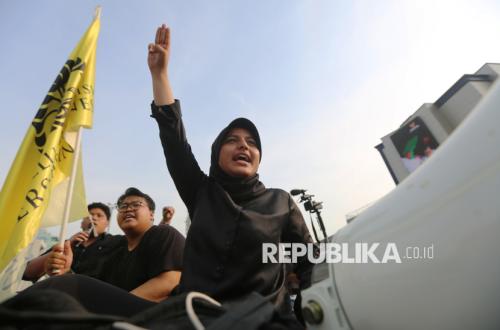
JAKARTA — The humanitarian tragedy in Gaza has shaken more than just Palestine. The genocide, which the world’s powers have failed to stop, has also awakened political consciousness among young people in many countries, particularly prompting demands that governments and institutions be held accountable for what they see as allowing injustice to continue.
Francesca Albanese, the UN Special Rapporteur on the situation of human rights in the occupied Palestinian territory, said the suffering of the Palestinian people had helped spark a revival of youth movements around the world.
“I think there is a connection between what is happening in Palestine, especially in Gaza, and the awakening of young people,” Albanese said in an interview after a discussion at Taman Ismail Marzuki (TIM) in Jakarta on Wednesday (21 October 2026).
She said young people in many countries, particularly the United States, Europe and Australia, were among the first to demand accountability for what was happening in Palestine. They have not only staged demonstrations but also challenged their educational institutions over their ties with Israel.
Albanese highlighted student campaigns urging universities to end academic links and cooperation considered to contribute to Israel’s occupation and the system of apartheid imposed on Palestinians.
For these young people, she said, the Gaza tragedy is not simply an event that will one day be studied in history books. They have witnessed civilian suffering directly through widely circulated reports and images, and have felt compelled to take a stand.
“For these young people, this genocide is a memory being formed,” Albanese said.
She contrasted the current generation’s response with that of her own generation, which, she said, failed to act adequately when genocides took place in Rwanda and the former Yugoslavia.
Albanese said today’s young people believe they can drive change, including by pressuring institutions to end relationships they regard as perpetuating injustice.
The Boycott, Divestment and Sanctions (BDS) movement, which advocates economic pressure on Israel, has also provided a framework for such action, she said. The movement, which has been active for around two decades, encourages people to use consumer choices, investment decisions and institutional ties as tools of political pressure.
From campuses to the streets of Europe
Waves of solidarity with Palestinians have been particularly visible on campuses in the United States and Europe since the Gaza war began in October 2023. In 2024, students at several US universities set up solidarity encampments and demanded that their institutions disclose and sever investment or other ties linked to Israel.
Similar protests spread to campuses across Europe and Australia. Students’ demands went beyond ending the attacks in Gaza to include transparency over university investments, the termination of certain academic relationships and institutional accountability.
More recently, however, youth protests have not been limited to Palestine. In several European countries, economic and social concerns have also brought young people on to the streets.
On 17 October 2026, large demonstrations took place in France, Belgium, Italy and Portugal. In France, the Interior Ministry reported that more than 550,000 people took part. The protests were driven by a range of concerns, including the rising cost of living and dissatisfaction with government policy.
In Portugal, demonstrators highlighted low wages, high housing costs and difficulties accessing accommodation in major cities. In Belgium, student protests were also linked to rising education costs. In Italy, demonstrations raised economic concerns and increasing prices.
Al Jazeera reported that the demonstrations in these countries took place separately and were not organised under a single movement command. Nevertheless, several of their demands had common themes: an increasingly heavy cost of living, inadequate support for education and uncertainty about the future after leaving school or university.
These developments reflect Albanese’s view that the youth revival is not driven by a single issue. Palestine, she said, can awaken broader awareness of injustices that young people also experience in their own countries.
“If Palestine has awakened them, I think they are also rising up against the injustices of which they themselves are victims,” she said.
Albanese said young people in many countries now face uncertainty and increasingly limited opportunities. These conditions are felt even in countries of the Global North, which have traditionally been seen as more prosperous and enjoying high levels of welfare.
In her view, this situation brings the struggle for human rights together with demands for a fairer life.
“That is why we are seeing a unity of struggles, a unity of the human rights movement and a unity of society,” she said.
Albanese nevertheless warned of another troubling trend: the growing pattern of repression against these movements.
“But we are also seeing unity in repression. This is very frightening,” she said.
Gaza and lessons in perseverance
Albanese also emphasised the resilience of the Palestinian people in the face of occupation, displacement and the devastation of war. The long experience of Palestinians, she said, shows how a people can continue to defend its existence and rights despite extraordinary pressure.
She said international solidarity should not stop at statements of support. Young people can play a role by demanding accountability, pressing for policy changes and reviewing institutional ties and economic activities that could help sustain human rights violations.
For Albanese, change cannot depend solely on the actions of one country or one group. A transnational movement is needed to promote accountability and end relationships considered to perpetuate injustice.
In her view, the awakening of young people shows that Palestine has become part of the global conversation on human rights. That struggle is also intertwined with young people’s demands for a safer, more equal life and a future.
Source: jawawa.id (https://jawawa.id/newsitem/francesca-albanese-gaza-genocide-has-awakened-youth-resistance-worldwide-1792597917)
Originally published by Republika (https://news.republika.co.id/berita/tn9k1s393/francesca-albanese-genosida-gaza-bangkitkan-perlawanan-anak-muda-dunia), translated from Indonesian