
France on Edge as Military Deploys to Quell Mass Unrest
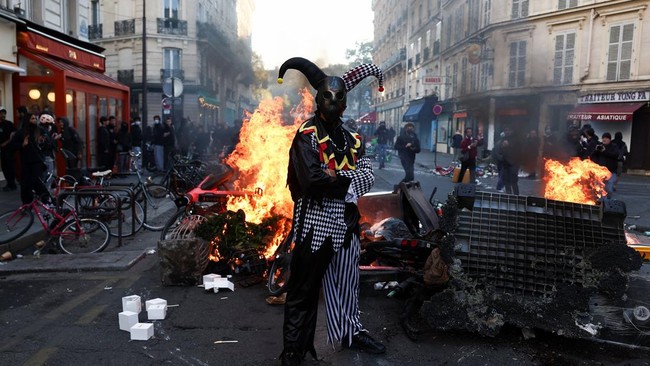
France’s government will reinforce police ranks by deploying military personnel in a major security operation to prepare for further protests on Saturday. The drastic move follows the government’s public admission that it failed to quell a wave of violence and looting last weekend.
Reuters reported on Wednesday (21 October 2026) that Prime Minister Sébastien Lecornu said the urgent priority was to restore order after mass unrest devastated Paris, Marseille, Lyon and other cities on 17 October.
“Next Saturday’s deployment will be massive,” he said.
During a heated debate, Interior Minister Laurent Nunez confirmed that the military would be deployed alongside police. The government also promised a complete overhaul of its tactics after facing sharp criticism for leaving city centres vulnerable and inadequately protected.
Curfews help restore calm
Lecornu, who described the crisis as a choice between “violence or the Republic”, directly blamed radical left-wing groups for the unrest. The groups, in turn, accused the government of playing down public anger over soaring living costs and deteriorating public services.
The scale of the unrest stunned France and intensified political tensions ahead of next year’s presidential election. Protests in other European countries, including Italy and Albania, have also heightened fears that public anger over living standards could spread across the continent.
Relatively calm nights were eventually achieved after the government imposed targeted curfews in some of the worst-affected areas. Police said the local curfews, some specifically targeting children and young people under 18, would remain in place until Tuesday night.
Lecornu nevertheless acknowledged intelligence failures, overly static police deployments and the authorities’ mistake in not cancelling previously scheduled police leave.
“I deeply regret what happened and accept my share of responsibility,” Nunez said.
Suspect arrested over Limoges town hall fire
In response, the French parliament is setting up a special inquiry committee, while authorities have assigned 200 investigators to track down those responsible for the street violence. On Tuesday, police arrested a man suspected of starting the fire that destroyed the historic town hall in Limoges.
Local officials said the suspect was already on a security watchlist and belonged to an ultra-left group.
Sylvain Maillard, a Renaissance MP for Paris, also highlighted a shift in the rioters’ tactics.
“Some apps have become walkie-talkie systems for rioters and looters,” Maillard said.
The turmoil has shaken the country’s economy. France’s borrowing costs surged on Tuesday as investors worried about the prospect of further unrest, pushing the yield on 10-year government bonds to its highest level since 2002. Supermarket giant Carrefour also reported losses of tens of millions of euros due to widespread theft and vandalism.
Despite rising tensions, France’s main student union, UNEF, has threatened further protests on Saturday to keep up pressure on the Macron government over what it says is an underfunded education system. The “Yellow Vests” (Gilets Jaunes) have also called for demonstrations against rising fuel prices. The group, which emerged in 2018 in response to fuel tax protests, is ready to organise blockades again as it did in the past.
“We will keep moving forward,” a UNEF representative said on social media.
Italy faces a new form of unrest
The turmoil is not confined to France. Cities in northern Italy, including financial hub Milan, were also hit by unrest last weekend. Although it was not on the same scale as in France, it took the government of Prime Minister Giorgia Meloni by surprise, and new security measures are expected soon.
Defence Minister Guido Crosetto described the unrest as a form of “hybrid warfare” coordinated through social media platforms such as TikTok and YouTube.
“The events in Milan and elsewhere in Italy are fundamentally different from what we saw in another era,” he said.
“The West has not understood this or taken meaningful action in response.”
Following the unrest in Milan’s Corso Vittorio Emanuele II shopping district, sportswear retailer On and Levi’s were forced to operate behind wooden boards. Several luxury shops only felt safe enough to put their merchandise back in their windows after hiding it for security reasons.
Elsewhere in Europe, demonstrators in Albania were also reported to be preparing to flood the streets of Tirana for a seventh consecutive day, seeking to bring down the government of Prime Minister Edi Rama.