
France in Turmoil as Macron Warns of Threat of Major Riots on 31 October
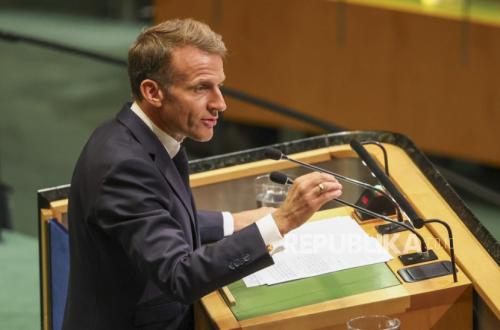
PARIS — French President Emmanuel Macron has warned that a nationwide wave of demonstrations scheduled for Saturday (31 October 2026) could trigger major unrest in several cities. The warning comes as the government faces mounting social pressure over the rising cost of living, dissatisfaction with public services and demands for education reform that previously prompted student protests.
During a visit to Marseille on Monday (26 October 2026), Macron described the forthcoming demonstrations as a high-risk day requiring security forces to be prepared. The government is also preparing for a nationwide mobilisation by trade unions on 5 November, which could prolong political and social tensions ahead of France’s 2027 presidential election.
“We know that next Saturday will still be a high-risk day. We also know that 5 November will be a day of national mobilisation involving all the trade unions,” Macron told journalists, according to Anadolu Agency on Monday.
Macron said the government would not allow violence to recur every weekend, while recognising the public’s right to express its views through demonstrations. Authorities will strengthen security around shopping districts, public facilities and city centres that have previously suffered damage and looting.
The warning follows demonstrations on 17 October that turned into riots in several major French cities, including Paris and Marseille. Protesters clashed with police, while buildings, shops and public facilities were damaged in acts of violence and looting.
The French government subsequently increased the deployment of security forces ahead of further demonstrations on 24 October. Reuters reported that about 70,000 police officers were deployed as at least 410,000 people took to the streets across France, according to figures from the Interior Ministry.
That figure differs from the estimate by the General Confederation of Labour (CGT), which said about 800,000 people took part in nationwide demonstrations that day. The gap highlights the scale of the mobilisation as well as the differing methods used by the government and workers’ organisations to count participants.
Macron acknowledges security forces’ failure
During his visit to Marseille, Macron openly acknowledged that the government had failed to anticipate the scale of the violence during the 17 October demonstrations. He said the number of police deployed at the time had been insufficient to respond to the situation as it developed on the ground.
“We did not anticipate that so many radical left-wing groups would mobilise very early in the morning, in an unusual manner,” Macron said. He added that the authorities had not expected criminal groups to be present and become involved in attacks and looting.
Macron said the combination of radical-group mobilisation and criminal activity had left the security response out of proportion to the level of threat. This was the government’s assessment of the causes of the violence, while the broader demonstrations involved groups with a range of social and economic demands.
Macron visited Marseille City Hall, which demonstrators had stormed on 17 October, and saw the damage left behind. He also met security personnel and business owners affected by looting to underline the government’s commitment to restoring order.
The government said it would maintain tighter security for the 31 October demonstrations, including directing protest routes away from city centres. The measures are intended to reduce the risk of damage to public facilities and protect economic activity without imposing a general ban on protests.
Macron also rejected calls from some quarters for the government to declare a national state of emergency immediately. He said order could still be maintained using the legal powers and security forces already available, making emergency powers unnecessary for now.
From student protests to nationwide anger
The wave of demonstrations now shaking France began with secondary-school students’ protests in September 2026, calling for improvements to education. Shortages of teachers, the condition of school buildings and limited access to higher education were among the issues that prompted school blockades and demonstrations in cities across the country.
The movement expanded as workers, students and activists from the Yellow Vests movement joined broader mobilisations. Demands initially focused on education but widened to include the rising cost of living, household purchasing power, the quality of public services and economic inequality.
Reuters reported that trade unions believe public anger now spans a range of professions, including teachers, firefighters and other workers. This indicates that the protests are no longer confined to schools, but have become a source of social pressure on Macron’s government.
The Yellow Vests movement has a long history of opposition to the French government’s economic policies. Emerging in 2018 in response to a proposed fuel-tax increase, it went on to become a symbol of discontent over the cost of living and relations between the government and the public.
The movement’s renewed involvement has given the latest demonstrations a broader political and social dimension. Its organisers have called for further action on 31 October, while several trade unions are preparing strikes and a nationwide mobilisation on 5 November.