
France in Flames: Could the History of Mass Protests Repeat Itself?
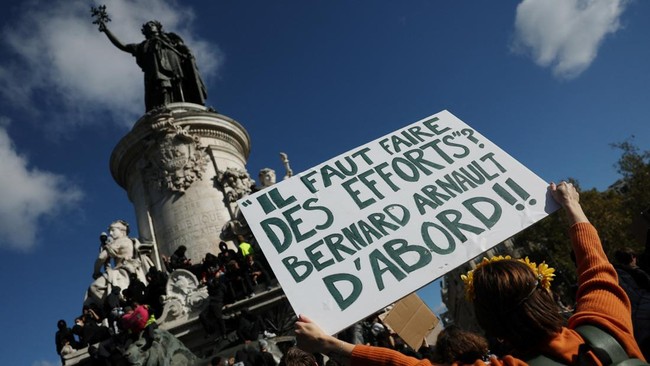
France has been hit by major unrest. Demonstrations that began as a way to voice dissatisfaction with various social issues have turned into violence spreading across several cities.
The unrest escalated, with government buildings set alight, shops looted and clashes between demonstrators and French police becoming unavoidable. The violence on Saturday (17 October 2026) was among the worst France has seen in recent years.
The problems France is facing are far greater than the unrest visible on its streets.
The government’s increasingly strained finances, public discontent and political competition ahead of the 2027 presidential election have left the country facing an uncertain future.
Citing The Economist, the latest unrest could mark the start of another wave of demonstrations. The various grievances fuelling public anger have yet to be resolved.
Thousands arrested
Last weekend’s unrest showed the scale of anger among some French people over the conditions they face.
Around 500,000 people took to the streets to voice a range of grievances, from high fuel prices and the state of education to police conduct.
In Limoges, the roof and clock tower of the 19th-century town hall collapsed after the building was set on fire.
In Marseille, a group of masked rioters broke into the town hall and toppled a statue of Marianne, a symbol of the French Republic.
Unrest also broke out in Bordeaux. Masked teenagers smashed the windows of Louis Vuitton and other shops, then made off with bags, shoes and other merchandise.
Black smoke rose over several parts of the city as police tried to disperse the crowds. More than 2,000 people were arrested in last weekend’s unrest.
French President Emmanuel Macron strongly condemned the violence.
“Tonight, we all feel anger and shame,” Macron said in a televised address.
Not all demonstrators supported the destruction. Pauline, a 20-year-old student at the University of Bordeaux, said she had joined the protests because she was frustrated by various problems in her country.
Overcrowded lecture halls, high petrol prices and police conduct were among the reasons she took part in the demonstration.
But she was also disappointed when the protest turned into rioting.
“The rioters are damaging the image of our movement,” Pauline complained, according to The Economist.
The situation showed how demonstrations initially intended to convey public demands had turned into unrest damaging public facilities.
Yet France is known for its extensive social protection system, good public transport and relatively high quality of life.
Why is France repeatedly in turmoil?
France is widely known as one of the world’s most romantic tourist destinations. Paris, with the Eiffel Tower, historic buildings and rows of cafés, attracts millions of visitors.
But behind this beauty, France’s streets have a long history of people expressing anger and dissatisfaction with the government.
For decades, France has repeatedly seen demonstrations involving hundreds of thousands or even millions of people.
One of the best known was the May 1968 protests, when students and workers took to the streets to demand social and political change. The action grew into a major wave of strikes that shook the government of President Charles de Gaulle.
In 1984, between 850,000 and 1.5 million people took to the streets to defend private education.
Mass protests returned in 2006, when around one million to three million people opposed a new employment contract policy for young people.
Four years later, in October 2010, around 1.2 million to 3.5 million people demonstrated again, this time against raising the retirement age from 60 to 62.
The scale of these protests reflects France’s long tradition of people making their demands heard through demonstrations.
However, the latest wave of unrest in October 2026 has come as France faces increasingly complex problems.
According to The Economist, at least three major issues are making the situation more difficult and could trigger further demonstrations.
1. Political rivalry ahead of the 2027 election
France is due to hold its presidential election in April and May 2027. After nearly a decade in office, Emmanuel Macron cannot run again because the constitution limits presidential terms.
This has opened up a contest among political figures with sharply differing views.
On the left is Jean-Luc Mélenchon, leader of La France Insoumise (LFI). On the right, Marine Le Pen is one of the leading figures with the strongest support.
The French government has accused radical left-wing groups of exploiting the demonstrations for political purposes. Prime Minister Sébastien Lecornu warned that the unrest could be a warm-up for the presidential election.
Mélenchon denied responsibility for the violence and instead blamed the police response.
Meanwhile, Le Pen’s supporters see the unrest as evidence that Macron’s government is increasingly losing control.
The rivalry is particularly notable in light of the latest opinion poll cited by The Economist.
Marine Le Pen has around 32% support, while Édouard Philippe and Jean-Luc Mélenchon each have around 15%–16%.
Growing political divisions put France at risk of another wave of demonstrations, including after the presidential election.
2. Government finances under mounting pressure
Amid political tensions, France’s public finances are also facing major problems.
The Economist estimates that France’s budget deficit will reach 5.4% of gross domestic product (GDP) in 2026, one of the highest in the eurozone.
The size of the deficit shows that government spending remains far greater than its income.
To cover the shortfall, the government must continue to seek additional financing, including by issuing debt.
The problem is that borrowing costs for France are rising. The country now has to offer higher bond yields than Italy and Greece.
Interest payments on the debt are also increasing. In 2026, spending on debt interest is expected to exceed the budgets for education and defence.
This leaves the French government in a difficult position.
On the one hand, the public is demanding better assistance and public services. On the other, the government must control spending to improve its financial position.
The situation differs from the Yellow Vest protests of 2018–2019. At the time, Macron had more fiscal room to provide assistance and ease public anger.
Now the government’s options are increasingly limited by the large deficit, high debt and rising interest costs.
3. The pension-age dispute remains unresolved
Another problem is the pension system, one of the largest areas of government spending in France.
Raising the retirement age could help reduce the budget burden over the long term. However, the policy is highly unpopular among the public.
Some politicians have instead promised to lower the retirement age in order to win voters’ support.
Yet such a move could increase government spending further while the country’s finances are already under pressure.
One figure who continues to argue for a higher retirement age is Édouard Philippe, a former prime minister from the centrist camp.
However, his support in the polls remains behind Le Pen’s.
This illustrates the dilemma facing France: policies needed to improve the country’s finances may not be popular with the public.
As a result, politicians face pressure to make promises that could add to the government’s budget burden.
These three issues pose a formidable challenge for France.
As public anger rises, the government must maintain security, improve economic conditions and contend with political competition ahead of the presidential election.
Yet not all French people want change through violent action. The day after the unrest, business resumed at a number of cafés, showing that everyday life continued amid the tension.
But without resolving the issues behind public dissatisfaction, France risks being hit by another mass protest.
The unrest of 17 October 2026 could be a sign that the country’s problems are far from over.
Source: jawawa.id (https://jawawa.id/newsitem/france-in-flames-could-the-history-of-mass-protests-repeat-itself-1792417835)
Originally published by CNBC Indonesia (https://www.cnbcindonesia.com/research/20261019153033-128-777555/prancis-membara-sejarah-demo-jutaan-orang-terulang), translated from Indonesian