
France hit by severe wave of protests: what is behind it?
Paris (ANTARA) — France was hit by a wave of mass demonstrations that escalated into unrest in several cities in mid-October 2026. Initially triggered by education issues and school conditions, the protests developed into a broader movement reflecting public anger over the rising cost of living, economic inequality and declining public services.
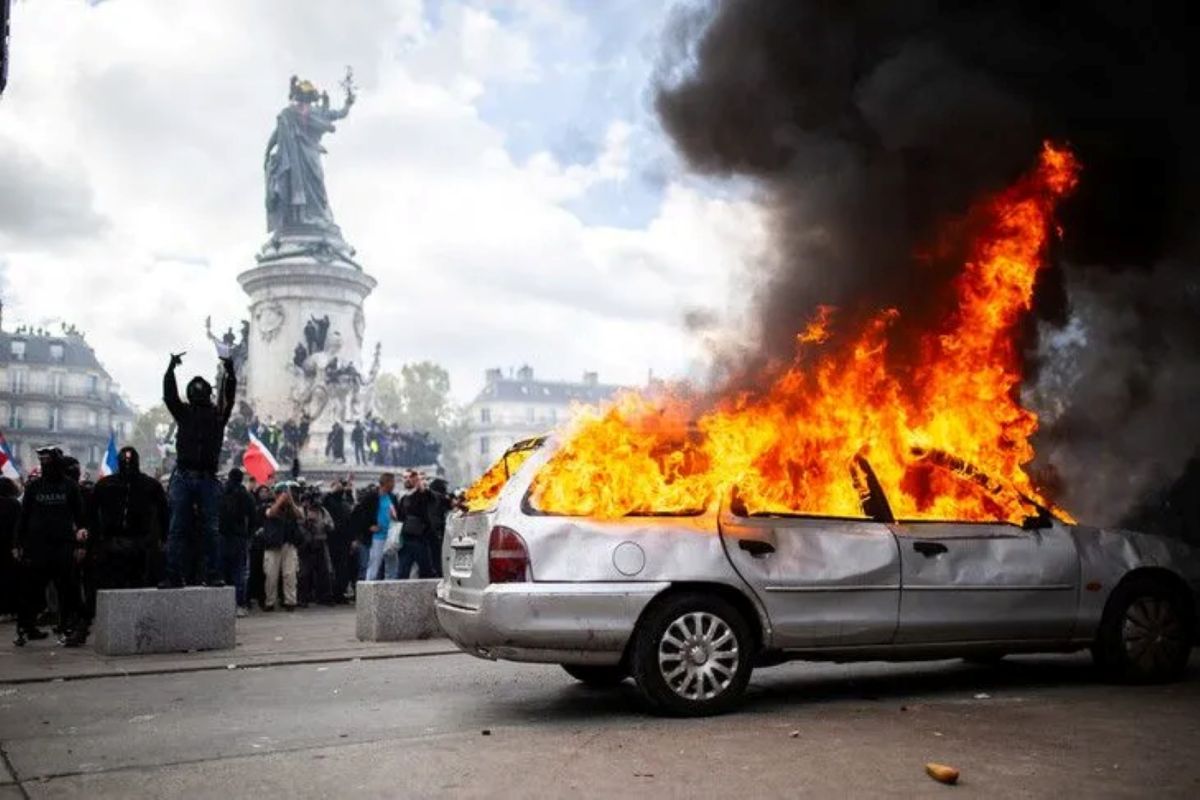
Tensions rose on Saturday, 17 October, when hundreds of thousands of people took to the streets across France. Most demonstrations were peaceful, but some groups clashed with police, looted shops, set vehicles alight and damaged public buildings.
Reuters reported on 18 October 2026 that the unrest was among the worst bouts of violence France had experienced in recent years. President Emmanuel Macron called for calm while stressing that peaceful demonstrators’ demands should be distinguished from criminal acts.
What, then, caused the wave of mass protests in France to escalate into unrest?
- Rising living costs and economic pressure
One of the main drivers of the demonstrations was the growing economic burden on the public. Higher prices for everyday goods and fuel made many people feel that it was becoming increasingly difficult to maintain their purchasing power.
The issue became more sensitive because people believed the government’s policies had not done enough to meet the needs of low- and middle-income groups.
Public anger over the economy recalled the Yellow Vests, or Gilets Jaunes, movement that emerged in 2018. At the time, a fuel tax increase helped trigger demonstrations that subsequently grew into broader protests against inequality and the government’s economic policies.
Similar frustration resurfaced in October 2026. This time, however, the demonstrations also involved school pupils, university students, teachers, trade unions and other groups with different demands.
The latest wave of demonstrations in France began with education issues, particularly the increasingly poor conditions in secondary schools.
The protests began to gather pace in September 2026, following concerns about shortages of teachers and support staff, limited resources and school buildings in need of repairs.
One of the starting points was a school staff strike at Lycée Saint-Exupéry in the Créteil area on 17 September. Pupils later joined in, voicing objections to what they considered inadequate learning conditions.
The action subsequently spread to several areas, including Paris, Marseille, Lyon, Lille and Bordeaux. Teachers, parents and trade unions joined in, urging the government to improve educational facilities and meet staffing needs.
Education concerns became a gateway to broader demands, particularly over social inequality, public-service budgets and the future of younger generations.
- Discontent with the government and social inequality
Beyond economic and education issues, the demonstrations also reflected dissatisfaction with the direction of President Emmanuel Macron’s policies.
Some demonstrators believe public services are increasingly overstretched, while people face economic pressures that are out of proportion to their ability to cover everyday expenses.
This suggests that the protests are not simply opposition to a single policy. They reflect accumulated frustration among different groups with differing interests.
Student and school-pupil movements have converged with groups that had previously campaigned on the cost of living, workers’ welfare and economic equality. The combination of these demands has turned the demonstrations into a greater political challenge for the government.
The situation is particularly sensitive ahead of France’s 2027 presidential election. Public discontent could become a major issue in the coming political contest.
The large number of demonstrators does not mean that all participants were involved in violence. Most took to the streets to express their demands peacefully, while the unrest involved groups responsible for vandalism, looting and clashes with authorities.
Several cities saw serious incidents on 17 October. Limoges City Hall caught fire, public buildings in Marseille were attacked, and facilities and shops in Lyon were also damaged.
In Paris, clashes broke out as police tried to control the crowds. Officers used tear gas and took security measures to disperse groups involved in violence.
The French government blamed far-left groups and criminals for some of the acts of vandalism. However, this was the authorities’ assessment and does not mean that all demonstrators belonged to those groups.
President Macron also stressed that peaceful public demands should not be equated with looting and vandalism.
In other words, social anger formed the backdrop to the demonstrations, while violence by some groups worsened conditions on the ground.
The demonstrations in mid-October 2026 had a considerable impact. According to Reuters on 18 October, more than 500,000 people took part in demonstrations in cities across the country on Saturday. The Associated Press, meanwhile, put the estimated turnout at between 550,000 and 800,000.
The precise number of participants differs according to the source and counting method, but both reports indicate a large-scale public mobilisation.
On Sunday, 18 October, Interior Minister Laurent Nuñez said police had arrested around 2,400 people across France. Nearly 1,000 police officers were reportedly injured, while one demonstrator died after suffering cardiac arrest during the protest in Paris.
The damage also affected businesses. Reuters reported that several shops, including Carrefour outlets, were looted or vandalised. The incidents added to the economic losses borne by businesses and local authorities.
Macron called for calm and said those responsible for violence must be held accountable. The government also said it might consider restricting demonstrations in certain locations to protect public buildings and businesses.
The protests in France show how economic and education concerns, together with declining trust in the government, can combine to drive large-scale public mobilisation.
Demands that initially centred on school conditions have expanded to include the cost of living, the quality of public services and social inequality. This means resolving the crisis will require more than security measures and action against those responsible for unrest.
The government is also under pressure to address the issues people face, including repairing educational facilities, ensuring public services function properly and easing the financial strain on households.
It remains unclear whether this wave of protests will develop into a prolonged movement like the Yellow Vests in 2018. What happens next will depend greatly on the government’s response, the security situation and the ability of different parties to find a way forward on the demonstrators’ demands.
The unrest is a reminder that accumulated social discontent can develop into a wider crisis when people feel their concerns are not being addressed.