
FPCI: 100 GW Solar Power Target Requires Regulatory Certainty
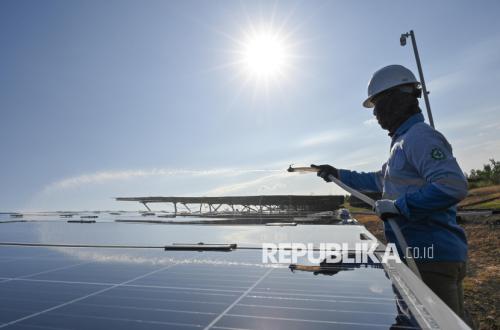
The government’s target to develop solar power plants (PLTS) with a capacity of 100 gigawatt peak (GWp) is believed to require regulatory certainty to ensure projects are implemented consistently. The Foreign Policy Community of Indonesia (FPCI) maintains that clarity in rules is essential, as the programme requires massive investment and involves numerous government agencies.
FPCI Founder and Chairman Dino Patti Djaluscstated that the government’s political commitment to the 100 GWp solar development must be immediately followed by a clear regulatory foundation.
“This is a step worthy of appreciation from President Prabowo, and we fully support it. The political commitment to 100 GWp is very encouraging and the target is certainly achievable. The next step is to strengthen it with a clear and robust regulatory foundation,” Dino said in a statement on Tuesday (1/9/2026).
According to Dino, regulatory certainty is needed to bridge political commitment with programme execution. He expressed hope that solar energy development could become a long-term policy of the President Prabowo administration.
“We want to see the 100 GWp solar ambition become President Prabowo’s legacy in the near future,” he added.
The government launched the 100 GWp solar programme and Battery Energy Storage System (BESS) on 25 August 202<0xA0>6. On that occasion, President Prabowo also commenced the construction of a 305 MWp solar plant and a 1 GWh BESS owned by PT PLN in Gilimanuk, Bali.
Prabowo explained that the 100 GWp programme encompasses diesel-to-solar conversion (de-dieselisation), rural and productive village electrification, power grid strengthening, and energy provision for industrial zones. BESS will be integrated to support a cleaner, more reliable, and sustainable electricity system.
The President also appointed several officials to oversee the programme’s implementation, namely Coordinating Minister for Economic Affairs Airlangga Hartarto, Minister of Energy and Mineral Resources Bahlil Lahadalia, Minister of Investment and CEO of Danantara Rosan Roeslani, President Director of PLN Darmawan Prasodjo, and President Director of Pertamina Simon Aloysius Mantiri.
FPCI believes that this cross-agency coordination must be accompanied by a clear division of authority. Clarity regarding institutional roles, procurement, financing, and project stages is a crucial factor in the programme’s execution.
Minister of Energy and Mineral Resources Bahlil Lahadalia stated that the 100 GWp solar development is a government move to utilise Indonesia’s solar energy resources. The programme requires an investment of approximately US$73 billion and is estimated to create around 5.52 million jobs.
Bahlil also estimated that the programme could generate subsidy efficiencies of around Rp73.9 trillion annually. The scale of investment needs and the potential economic benefits make the certainty of project schemes a vital factor in its implementation.
Bahlil noted that the initial implementation phase includes 14 projects with a total capacity of 5.3 GWp across various regions in Indonesia. The government is also preparing an intervention mechanism for projects undertaken by Independent Power Producers (IPP) should developers be unable to offer competitive prices.
In such circumstances, the government is considering the possibility of assigning tasks to Danantara, with financing adjusted according to Presidential directives.
Bahlil emphasised that solar development must also provide added value to the national economy. According to him, solar panels and batteries should be produced domestically, involving the Indonesian workforce.
Developing the domestic industry is seen as a way to expand the economic benefits of solar investment, in addition to increasing renewable energy capacity and strengthening energy security.
FPCI believes the programme could also create opportunities for the development of the domestic solar industry, the expansion of energy access, and the enhancement of power system resilience. Transparency in implementation is necessary to maintain accountability and provide certainty for both public and private stakeholders.
The 100 GWp target has now entered the implementation phase following the government’s programme launch and the commencement of initial projects. Its success will depend on policy consistency, regulatory clarity, and project execution in accordance with the set targets and financing schemes.