
Four Years On, Sexual Violence Law Still Needs Stronger Implementation
JAKARTA – Implementation of the Sexual Violence Crime Law (UU TPKS) still needs strengthening to ensure victims have better access to justice and protection. Although the regulation provides a framework for handling sexual violence cases, practice on the ground continues to face several challenges, from officials’ understanding of the law to coordination between institutions.
Law No. 12/2022 on Sexual Violence Crimes prohibits the resolution of sexual violence cases outside the judicial process, except in cases involving child perpetrators as provided for by law. However, implementation of this provision still needs to be reinforced to ensure cases are handled in accordance with the legal framework and with victims’ rights at the centre.
Indonesian Judicial Research Society (IJRS) data for 2018–2023 show that the UU TPKS was used in only 1.4 per cent of case handling. Meanwhile, records from the Indonesian Women’s Legal Aid Association (FPL) for 2025 show that 18.2 per cent of court rulings had applied the law. Vanita Naraya Executive Director Kunto Adi Wibowo said the regulation had established a relatively progressive legal foundation, but its implementation still needed support.
“Normatively, the UU TPKS puts us among those with relatively progressive legislation, but its implementation is what needs to be pushed forward,” Kunto said in a press release on Saturday (28 November 2026).
Vanita Naraya Programme Director Dian Kartika Sari also said that some regions still tend to resolve sexual violence cases through customary legal mechanisms without continuing them through the state legal process. This is one issue that needs examination to ensure victims can access justice in accordance with the law.
Vanita Naraya research conducted in 12 provinces from July to October 2026 identified several challenges to implementing the UU TPKS. These include uneven understanding of the law among law-enforcement officials, differing standards for handling cases across institutions, and personnel rotations that undermine continuity in officials’ capacity.
The research also recorded victim-blaming, shortcomings in restitution and victim-assistance mechanisms, and a lack of alignment in the application of the UU TPKS, the Criminal Code (KUHP) and the Child Protection Law.
In response to the findings, Vanita Naraya urged the House of Representatives (DPR) and regional legislatures (DPRD) to strengthen oversight of law-enforcement officials, harmonise regulations and ensure funding is available for the handling of cases and the recovery of sexual violence survivors. Stronger inter-agency coordination was also considered essential to make implementation more effective.
Dian also called for a coordination forum involving law-enforcement officials and civil society organisations. The forum is expected to help accelerate victims’ access to justice and protection services.
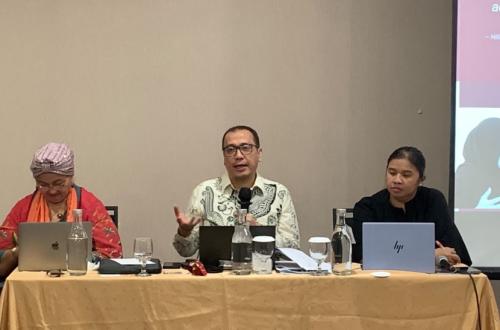
The preliminary research findings were presented at a Women, Peace and Security (WPS) discussion held as part of the National Consolidation of Women Parliamentarians, organised by the Indonesian Women’s Parliamentary Caucus (KPP-RI).
Source: jawawa.id (https://jawawa.id/newsitem/four-years-on-sexual-violence-law-still-needs-stronger-implementation-1795837875)
Originally published by Republika (https://news.republika.co.id/berita/tp6xzp416/empat-tahun-uu-tpks-implementasi-masih-perlu-diperkuat), translated from Indonesian