
Four Possible Scenarios After Israel’s Election
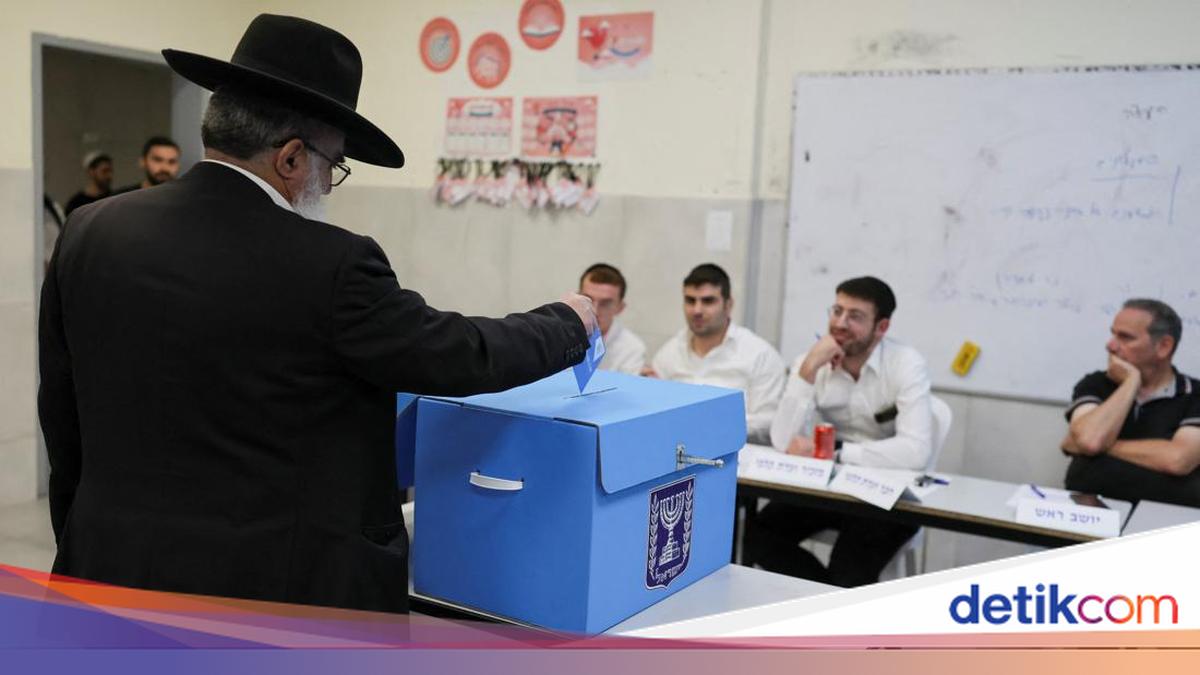
Israelis voted in legislative elections on Tuesday (27 October), local time, with turnout at its highest level in decades. Vote counting is under way, and preliminary results show Prime Minister Benjamin Netanyahu’s coalition ahead of the opposition.
Preliminary data released by Israel’s Central Elections Committee on Wednesday (28 October) at 9.20am local time showed that 66.2 per cent of votes had been counted. Netanyahu’s Likud party remained in first place with 28 seats, followed by Yashar, led by his main challenger Gadi Eisenkot, with 21 seats.
Based on the political blocs, Netanyahu’s right-wing coalition was ahead with a total of 56 seats, while the opposition bloc led by Eisenkot had 48. Arab parties, which also oppose Netanyahu but are not aligned with the opposition, secured a total of 16 seats.
A total of 120 seats in the Knesset, Israel’s parliament, were contested in the election, meaning at least 61 are needed for a parliamentary majority and to form a new government. If neither of the main political blocs reaches that threshold, difficult coalition negotiations between the parties are expected.
Here are four possible scenarios following Israel’s election, according to AFP on Wednesday (28 October 2026.
- Coalition
The parties will soon begin coalition negotiations in an effort to reach the 61-seat threshold, but the path forward remains unclear.
Israeli President Isaac Herzog will nominate the candidate with the best chance of forming a government, who may not necessarily come from the party with the most seats.
Arab Israeli parties, particularly Ra’am, have said they are open to forming a coalition with Eisenkot’s bloc. However, that bloc has kept its distance, viewing their support as a liability during the campaign.
For Netanyahu’s coalition, meanwhile, there is no clear route to gaining more seats after several smaller right-wing parties failed to pass the 3.25 per cent threshold required to enter parliament.
Coalition talks could be difficult, as parties tend to insist on advancing their own constituencies’ interests, potentially resulting in an unstable government. Netanyahu took 58 days to form his government after the 2022 election.
- Minority government
If neither major political bloc secures 61 seats, a candidate could try to govern as a minority, without majority support, relying on ad hoc backing from other MPs.
In this scenario, MPs from Arab Israeli parties could play a crucial role. The Arab community makes up 20 per cent of Israel’s population, and its members generally identify as being of Palestinian descent.
Ra’am, led by Mansour Abbas, has previously acted as kingmaker. It became the first Arab party to join an Israeli governing coalition, serving in the 2021–2022 government led by Prime Minister Naftali Bennett and Yair Lapid.
Another Arab party, the Joint List, has said it is unlikely to formally join a coalition government. However, it has offered to act as a “safety net” for any side that succeeds in removing Netanyahu from power.
- National unity government
Given Israel’s deep polarisation, the idea of a national unity government may seem like little more than a pipe dream. In theory, however, it could produce a less extreme government.
Israeli observers often discuss the possibility of a national unity government in which Netanyahu would drop his provocative far-right allies and ultra-Orthodox parties, and work with Eisenkot, whose views on many security issues are similar to his own.
Such a broad coalition would also exclude Arab Israeli parties.
A poll published on 16 October found that 55 per cent of Israelis would prefer a national unity government to another election if this year’s vote failed to produce a clear parliamentary majority.
Nevertheless, a national unity government in wartime is expected to face strong resistance, particularly from the opposition, which has campaigned to oust Netanyahu and portrayed him as unfit to lead.
- Political deadlock and a new election
If no candidate succeeds in forming a government, Israel will have to hold another election.
The country has held four elections between April 2019 and March 2021 because politicians were unable to form a lasting coalition.
In principle, a candidate nominated by the Israeli president has 28 days to form a coalition, with a possible 14-day extension, although other procedural routes could prevent an immediate return to the polls.