
Four Months in Power, Where Is Iran's Supreme Leader Mojtaba Khamenei?
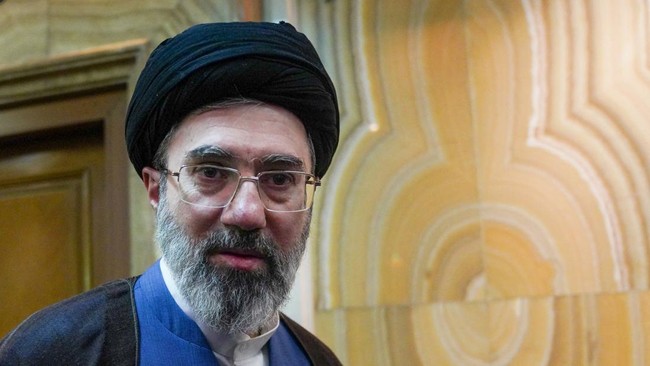
More than four months after being appointed as Iran’s Supreme Leader, Mojtaba Khamenei has still not appeared in public. His absence was particularly conspicuous at the most symbolic moment: the funeral of his own father, Ayatollah Ali Khamenei, held on Thursday (9/7) in Mashhad. Amidst a procession attended by key figures of the Islamic Republic of Iran, there was no appearance by Mojtaba, either in person or via video recording. No new photograph, no speech, and no written message was released to mark the funeral of the leader who had led Iran for 37 years. Yet, since the Assembly of Experts appointed him as the new leader on 8 March, the country’s highest decisions have formally been in his hands.
No official explanation has been given for Mojtaba’s continued absence from the public eye. However, several senior sources in Iran cited by Reuters point to two main factors: health and security. According to the sources, Mojtaba sustained injuries, including facial wounds, in the US and Israeli attack in late February that killed his father. These injuries are said to still be in the recovery phase. President Masoud Pezeshkian last provided an update on his condition in May, stating he had met with Mojtaba and that his health was continuing to improve. On the other hand, the security factor is considered no less important. The attack that killed Ali Khamenei on the first day of the war demonstrated that the position of Supreme Leader is now a highly risky target.
Despite this, not all Iranians view the absence as something that can be sustained in the long term. “I understand that for security reasons he should not appear in public. But the country is going through a very difficult time. There is a need for the Supreme Leader to be seen. Even if injured, the people need to see that someone is leading the country,” said Taghi, a shopkeeper in Isfahan. This comment reflects a problem larger than just one person’s absence from a funeral ceremony. Iran is still grappling with the impact of war with the United States and Israel, an economy pressured by sanctions, and political uncertainty following a sudden leadership transition. In such a situation, a leader’s presence is not merely ceremonial but a symbol that the government continues to function.
For Iran, the succession of the Supreme Leader is not just a change of office. What is at stake is authority. Ayatollah Ruhollah Khomeini, the Islamic Republic’s first leader after the 1979 Revolution, possessed charisma as a revolutionary figure and the country’s most influential cleric. His position was almost never questioned. His successor, Ali Khamenei, started from a different point. When appointed in 1989, he had served as president but was not known as a cleric with religious authority equal to Khomeini. However, over 37 years of leadership, Ali Khamenei gradually consolidated power. With the support of the Islamic Revolutionary Guard Corps (IRGC), he sidelined political rivals and expanded the influence of the Supreme Leader’s office into nearly all aspects of Iranian political life. Mojtaba Khamenei faces a similar challenge. He also lacks a reputation as a senior cleric and, prior to his appointment, was better known for managing his father’s office network than for appearing as a political figure in the public sphere. The difference is that Ali Khamenei built his authority over decades of leadership, whereas Mojtaba begins his tenure in a wartime situation, with a public that has never even seen him speak.
The absence of Mojtaba also raises questions about who is currently determining the direction of power in Iran. Several analysts assess that Mojtaba’s close relationship with the IRGC was a key reason he secured support for the top position. For years, he built close ties with networks of Revolutionary Guard commanders while managing Ayatollah Ali Khamenei’s office. However, this closeness also invites new interpretations. Professor of modern history at the University of St Andrews, Ali Ansari, assessed that Mojtaba’s greatest challenge is not merely leading the country but building legitimacy as a successor. “How do you create a charismatic succession if the successor figure is never seen?” he told Reuters, adding that such a condition is “unsustainable in the long term.” A similar view was expressed by Jason Brodsky of United Against Nuclear Iran, who sees a shift in the balance of power. If the Supreme Leader’s office was the centre of control during Ali Khamenei’s era, the IRGC’s influence is now expected to grow because Mojtaba is considered more dependent on the institution’s support. Farzan Sabet of the Geneva Graduate Institute also observed this tendency, noting that while Mojtaba’s low public profile can be managed temporarily, the new leader will eventually need to appear to build authority in the eyes of the public and the political elite. Alex Vatanka of the Middle East Institute suggested that Mojtaba is likely to rule through state institutions rather than dominate them as his father did. He noted that the charisma of Ruhollah Khomeini and the authority of Ali Khamenei were built through decades of crisis and experience, not automatically inherited.