
Four IPB Professors Propose Innovations for Sustainable Biological Resource Management
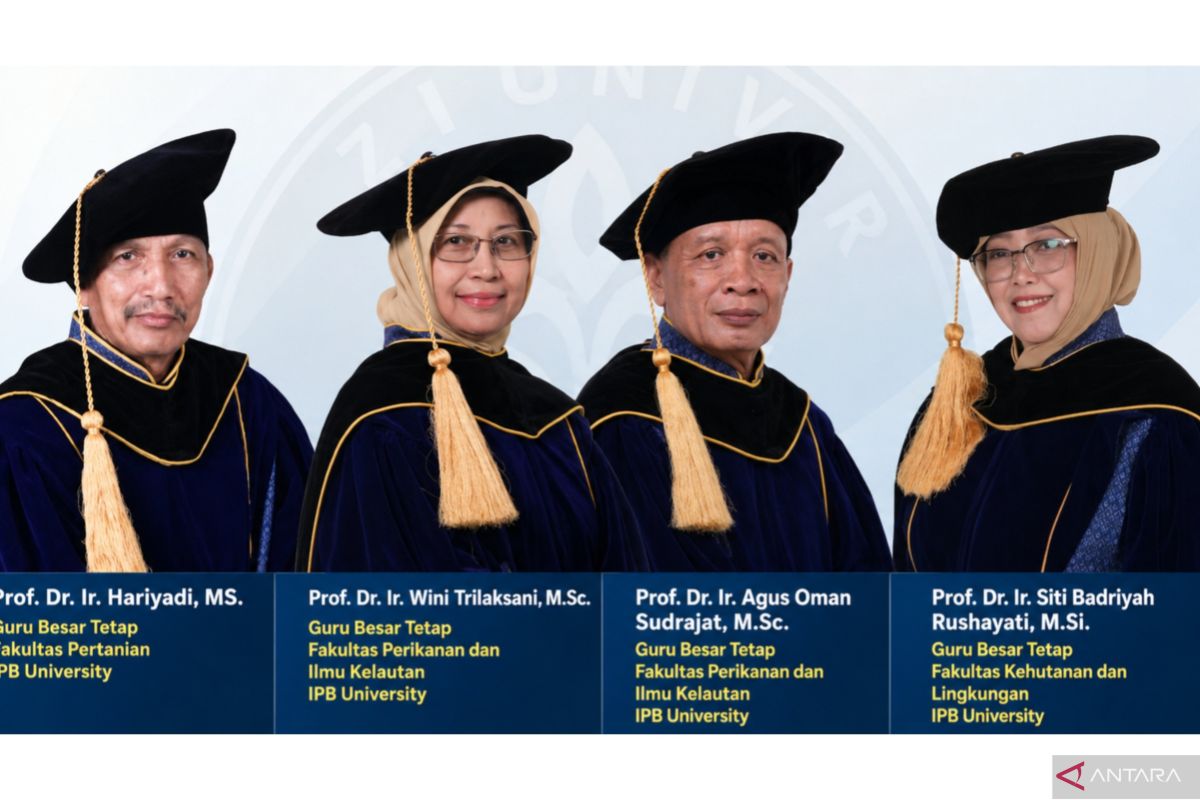
Four professors from the Bogor Agricultural University (IPB) have offered various innovations for the sustainable management of biological resources through scientific orations addressing the plantation, fisheries, aquaculture, and forestry sectors. In a virtual press conference held in Bogor Regency, West Java, on Wednesday, the professors highlighted the use of science to tackle challenges in food security, climate change, the blue economy, and natural resource sustainability.
Professor Hariyadi from the Faculty of Agriculture introduced a ‘new nexus’ concept for sustainable palm oil plantation management. This framework integrates productivity, resource efficiency, climate change mitigation, digital agriculture, circular bioeconomy, and smallholder empowerment. ‘The new nexus concept needs to be built as an integrative framework of productivity, climate resilience, circular bioeconomy, digital monitoring, socio-economic inclusion, and research results as scientific evidence,’ Hariyadi stated.
Meanwhile, Professor Wini Trilaksani from the Faculty of Fisheries and Marine Science highlighted the potential of fisheries by-products as a source of value-added biomolecules that can support the blue economy. She explained that fish parts previously considered waste, such as eyes, skin, bones, and swim bladders, can be processed into functional foods, nutraceuticals, cosmetics, and biomaterials. ‘The blue economy is not only built from the sea producing commodities, but from the ability of science to transform every fraction of biomass into value,’ she said.
Professor Agus Oman Sudrajat, also from the Faculty of Fisheries and Marine Science, explained that hormonal control of fish reproduction plays a crucial role in increasing the productivity and sustainability of national aquaculture. He noted that hormonal technology can accelerate reproduction, improve seed quality, speed up domestication, and support the sustainable availability of fish seed.
In the forestry sector, Professor Siti Badriyah Rushayati from the Faculty of Forestry and Environment emphasised the importance of forest environmental services in facing the triple planetary crisis of climate change, biodiversity loss, and pollution. She stated that forests play a role in carbon storage, maintaining biodiversity, improving air quality, and supporting public health through the healing forest concept. ‘Forest environmental services must be placed as an integral part of development policies to create a balance between economic growth, environmental sustainability, and public welfare,’ she said.