
Four Institutions Collaborate to Explore Downstream Sectors and Impact Investment
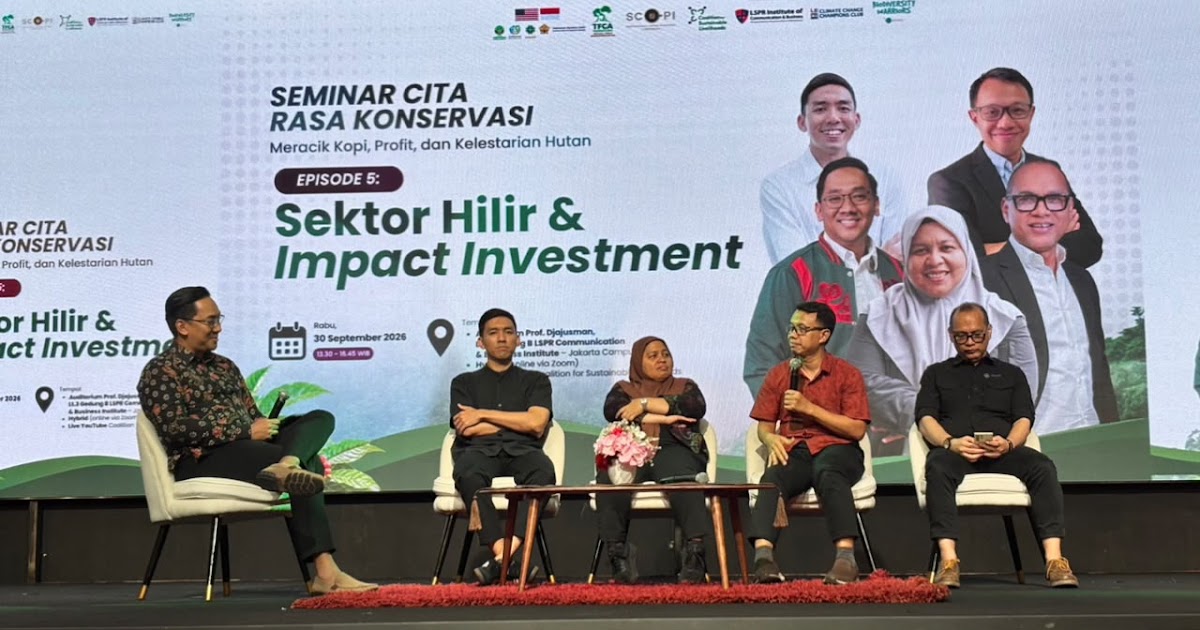
The TFCA-Sumatera program of the KEHATI Foundation, the Sustainable Coffee Platform of Indonesia (SCOPI), and the Coalition for Sustainable Livelihoods (CSL), in collaboration with the LSPR Institute of Communication and Business, organised the 5th edition of the ‘Savoring Conservation Seminar: Blending Coffee, Profit, and Forest Sustainability’. The event, titled ‘Downstream Sectors and Impact Investment’, was held at the Prof. Djajusman LSPR Jakarta Auditorium via a hybrid format.
The seminar aimed to dissect the conservation business ecosystem from upstream to downstream, bringing together perspectives from business players, impact investors, and development partners to support nature-based business innovations. Nature-based commodities such as coffee, cocoa, spices, and non-timber forest products play a crucial role in community economies and ecosystem maintenance. However, historically, land-use sectors have contributed significant emissions.
Consequently, the discussion addressed challenges and solutions for connecting commodity business models to boost farmer welfare through impact investment approaches and fair trade downstream processing. Faris Nurf_auzi Nurmianto, Head of Business Development at Pandawa Agri Indonesia, shared an upstream-to-downstream ecosystem approach. Pandawa Agri Indonesia integrates technological innovation, farmer assistance, data-based monitoring, and environmental incentive schemes through Agro Environmental Schemes (AES). This model encourages the adoption of measurable eco-friendly farming practices and provides economic benefits to farmers.
“To date, the Pandawa Agri programme has delivered a tangible impact for more than 2,700 farmers, reducing more than 5.1 million litres of pesticides, avoiding 3.8 million tonnes of CO2e emissions, and protecting 75,600 spray workers from excessive chemical exposure,” said Faris.
From an investor’s perspective, Fitrian Ardiansyah, Impact Director at ACLF–ADM Capital, emphasised that developing nature-based commodities requires more than just access to funding. He outlined several aspects considered by investors, ranging from market conditions and business readiness to the strength of financial models and innovative financing scheme options. He noted that alternative funding, such as shareholders and angel investors, could also be part of a strategy to accelerate business growth.
Furthermore, Fitrian encouraged stronger collaboration between businesses, investors, and stakeholders to not only produce measurable social and environmental impacts but also to build more solid and investment-ready business models. This would enable access to more sustainable financing and larger-scale investment.
During the same event, Riki Frindos, Executive Director of the KEHATI Foundation, emphasised the importance of shifting the conservation funding paradigm from grants as activity-based funding to catalytic capital for building investment readiness. He noted that a readiness gap still exists between the success of conservation programmes at the local level and investor requirements. Therefore, grants should be directed towards strengthening governance, institutional capacity, financial management, traceability, and market validation so that communities, cooperatives, and conservation-based businesses become more ‘impact-ready’ and capable of accessing sustainable finance.
“We are open to various forms of cooperation, including research and innovation, to prepare businesses and beneficiary organisations to become more ready and independent,” said Riki.
From the perspective of NGOs and conservation activists, Fitri Hasibuan, Vice President of Programmes at Konservasi Indonesia, revealed that landscape-scale conservation efforts are insufficient if relying solely on grants. Diversification and other financing systems, such as impact investment, are needed to ensure sustainability and fund availability. “In viewing current conservation efforts, the mindset should be how to involve investment that can finance and guarantee that conservation efforts are sustainable. Conservation without funding is merely conversation. Every conservation activity requires funding, such as patrol systems, wildlife and nature protection, and so on,” said Fitri.
Industry players within the ecosystem are also expected to participate in these efforts, as conservation does not only produce environmental impacts but also creates a sustainable local economy ready to grow through impact investment. The seminar provided a constructive discussion that impact investment can serve as a bridge between economic growth and environmental sustainability, placing profit, people, and planet within a single investment framework.
Amidst narrowing access to grants as Indonesia moves towards middle-income country status, more innovative and integrated financing models are required, not limited to the carbon sector or specific commodities. Expanding access to funding, markets, and inclusive partnerships is expected to strengthen businesses and farmers at the local level, while driving business models that can grow economically without sacrificing forests and ecosystems.
Source: jawawa.id (https://jawawa.id/newsitem/four-institutions-collaborate-to-explore-downstream-sectors-and-impact-investment-1790873500)
Originally published by lensamedan.co.id (https://www.lensamedan.co.id/2026/10/saat-empat-lembaga-berkolaborasi.html), translated from Indonesian