
Fostering Farming Spirit Among Jambi's Orang Rimba
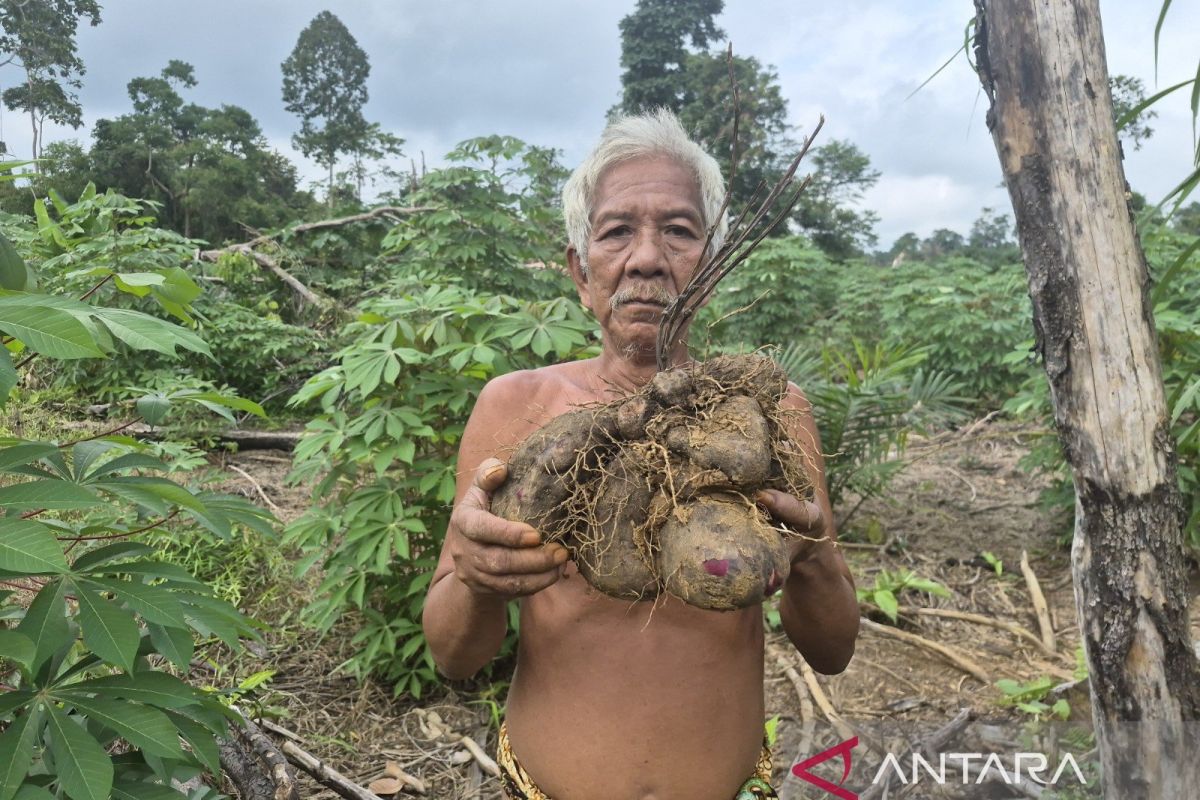
Batang Hari, Jambi - The sun had not yet risen high when our vehicle stopped at the end of the road in Sungai Terap, Jelutih Village, Bathin XXIV Subdistrict, Batang Hari Regency, Jambi. There, around five sudung —traditional Orang Rimba homes— stood scattered among the trees, without rigid layout. From a distance, Tumenggung Nyenong (73), the group’s leader, watched our arrival with a calm face. He seemed to be welcoming the journalists and support community visiting the eastern side of Bukit Dua Belas National Park (TNBD). Soon after the conversation began, Tumenggung Nyenong showed various large tubers from his garden. These were neatly stored under the sudung, serving as a food reserve for his family. ‘If there’s tuber, we eat tuber. If there’s rice, we eat rice,’ said Tumenggung Nyenong on Saturday, 23 May 2026. He explained that these tubers are safe to eat and often replace rice. Varieties include sticky tuber, sweet potato, and coconut tuber, all grown on land near their homes. In addition to tubers, Tumenggung Nyenong has begun cultivating other crops such as cassava, taro, durian, mango, petai, and areca nut. This farming effort is progressing slowly, following government and support group recommendations, as a strategy to meet food needs amid environmental changes. According to Nyenong, in recent years, the Orang Rimba have seriously adopted agroforestry practices—growing various economically valuable plants in one garden area. The hope is this method will maintain food availability while providing a more stable livelihood. This step is increasingly vital given the ‘melangun’ tradition—moving away from a specific area after a family member’s death—continues to be observed. In this tradition, they temporarily leave their homes to honour the deceased and alleviate grief. ‘We maintain the ’melangun’ tradition as it is an unyielding custom. The sky is upheld, the earth is trodden—these are ancestral rules,’ said Tumenggung Nyenong. Thus, the presence of gardens is vital. At least, when returning from ‘melangun’, they still have harvest-ready crops without having to start from scratch. Similarly, Tumenggung Ngelembo (53) has planted non-timber commodities such as jengkol, mango, lychee, durian, sapodilla, and petai on his new plot. The seedlings were provided by KKI Warsi. Despite not yet harvesting, Ngelembo continues to care for the plants despite his limited farming experience. ‘There are many challenges, especially plants dying from extreme weather, whether hot or rainy. This is still a learning phase,’ he said. In addition to developing agroforestry, 169 households from five Orang Rimba groups in Sungai Terap received 114 hectares of rubber plantation land. The land was allocated by an Industrial Tree Farm (HTI) company under an agreement with local government. Each family received less than one hectare. Some Orang Rimba rely on rubber tapping for income, though earnings fall far short of daily needs. Nyerban (37), a member of Tumenggung Nyenong’s group, admitted that rubber tapping income does not meet his family’s needs. To supplement earnings, he grows taro and chillies independently and tends to fruit trees provided by KKI Warsi.