
Fortified Rice Floods the Market, Making Medium-Premium Rice Scarce?
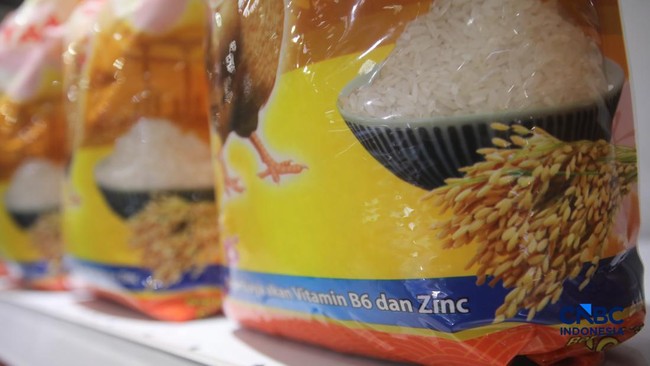
Jakarta, CNBC Indonesia - Fortified rice, claimed to contain added vitamins and other benefits, is increasingly abundant and easy to find in modern retail outlets.
In fact, its presence is sometimes so dominant that ordinary premium or medium rice without fortification or special claims is nowhere to be seen. Beyond fortification claims on labels, there is also rice with special labels indicating the type or variety, such as long grain, short grain, or pulen (soft and sticky).
Moreover, rice bearing these fortification labels and specific claims is priced far above medium and premium rice. Some reach Rp63,500 per 2.5 kg pack, others Rp72,800 per 2.5 kg pack. There are also products priced at Rp21,500 per 5 kg pack and Rp145,000 per 5 kg pack.
For reference, the maximum retail price (HET) for medium and premium rice has been set at Rp13,500 per kg and Rp14,900 per kg respectively, pursuant to Decree of the Head of the National Food Agency (Bapanas) No 299/2025 on the Determination of Rice HET.
Even where premium-medium rice compliant with the HET is available, it is sold in large 20 kg packs. There is also premium rice without any special labelling, but its price per kilogram is far above the premium HET, reaching Rp21-25 thousand per kg.
This was observed at a modern retail outlet in Bekasi.
Laboratory Tests on Rice Label Claims
The growing circulation of fortified rice has drawn the government’s attention.
Minister of Agriculture and Head of the National Food Agency (Bapanas) Amran Sulaiman, in late July 2026, suspected that some producers had shifted from selling premium rice to fortified rice in pursuit of larger profit margins.
Amran said this suspicion arose after the Ministry of Agriculture found much rice marketed as fortified rice, yet laboratory test results showed the products did not meet fortification standards.
On another occasion, Amran acknowledged he was investigating the impact of increasingly prevalent fortified rice, sold at far higher prices, on inflation. The Central Statistics Agency (BPS) recorded Indonesia’s core inflation in August 2026 at 2.92% year on year (yoy), up from 2.17% in August 2025. Overall, Indonesian inflation in August 2026 reached 3.19% yoy.
BPS recorded several commodities contributing to core inflation in August 2026, including gold jewellery, cooking oil, rice with side dishes, mobile telephones, engine lubricants or oils, and laptops or notebooks. Meanwhile, in the volatile food component, BPS recorded inflation of 4.06% yoy, driven by rising prices of broiler chicken meat, rice, bird’s eye chilli, beef, and red chilli.
“Recently we checked one of them; with stock being plentiful, it means it is not because of stock, because rice is abundant. The problem is what we are investigating,” said Amran when met at the Sukamandi Rice Research Centre (BRMP) in Subang, West Java, on Wednesday (2/9/2026).
“Imagine, this fortified rice was said to contain vitamins, but it turns out there are none, and it is sold at Rp56,000 per kg, some at Rp42,000 per kg, on average he sells it at Rp22,000 per kg,” Amran exclaimed.
Amran considered the price difference to be very large, even linking it to potential inflationary pressure should such high-priced rice circulate in large quantities.
“Say the price of (medium) rice is Rp13,000 per kg; the difference with fortified rice sold at Rp22,000 per kg. So this is fraud, isn’t it?” said Amran.
He believes the sale of rice at such significantly higher prices is one of the factors driving inflation.
“That adds extraordinarily, doesn’t it? It should be priced at Rp13,500 per kg, but he sells it at Rp40,000 per kg. Do you think that adds to inflation? Is it a contributor? There it is (the cause),” he said.
These claims, he continued, harm consumers who must pay more than they should merely because of the label claims.
Bapanas also recorded that fortified rice failing to meet requirements averages Rp23,385 per kg, while comparable rice is priced at Rp13,689 per kg - a price difference of roughly Rp9,695 per kg.
He calculated that this situation harms consumers, with potential losses estimated at Rp89.19 trillion, assuming rice consumption of 9.2 million tonnes per year.
Amran explained that the problem arises when rice is sold using a fortification label, but the vitamin content claimed is not found in laboratory tests.
“None (of the vitamin content), just words. Merely claimed. The brand says fortified but there is nothing in it. So, regarding the permits, we will follow up,” he asserted.
So, what were the test results?
Amran said the results of the examination were still awaited. When asked when the laboratory test results would be announced, he gave no definite date.
“Well, pray. Wait,” said Amran when met at the Office of the Coordinating Ministry for Food, Jakarta, on Monday (7/9/2026).
When asked again about the possibility of new findings or further developments from the fortified rice examination, Amran asked the public to wait.
“Just wait for the invitation,” he said firmly.
Source: jawawa.id (https://jawawa.id/newsitem/fortified-rice-floods-the-market-making-medium-premium-rice-scarce-1788774803)
Originally published by CNBC Indonesia (https://www.cnbcindonesia.com/news/20260907155810-4-765897/beras-fortifikasi-bertebaran-bikin-beras-medium-premium-langka), translated from Indonesian