
Formulating Targeted Fuel Subsidy Policies Amid Global Volatility
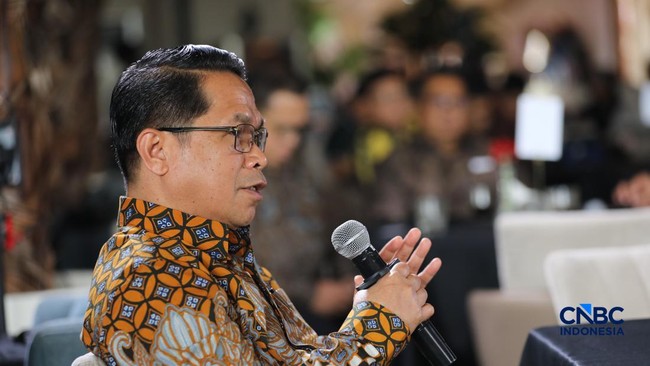
Jakarta, CNBC Indonesia - The government is currently preparing energy subsidy policies to ensure they are more precisely targeted, particularly amidst global geopolitical uncertainty and volatility that could potentially affect energy prices and supplies.
The Director General of Oil and Gas at the Ministry of Energy and Mineral Resources (ESDM), Laode Sulaeman, explained that the government needs to account for global dynamics when formulating energy subsidy policies, specifically for Fuel (BBM) and 3kg Liquefied Petroleum Gas (LPG).
“When discussing subsidies, there are two types: fuel and LPG. Before answering that, I want to share that, as the Minister of ESDM has stated, we are currently in a state of uncertain global dynamics, much like recovering from malaria only to fall ill again,” Laode said during a CNBC Indonesia Coffee Morning event titled “Formulating Precise Subsidy Policies: Can the State Protect the People’s Rights?” on Thursday (24/9/2026).
According to him, the current global geopolitical situation still requires vigilance, even if it has not yet escalated into a worse situation. This is because such volatility can impact crude oil prices as well as the smoothness of the global energy supply.
He noted that the rise in crude oil prices is currently a primary concern for the government. In addition to the ongoing Russia-Ukraine conflict, tensions in the Middle East and disruptions to energy trade routes are factors that must be anticipated.
“Crude prices are rising, and tensions that initially began in Russia and Ukraine have spread to issues in the Strait of Hormuz, which remain unresolved; there are also Houthi attacks on Saudi Arabia. Furthermore, Ukraine’s drone capabilities are able to strike Russian refineries,” Laode added.
Laode further observed that if energy-producing nations withhold exports due to increased geopolitical risks, the global energy supply will be disrupted. Therefore, Indonesia needs to have a strategy to face these various possibilities.
Subsidy Restructuring Since 2024
On the other hand, Laode stated that the government has been restructuring subsidies since 2024 to ensure more targeted distribution. The initial stage was conducted through data collection, followed by the restructuring of distribution mechanisms.
In 2025, the government will begin socialising and implementing the policy on a trial scale. Subsequently, in 2026, the restructuring will continue by utilising digital systems, including through the Pertamina Merchant App (MAP).
He mentioned that the experience from the trial implementation of LPG distribution in 2025 would serve as material for government evaluation in drafting future subsidy policies.
“In 2026, the scale of the Pertamina Merchant App (MAP) is being restructured. There are lessons to be learned from the 2025 LPG trial conditions, which showed periods of uncertainty that must be used as a reference,” he said.
One of the mechanisms being restructured is the use of barcodes for purchasing subsidised fuel and the use of National Identity Numbers (NIK) for purchasing 3kg LPG. For 3kg LPG, the government can utilise purchase data based on consumer identity to monitor consumption patterns, including those of households as well as micro, small, and medium enterprises (MSMEs).
“For example, the use of barcodes and purchasing LPG using NIK; we can study this. Since LPG consumers are households, they purchase using their ID cards, so we can check how much a citizen consumes per month. The same applies to MSMEs and others,” he said.
Currently, he stated that the government is still in the data matching stage and has not yet reached the stage of full sorting or restriction.
Laode emphasised that precision in targeting is the primary goal of the subsidy restructuring. However, implementation must be carried out gradually, considering data readiness and the condition of the community.
“So, the reference data we have is still in the matching stage, not yet at the sorting and restriction stage. We must not implement a policy that is well-intentioned but ultimately results in chaos,” he said.
The Importance of Data Validation
The Deputy Director of Commercial at PT Surveyor Indonesia, M. Chairudin, assessed that the government needs to ensure data accuracy before implementing targeted energy subsidy policies. According to him, the accuracy of subsidy distribution must be measured based on valid and verified field data.
He noted that discussions regarding targeted subsidies cannot be separated from the quality of the beneficiary data. The main issue is not just the identification system, but also the periodic updating and verification of data.
“When discussing whether it is targeted or not, it must be compared with the initial data received. Our primary problem relates to data; it is not just about a single identification number. There could be issues with election data, such as individuals who have passed away because there was no update or verification,” he said.
He stated that the field verification process is crucial because administrative data does not always reflect the actual needs of the community, such as the registration of LPG recipients.
Based on Surveyor Indonesia’s experience in field inspections, they found instances where the needs of the community or businesses did not always align with the information in the initial data.
“For example, a family in a certain decile—through verification and validation, we can find out during a visit. Our experience in this process often finds that initial data differs. For instance, regarding LPG recipients, when we inspect in the field, we find why they need so much; it turns out they are an MSME, and their needs exceed what was specified in the initial data,” he concluded.
Source: jawawa.id (https://jawawa.id/newsitem/formulating-targeted-fuel-subsidy-policies-amid-global-volatility-1790254396)
Originally published by CNBC Indonesia (https://www.cnbcindonesia.com/news/20260924180634-4-770688/meramu-kebijakan-subsidi-bbm-tepat-sasaran-di-tengah-gejolak-dunia), translated from Indonesian