
Former Trump Spokeswoman Says China’s Toilets Are Unfit; Beijing Hits Back
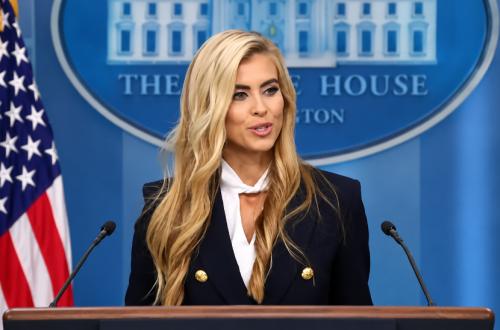
JAKARTA — The Chinese government has responded with a pointed remark to Katie Zacharia, a former White House press secretary who was recently dismissed by US President Donald Trump. Beijing invited Zacharia to visit China more often after she belittled the country’s progress, saying its toilet facilities were unfit.
Chinese Foreign Ministry spokesperson Mao Ning made the remarks at a regular press conference in Beijing on Friday (16 October 2026). They followed Zacharia’s comments about toilet conditions in China, which sparked debate amid scrutiny of her brief tenure at the White House.
“We welcome her to come and see China more often if she has the opportunity,” Mao said, according to the South China Morning Post (SCMP) on Friday.
The brief response was Beijing’s official reaction to comments Zacharia had made the previous day. Rather than issue a lengthy rebuttal, Mao invited the former White House official to see China’s development for herself.
The controversy began when Zacharia was interviewed by American conservative commentator Jack Posobiec on a programme broadcast on Thursday (15 October 2026). During the discussion, she recalled living in China and the views circulating ahead of the 2016 US presidential election.
At the time, Zacharia said, there was a perception that America’s era of greatness had ended. China was seen as a rising economic power that could potentially surpass Washington’s global dominance.
“I remember it very clearly. I had just come back from China and thought, how could China be the next great country? They don’t even have decent toilets,” Zacharia said.
Her comment drew criticism for disparaging China by using her experience of sanitation facilities as a measure of the country’s potential to become a global economic power.
SCMP reported that Zacharia made the remarks as the Trump administration was building dialogue with Beijing. The comments attracted attention not only for their content but also because of her position at the time of the interview.
China once faced a toilet crisis
Sanitation has long been part of China’s development story. The country previously faced serious problems with the availability and cleanliness of public toilets, particularly in rural areas, tourist sites and economically less-developed regions.
In a report published in November 2017, China’s official Xinhua news agency acknowledged that public toilets in various areas had previously been in poor condition. Some facilities were described as dirty, poorly maintained, difficult to access and insufficient to meet public needs.
In some rural areas, sanitation facilities still relied on basic systems that did not meet modern hygiene standards. The issue became a government priority because it was directly linked to public health, quality of life and the country’s image.
The Chinese government launched a sanitation improvement programme known as the “toilet revolution”. It included building and upgrading public toilets, particularly in tourist areas and the countryside.
Chinese President Xi Jinping gave the programme particular attention. Xinhua reported that Xi stressed the importance of steadily improving toilets to address shortcomings in basic infrastructure that affected people’s quality of life.
The policy showed that toilet facilities had been openly acknowledged as one of China’s development challenges. However, past sanitation conditions cannot, by themselves, be used to describe the whole of China today.
Over recent decades, China has undergone a sweeping transformation of its infrastructure. The development of major cities, transport networks, industrial zones and public facilities has accompanied the country’s economic growth.
Nevertheless, the divide between urban and rural areas remains a development challenge. Sanitation facilities vary between regions, so generalisations about toilet quality across China do not provide a complete picture.
She worked in Beijing
Zacharia’s comments attracted further attention because she was not entirely unfamiliar with China. The 41-year-old had lived in Beijing with her husband and worked at one of the country’s leading law firms.
According to SCMP, Zacharia listed experience at Zhong Lun Law Firm on her LinkedIn profile. She said she had been an associate in the firm’s international practice team for nearly two years, from 2011 to 2013.
Zhong Lun is one of China’s major law firms and handles a range of business transactions and international legal matters. The experience formed part of Zacharia’s professional record before she entered US political communications.
However, her work in Beijing has also prompted questions about her legal qualifications. Zacharia had previously claimed to have practised international transactional law while meeting all the necessary requirements.
Chinese legal rules restrict licences to practise as a Chinese lawyer to Chinese citizens. Foreign nationals may work in various professional capacities at law firms, but they are not automatically authorised to practise as licensed lawyers in China.
SCMP reported that Zacharia acknowledged taking the California bar examination after completing her law degree at Pepperdine University in 2011. She did not pass.
That admission intensified scrutiny of her use of the term “lawyer” in her professional profile. However, failing to obtain a US law licence does not in itself prove that all of her professional work in China was unlawful.
The specific authority and professional qualifications Zacharia held while working at Zhong Lun have not been detailed in the reports available to date.
Source: jawawa.id (https://jawawa.id/newsitem/former-trump-spokeswoman-says-chinas-toilets-are-unfit-beijing-hits-back-1792219832)
Originally published by Republika (https://news.republika.co.id/berita/tn1e4n451/eks-jubir-trump-sebut-toilet-china-tak-layak-beijing-balas-menohok), translated from Indonesian