
Former President's Son Now Leading Incumbent, Could Win Presidential Election
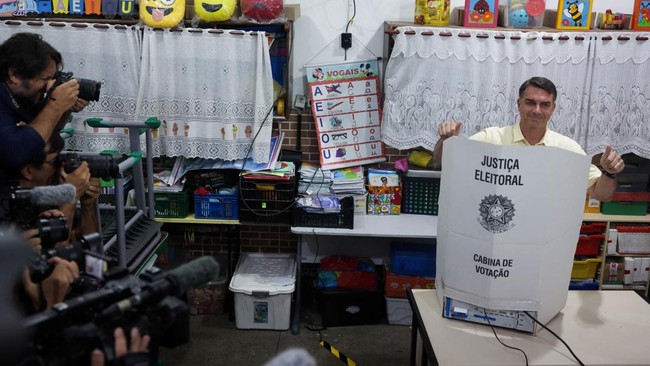
The 2026 Brazilian presidential election is confirmed to proceed to a second round after right-wing candidate Flavio Bolsonaro failed to secure a majority in the first round of voting. However, the 45-year-s Senator and son of former Brazilian President Jair Bolsonaro is currently leading President Luiz Inacio Lula da Silva based on preliminary vote counts.
With approximately 85% of the votes counted, Flavio has obtained 48.47%, while Lula has secured 43.49%. A candidate must obtain more than 50% of the vote to win the election in the first round.
Brazilian polling institute Datafolha projects that the election will proceed to a second round on 25 October. These preliminary results are a surprise, as several pre-election surveys predicted Lula would lead by approximately three percentage points over Flavio in the first round.
The competition between the two is expected to be tight. Pre-election surveys indicated that Lula and Flavio possess relatively balanced levels of support for the second round.
Bolsonaro’s Son Seeks to Restore the Right-Wing Movement
Flavio is leveraging his family’s significant political name in this battle. He is attempting to return the right-wing political movement, previously led by his father Jair Bolsonaro, to power in Brazil.
Preliminary results show that Flavio has secured strong support in several states in southern Brazil, which traditionally supports Bolsonaro. Meanwhile, the vote count in northeastern Brazil, a strong base for Lula, is progressing more slowly.
Some analysts suggest that a portion of the votes for Flavio represents a ‘protest vote’—voters seeking to oppose Lula rather than solely supporting Bolsonaro’s son. Flavio himself expressed hope that the dissatisfaction with Lula would be sufficient to carry him to victory even in the first round.
“I hope it is enough to ensure victory in the first round,” said Flavio.
Trump’s Influence Shadows Brazilian Election
This Brazilian presidential election is also shadowed by the tense relationship between the Lula administration and US President Donald Trump. While Trump has not officially endorsed a candidate, he has previously received Flavio Bolsonaro at the White House and offered public praise to the senator.
If Flavio wins, Brazil will follow the trend of right-wing victories in Latin America involving candidates with political proximity to Trump. Conversely, a Lula victory could present further challenges for Washington, as his previous administration clashed with the US on several issues, including trade and security.
Lula and his supporters have also warned of potential foreign interference in the Brazilian election. However, the Chairman of the Brazilian Superior Electoral Court, Kassio Nunes Marques, stated that the voting process is proceeding normally and international risk monitoring teams have found no threats.
Economy Becomes the Next Battleground
The race towards the second round will be determined not only by political issues but also by Brazil’s economic conditions. Although inequality and unemployment rates have decreased, Lula still faces difficulties in convincing voters burdened by a high cost of living, household debt, and increasing concerns regarding crime and gang activity.
Flavio is attempting to capitalise on these cost-of-living issues to attract voters. Meanwhile, the Lula administration has expanded several social assistance programmes and offered debt relief policies for families.
However, Brazil’s fiscal condition remains a major challenge for whoever wins the election. Brazil’s public debt has reached over 82% of Gross Domestic Product (GDP).
The government has also slashed Brazil’s economic growth projections to 2% this year and 2.3% next year. Furthermore, corruption cases continue to loom over the landscape.
“I chose Brazil so that it can start growing again,” said Marciano de Souza e Silva, a 52-year-old civil servant in Brasilia who was previously a Lula voter but has now shifted to support the right-wing camp.
Corruption Scandals Loom
Brazil’s political struggle is also unfolding amidst scandals involving several political figures and state institutions. These cases are linked to Banco Master, a bank that has since ceased operations.
Daniel Vorcaro, the former head of the bank, was arrested and accused of involvement in a multi-billion dollar fraud scheme. The investigation is also tracing Vorcaro’s connections to several prominent figures, including Supreme Court Justice Alexandre de Moraes and Flavio Bolsonaro.
Flavio is currently under investigation by the federal police regarding alleged money laundering in the case. He has denied any wrongdoing.
He previously admitted to receiving millions of dollars from Vorcaro to fund a film about his father. The Banco Master case has further intensified political tensions in Brazil ahead of the election and revived public anger regarding corruption issues.
In addition to electing a president, Brazilian citizens also voted on Sunday for all 513 members of the lower house and two-thirds of the Senate. The composition of this parliament will be a crucial factor for the elected president in executing their government agenda after the election.
The battle towards 25 October will now be a direct duel between Lula and Bolsonaro’s son. Both will compete for the votes of undecided voters and those of candidates eliminated in the first round.
Source: jawawa.id (https://jawawa.id/newsitem/former-presidents-son-now-leading-incumbent-could-win-presidential-election-1791176007)
Originally published by CNBC Indonesia (https://www.cnbcindonesia.com/news/20261005081855-4-773236/putra-mantan-presiden-kini-ungguli-petahana-bisa-menang-pilpres), translated from Indonesian