
Former KPK Commissioner Hopes Asset Forfeiture Law Can Seize Four Types of Assets
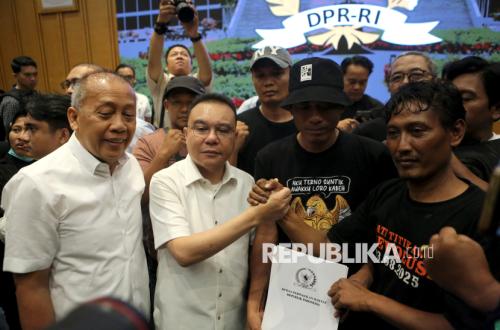
The House of Representatives (DPR) has promised to complete deliberation of the Asset Forfeiture Bill this year. Under pressure from members of the public demonstrating at the DPR/MPR Building on Thursday (27/8/2026), leaders of the legislative body signed a public pledge to pass the bill into an Asset Forfeiture Law by 15 December 2026 at the latest.
So what exactly is the Asset Forfeiture Bill? The bill has in fact been under discussion in the DPR for years. A draft of the bill already exists and only needs plenary approval to be enacted into law. However, successive membership periods of the legislative body have never pushed the Asset Forfeiture Bill into law for a variety of reasons.
Referring to the publicly available draft of the Asset Forfeiture Bill, the bill relates to the forfeiture of movable and immovable assets belonging to individuals or corporations that are suspected of being connected to or derived from criminal offences. Former Corruption Eradication Commission (KPK) commissioner Laode Muhammad Syarief said the Asset Forfeiture Law is expected to be able to seize at least four criteria of assets related to criminal offences.
Laode also said the law could carry out forfeiture of assets whose ownership is unreasonable. “I have not read the latest draft. But the Asset Forfeiture Law should at least be able to seize assets such as assets resulting from criminal offences, and assets whose value is not commensurate with legitimate income and whose origins cannot be reasonably explained,” Laode said when contacted by Republika from Jakarta on Friday (28/8/2026).
In addition, the Asset Forfeiture Law is also expected to be able to carry out forfeiture of assets used to commit criminal offences. “And other assets equivalent in value to the proceeds of a criminal offence if the assets derived from the criminal offence have been transferred or cannot be found,” Laode said.
According to him, the Asset Forfeiture Law is in fact crucial to ensure the recovery of state losses from the impact of criminal offences and crimes. “Therefore, the public really needs to oversee it,” Laode said.
So what are the crucial articles in the Asset Forfeiture Bill?
- Asset forfeiture without a criminal conviction
Article 2 of the Asset Forfeiture Bill states that asset forfeiture carried out under the Asset Forfeiture Law does not require a conviction against the asset owner who committed the criminal offence. “Asset forfeiture under this Law is not based on the imposition of a criminal sentence on the perpetrator of the criminal offence,” reads Article 2 of the draft Asset Forfeiture Bill. However, Article 3 sets out the rules that asset forfeiture carried out under the Asset Forfeiture Law does not eliminate the criminal prosecution process. “Asset forfeiture as referred to in Article 2 does not eliminate the authority to prosecute the perpetrator of the criminal offence,” reads Article 3 of the bill.
- What assets can be seized?
The draft Asset Forfeiture Bill includes this matter in Chapter II as Criminal Assets That Can Be Forfeited. Article 5 contains six classifications of assets that can be forfeited. The six classifications of assets that can be forfeited are divided into two sub-criteria. The first classification is contained in Article 5 paragraph (1), which explains four classifications of assets that can be forfeited.
Assets resulting from a criminal offence or assets obtained directly or indirectly from a criminal offence, including those that have been gifted or converted into personal wealth, the wealth of another person, or a corporation, whether in the form of capital, income, or other economic benefits obtained from such wealth.
Assets that are known or reasonably suspected to have been used or to have been used to commit a criminal offence.
Other legitimate assets belonging to the perpetrator of a criminal offence as a substitute for assets that have been declared forfeited by the state, or…
Assets that are found items known or reasonably suspected to originate from a criminal offence.
Other classifications of assets that can be forfeited are contained in Article 5 paragraph (2). These include:
Assets that are not commensurate with income or not commensurate with the source of wealth accumulation whose lawful origin cannot be proven and are suspected to be related to criminal assets obtained since the entry into force of this Law.
Assets that are seized objects obtained from the proceeds of a criminal offence or used to commit a criminal offence.
Source: jawawa.id (https://jawawa.id/newsitem/former-kpk-commissioner-hopes-asset-forfeiture-law-can-seize-four-types-of-assets-1787928688)
Originally published by Republika (https://news.republika.co.id/berita/tkhh86409/eks-komisioner-kpk-harap-uu-perampasan-aset-dapat-merampas-empat-jenis-aset), translated from Indonesian