
Former KPK Chief: Asset Forfeiture Cannot Be Applied to Everyone
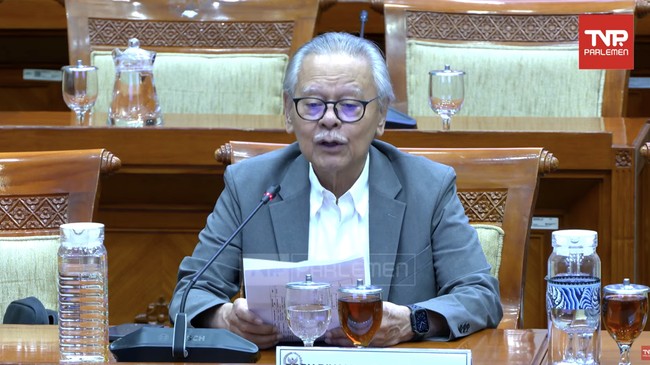
Jakarta, CNBC Indonesia - The former leader of the Corruption Eradication Commission (KPK), Erry Riyana Hardjapamekas, has revealed that Indonesia already possesses numerous legal instruments regarding asset forfeiture and the recovery of state assets from corrupt actors.
He made these remarks during a Public Hearing (RDPU) with Commission III of the Indonesian House of Representatives (DPR RI) regarding the discussion of the Asset Forfeiture Bill (RUU Perampasan Aset).
“The legal instruments in Indonesia addressing asset forfeiture or asset recovery are actually quite numerous, ranging from the Criminal Code (KUHP), the Criminal Procedure Code (KUHAP), the Anti-Corruption Law, the Narcotics Law, and others,” Erry stated during the hearing on Monday (2 /09/2026).
Erry explained that within both the Anti-Corruption Law and the Narcotics Law, there are legal instruments involving the reverse burden of proof regarding the wealth of suspects or defendants, specifically under Article 28 and Article 38B of the Anti-Corruption Law, and Article 97 and 98 of the Narcotics Law.
“In the Anti-Corruption and Narcotics Laws, it is already regulated that if a defendant fails to prove that their other assets were obtained legally, then those assets may be forfeited,” he explained.
Therefore, he argued, the drafting of the Asset Forfeiture Bill should incorporate the existing legal instruments found in those laws, and should not be applied to everyone without clear evidence.
“What I am conveying is that asset forfeiture should not be drafted arbitrarily; it should not be applied to everyone without clear proof, because this is an issue where law enforcement officers are sometimes somewhat lazy or lack the capability to conduct tracing and tracking,” he said.
“The results of this tracing and tracking are what should actually serve as valid and highly convincing evidence to forfeit or recover state assets,” Erry emphasised.