
Former Indonesian Minister Arrested by Attorney General’s Office; Safe Found Containing Rp4bn
A former minister identified by the initials DG was implicated in a bribery case that caused a public outcry during the Old Order era. DG served as justice minister in the first Ali Sastroamidjojo Cabinet (1953–1955) and was chairman of a political party.
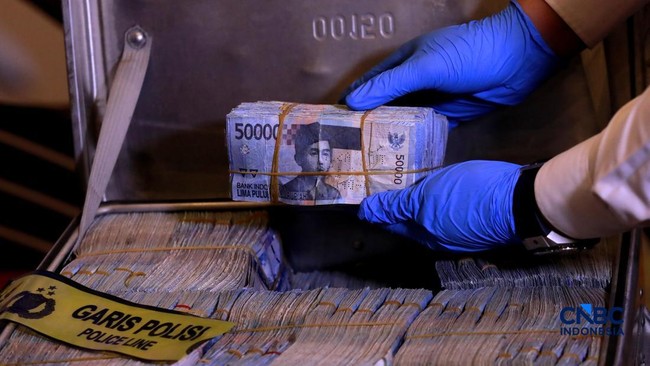
During the investigation, authorities found a safe containing money worth around Rp4bn in today’s terms.
The case began on 12 August 1955. On the Attorney General’s orders, the Military Police arrested DG after investigators had gathered what they considered sufficient evidence. Before the arrest, authorities searched the suspect’s home on Jalan Cut Mutia in Central Jakarta, as well as a house at Jalan Kenari No. 22 believed to be connected to him.
At the house on Jalan Kenari, investigators found a safe containing Rp135,000.
“A safe containing Rp135,000 was found at Jalan Kenari 22. The owner of the safe was not identified, but it is known that Mr DG withdrew money at that address three times,” the newspaper Algemeen Indisch dagblad reported on 13 August 1955.
The sum was substantial at the time. With gold costing about Rp86 per gram in 1955, the money could have bought around 1.57 kilogrammes of gold, worth approximately Rp4.14bn at current gold prices.
The arrest of a former minister prompted allegations that the case was politically motivated. In an interview with the daily Merdeka on 15 August 1955, Attorney General Soeprapto rejected that suggestion. He said the investigation had been under way for a long time, was based on sufficient evidence and was known to Prime Minister Burhanuddin Harahap.
“The grounds for detention are strong enough. There is no obstacle to Attorney General Soeprapto signing the detention order,” Merdeka reported on 15 August 1955.
The case against DG stemmed from allegations that he accepted a Rp40,000 bribe in connection with issuing a visa to Bong Kim Thjong, a person of Chinese descent from Hong Kong. The allegations came to light after Tan Po Goan gave the newspapers Keng Po and the Attorney General’s Office documents indicating irregularities in the visa process.
When the case went to court, Tan appeared as a key witness. He said he began to suspect DG after the minister ordered the deportation of Tjhon Hoen Nji, a person of Chinese descent, without clear legal grounds. This suspicion led him to investigate further, uncovering alleged irregularities in the issuance of Bong Kim Thjong’s visa.
“He ordered the expulsion of a foreign national without valid grounds,” Tan was quoted as saying by Java Bode on 18 October 1955.
In court, prosecutors accused DG of accepting Rp40,000 in return for issuing Bong Kim Thjong a permanent visa. The money was allegedly handed over through intermediaries: Rp20,000 via Soebagio and another Rp20,000 via Surjosuksoro, also known as Notopuro, on behalf of Bong Siang Thjong, Bong Kim Thjong’s sibling.
DG denied all the charges. Regarding the deportation of Tjhon Hoen Nji, he acknowledged ordering the expulsion, saying it was necessary for national security because the individual was considered to support the Kuomintang, or Chinese Nationalist Party.
“I did expel him. But it was for the sake of national security,” DG was quoted as saying by Java Bode on 22 November 1955.
DG also denied taking a bribe. He said the decision to issue Bong Kim Thjong’s visa was a policy known to parliament, while the money received by Soebagio and Notopuro was their personal business, as they had used the minister’s name without authorisation.
According to the book Pergulatan Demokrasi Liberal 1950–1959 (2021), one of DG’s secretaries also defended him, saying no money had gone to the accused. The court nevertheless found DG guilty of accepting a Rp40,000 bribe and sentenced him to one year in prison.
“The judge sentenced him to one year in prison for his involvement in receiving a Rp40,000 bribe,” Zutphens dagblad reported on 3 January 1956.
DG subsequently sought a presidential pardon. On 19 July 1956, President Sukarno granted it, reducing his sentence to six months.
“President Sukarno has granted DG’s request for a pardon, reducing his one-year sentence to six months,” Deputy Attorney General A. Muthalib was quoted as saying by Merdeka on 20 July 1956.
As time spent in detention during the trial counted towards his sentence, DG served only about one further month. The pardon sparked controversy, with critics saying it reflected the government’s weak commitment to tackling corruption.
The controversy reached the State Palace. Vice-President Mohammad Hatta said he was disappointed that the pardon had been granted without consulting him.
“I was not consulted by Bung Karno; he simply went ahead without me,” Hatta said, according to his autobiography Mohammad Hatta: biografi politik (1990).
That disappointment later became one of the factors behind Hatta’s resignation as vice-president.
Source: jawawa.id (https://jawawa.id/newsitem/former-indonesian-minister-arrested-by-attorney-generals-office-safe-found-containing-rp4bn-1793436653)
Originally published by CNBC Indonesia (https://www.cnbcindonesia.com/market/20261031122051-17-781135/mantan-menteri-ri-ditangkap-kejaksaan-agung-ketemu-brankas-isi-rp-4-m), translated from Indonesian