
Former Indonesian Finance Minister Weeps While Serving as NTT Disaster Volunteer
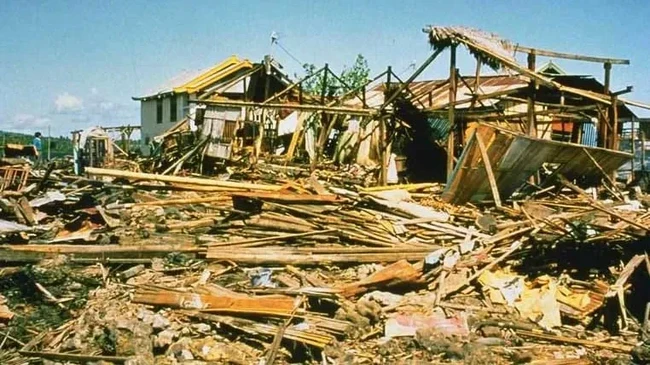
Former Indonesian Finance Minister Frans Seda wept upon seeing the suffering of victims of the 1992 earthquake and tsunami in East Nusa Tenggara (NTT). At the time, he was serving as a volunteer and chairman of the National Committee for the Flores Earthquake Disaster to help communities affected by the catastrophe.
On 12 December 1992, a magnitude 7.8 earthquake struck Flores and triggered a tsunami up to 25 metres high that slammed into the island’s northern coast. The epicentre was off the coast of Flores, around 35 kilometres north of Maumere. The powerful tremor caused hundreds of buildings in Maumere, the capital of Sikka Regency, to collapse. Several coastal villages were also submerged after the land subsided due to the earthquake.
Frans Seda, a son of NTT, immediately went to the location to assist with disaster response. He had close ties to Flores, having been born in Maumere. Seda was Indonesia’s 14th Finance Minister, serving from 1966 to 1968, and was the first son of NTT to hold a ministerial post during the Soeharto era.
Several days after the disaster, Seda helped oversee the handling of victims and the reconstruction process. While among the community, he saw first-hand the difficult conditions the victims had to endure.
The Bernas daily (16 December 1992) recorded the moment when Frans Seda could not hold back his tears while describing the disaster conditions. “Flores community elder and chairman of the national committee for the Flores earthquake disaster, Frans Seda, could not hold back his tears when explaining the disaster in NTT,” the newspaper reported.
Seda shed tears after seeing that many residents were still unable to live in proper conditions. The earthquake had destroyed their homes, while the weather made life even harder for the victims. “Not only that, the people who are now living without shelter are being drenched by heavy rain, which is very distressing,” Seda said.
According to Seda, the suffering of residents was also compounded by food shortages. Health problems emerged, while the condition of children was also a concern because they did not yet fully understand the situation.
Seeing these conditions, Seda urged the Indonesian public to provide assistance to the victims. He believed the people of Flores needed support to get through the difficult period after the disaster.
Amid these conditions, the Soeharto government also moved quickly to handle the impact of the Flores earthquake and tsunami. Four days after the disaster, on 16 December 1992, Soeharto sent large-scale aid to NTT and declared the Flores earthquake and tsunami a national disaster.
“The Head of State’s decision to declare the natural disaster a national disaster is expected to encourage communities at home and abroad, as well as regional governments, to extend a helping hand to the victims,” the Bernas daily reported.
From the first day of the disaster, several cabinet ministers were also ordered by Soeharto to check conditions on the ground. About a week later, Soeharto flew directly to NTT to see the condition of the victims.
At the disaster site, according to the Bali Post (24 December 1992), Soeharto checked on the community and called for the reconstruction of affected areas to be accelerated. The government then continued handling and reconstruction efforts to help residents resume their lives after the disaster.
According to the National Disaster Management Agency (BNPB), the 1992 Flores earthquake and tsunami killed more than 2,500 people. Around 500 people were declared missing and 447 others were injured. Meanwhile, around 5,000 people were displaced by the disaster.