
Former Customs Director faces first hearing in CPO POME corruption case
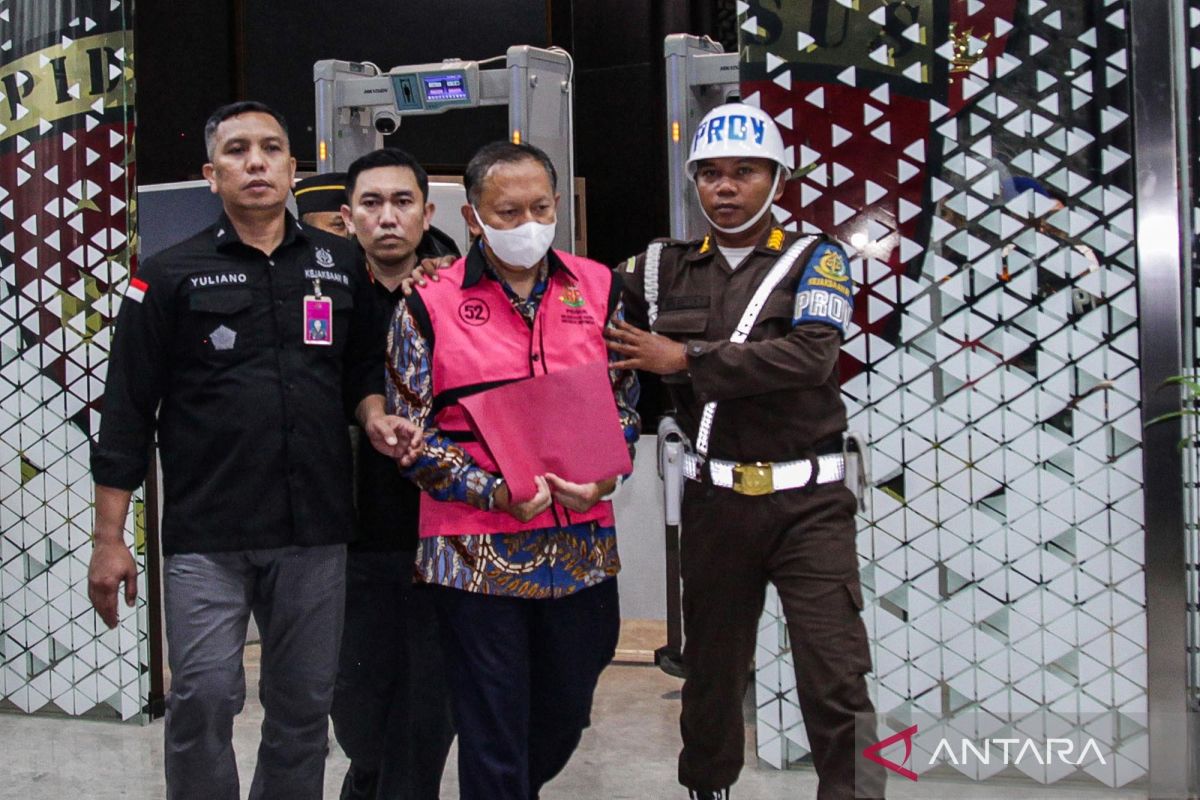
Jakarta (ANTARA) - Former Customs Director Fadjar Donny Tjahjadi faced the first hearing in the alleged corruption case involving the export of crude palm oil (CPO) and its derivative products for the 2022-2024 period, which were disguised as palm oil mill effluent (POME), at the Corruption Court at the Central Jakarta District Court on Tuesday.
Based on the Case Tracking Information System (SIPP) of the Central Jakarta District Court, the first hearing was scheduled for the reading of the indictment in the Wirjono Projodikoro 2 courtroom.
In addition to Fadjar, who served as Director of Customs Technical Affairs at the Directorate General of Customs and Excise of the Ministry of Finance from 2017 to 2024, the indictment was also to be read against ten other defendants, including Lila Harsyah Bakhtiar, a Senior Policy Analyst and Industry Development Functional Official at the Directorate of Forest Product and Plantation Industry of the Ministry of Industry for the 2021-2024 period.
Also named were Muhammad Zulfikar, Head of Customs and Excise Service Section VI at the Customs and Excise Supervision and Service Office VI Type Madya Pabean B Dumai in 2021; Edy Susanto, President Director of PT Sinar Mutiaranusa Palmindo; Tony, Director of PT Tanimas Edible Oil; and Yusrin Husin, Director and owner of PT Kencana Permata Nusantara.
Further defendants included Randy Tjahyadi Maliwarna, Director of PT Trimitra Agro Jaya; Van Ricardo, Director of PT Surya Inti Primakarya; Felix, Director and owner of PT Agrojaya Perdana; Erwin, Director of PT Bumi Mulia Makmur; and Robin, Director of PT Cakra Kaya Kreasi.
The case allegedly occurred when the government implemented a policy of restricting and controlling CPO exports as an effort to maintain domestic cooking oil availability and price stability for the public.
The policy was implemented through the Domestic Market Obligation (DMO) mechanism, export approval requirements, and the imposition of export duties and palm oil levies.
Within this policy framework, CPO was designated as a national strategic commodity classified under HS Code 1511 for customs purposes, without distinction based on acid content (Free Fatty Acid/FFA). Consequently, all forms of CPO, including high-acid CPO, remained subject to export restriction provisions and obligations to the state.
However, in practice, investigators found irregularities in the form of manipulation of export commodity classification. CPO that was substantively high-acid CPO was knowingly and deliberately claimed and treated as POME or Palm Acid Oil (PAO) using HS Code 2306, which should be reserved for solid residues or waste.
The classification manipulation was carried out with the aim of avoiding the CPO export control regime, so that commodities that were essentially CPO could be exported as if they were not CPO and were exempted or relieved from obligations imposed by the state.
The defendants allegedly not only knew the applicable legal provisions but also actively participated in designing, using, and allowing the deviant mechanism to continue.
Based on the State Financial Loss Calculation Report by the Financial and Development Supervisory Agency (BPKP) of the Republic of Indonesia, there were state financial losses in the case.
In this case, the investigation team seized cash amounting to Rp40 billion, as well as assets in the form of land, buildings, palm oil plantations, and vehicles worth approximately Rp696.5 billion.
The defendants are charged with violating Article 603 in conjunction with Article 20 letter a or c of the National Criminal Code, or Article 3 in conjunction with Article 18 of Law Number 31 of 1999 on the Eradication of Corruption as amended and supplemented by Law Number 20 of 2001.