
Forging a Path to Salt Self-Sufficiency from Rote’s Coast
The salt, which meets these specifications, is intended to supply industrial demand while helping reduce dependence on imported salt.
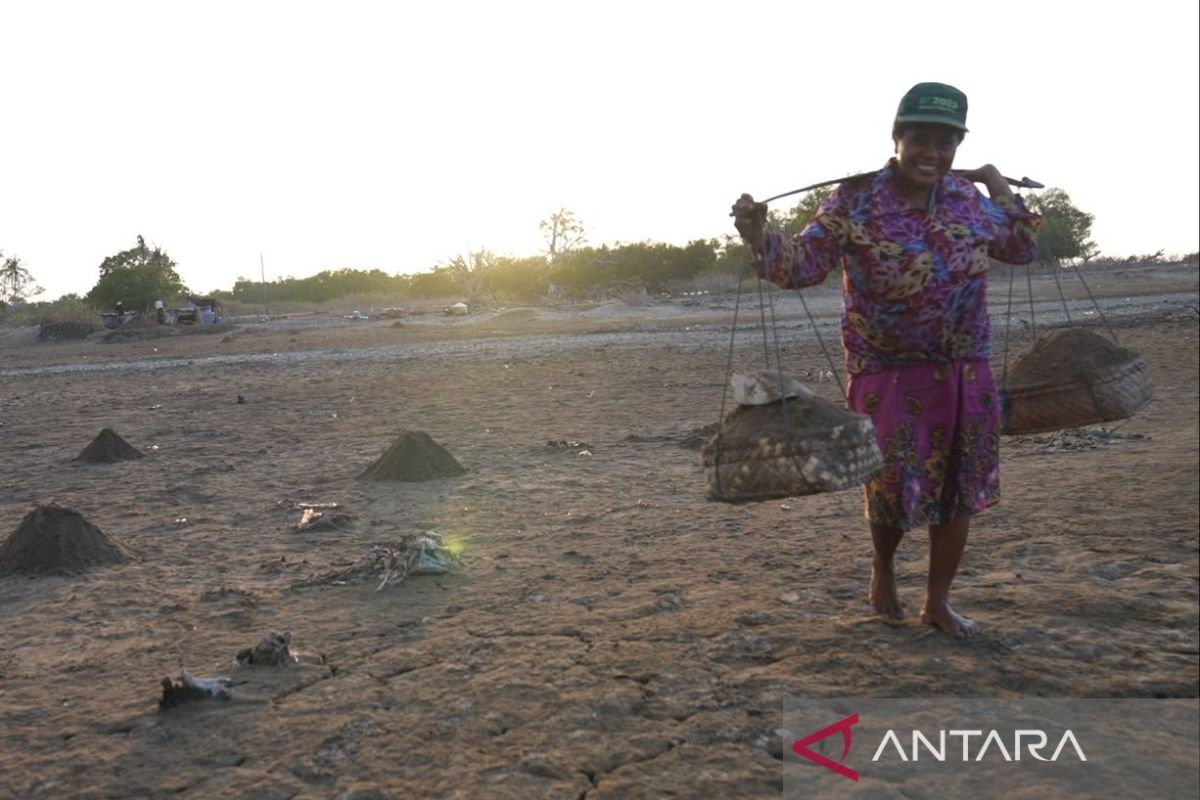
Jakarta (ANTARA) — The newly breaking dawn on the coast of Oetefu greets Yuliana Antonia Messa warmly as she works up a sweat among the plots of her salt ponds.
Her sweat bears witness to the long journey of the woman known affectionately as Mama Nia. For more than four decades, she has made her living from the salt ponds and the white crystals they produce.
For her and the coastal communities of Rote Island, East Nusa Tenggara, salt farming has been a way of life passed down through generations.
This work, carried on from one generation to the next, is the mainstay of many families living along the coast of the archipelago’s southernmost island.
“We people here regard salt as ‘light’. We continue what our ancestors practised. We carry it on because the word of God says that salt is the light of the world,” Mama Nia said.
After relying on traditional ponds for their livelihoods for decades, the people of coastal Rote Ndao now have an opportunity to develop the region’s salt potential on a larger industrial scale.
That opportunity emerged after the government designated Rote Ndao as the site for the National Salt Industry Centre (K-SIGN).
K-SIGN is planned as one of the country’s salt production centres, intended to increase domestic supply and reduce dependence on imports.
Rote Ndao was selected for good reason. The area is considered to meet the requirements for a salt industrial zone, with suitable expanses of land, a long dry season, appropriate soil texture and solar intensity data that support production through open evaporation of seawater.
These conditions mean Rote is seen as having the potential to become a large-scale salt production area.
“The development of K-SIGN in Rote Ndao is part of the mandate set out in Presidential Regulation No. 17 of 2025 on accelerating national salt development. It contains three strategies: intensifying production, applying technology and expanding the cultivated area,” said Zaki Muhasin, head of the Kupang Salt Management Centre.
K-SIGN will be developed in stages. The first phase covers around 616 hectares, followed by a second phase of about 751 hectares.
For production, seawater is pumped from a pump house and channelled through a series of production ponds stretching 12.5 kilometres before reaching the crystallisation area.
Each stage requires precise control, from water levels and flow rates to salinity. The aim is to bring the water to the required concentration of 25 degrees Baumé.
Source: jawawa.id (https://jawawa.id/newsitem/forging-a-path-to-salt-self-sufficiency-from-rotes-coast-1793623950)
Originally published by Antara (Indonesian) (https://www.antaranews.com/berita/5827047/meniti-jalan-swasembada-garam-dari-pesisir-rote), translated from Indonesian