
Forests Burn as the World Races to Save Wildlife
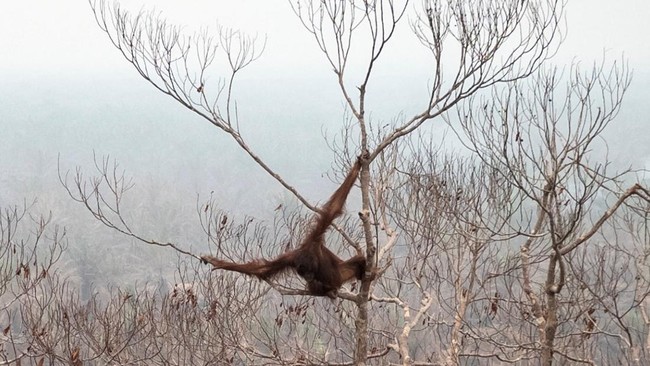
Jakarta — Forest and land fires still affecting several parts of Indonesia have once again highlighted the importance of protecting wildlife habitats.
As threats to global biodiversity increase, conservation efforts require not only rescuing animals but also restoring habitats and securing sustained government support.
The Ministry of Forestry recorded 290 wild animals handled in a national tally as of 8 October 2026. Of these, 96 were orangutans and 78 proboscis monkeys. The figures include animals found alive and dead.
Amid threats to wildlife habitats, the government continues to strengthen its response to forest and land fires by deploying personnel, conducting firefighting operations and rescuing affected animals.
The threat fires pose to wildlife is reflected not only in the number of animals handled, but also in the damage to their habitats. MapBiomas Indonesia data show that, from January to August 2026, a total of 20,363 hectares of burned land fell within the habitats of four iconic Indonesian species.
In a press release on Wednesday (21 October 2026), the Ministry of Forestry said it had deployed 1,419 Manggala Agni fire-control personnel and 1,000 forestry police, while placing 5,000 civil servants on standby to respond to fires. By 19 October 2026, the government had imposed administrative sanctions on 32 companies and brought criminal proceedings against 125 legal subjects.
These efforts matter because the impact of fires does not end when the flames are extinguished. Habitat damage can reduce wildlife’s access to food, shelter and breeding grounds.
Threats to wildlife are not confined to Indonesia. Around the world, habitat loss, climate change and human activity continue to put pressure on animal populations and disrupt ecosystem balance.
Mongabay reported on 19 October 2026 that biodiversity loss is not always marked by a species’ extinction. The death of an old female elephant, for example, can affect the survival of its herd because of her knowledge of water sources during droughts. The loss of elephant herds can also hinder seed dispersal and forest regeneration.
These threats are now under discussion at the United Nations Biodiversity Conference, or COP17, being held in Yerevan, Armenia, from 19 to 30 October 2026.
COP17: The world races to protect biodiversity
Threats to wildlife and ecosystems are a focus of COP17, the United Nations Biodiversity Conference taking place in Yerevan, Armenia, from 19 to 30 October 2026.
The meeting gives countries an opportunity to assess implementation of the Kunming-Montreal Global Biodiversity Framework, agreed in 2022.
Under the agreement, countries have pledged to protect at least 30% of the world’s land and waters and restore 30% of degraded ecosystems by 2030.
COP17 is the first global review of progress towards the framework’s 23 biodiversity targets. The 2030 deadline is now only four years away.
The record of the previous agreement shows that protecting nature remains a major challenge. None of the 20 Aichi Biodiversity Targets, set for achievement by 2020, was fully met at the global level.
Funding is also an obstacle. According to a report cited by the Associated Press, global biodiversity funding is targeted to reach US$200 billion a year by 2030, while current funding is estimated at only US$75 billion to US$92 billion annually.
This leaves an annual funding gap of about US$108 billion to US$125 billion compared with the target.
The scale of the shortfall shows that international commitments still face difficulties in implementation. Nevertheless, some countries are beginning to demonstrate that consistent environmental protection can produce tangible results.
Brazil, for instance, has reduced deforestation in the Amazon rainforest to its lowest level since records began in 1988.
Amazon records its lowest deforestation rate
Amid global biodiversity threats, some countries are starting to show success in curbing forest destruction. Brazil, for example, has recorded the lowest level of deforestation in the Amazon since records began in 1988.
Reuters reported on 16 October 2026 that data from Brazil’s National Institute for Space Research (INPE) showed 3,335 square kilometres (km²) of Amazon rainforest were deforested between August 2025 and July 2026.
That was a fall of about 42% from the previous period and below the earlier low of 4,571 km² recorded in 2011-12.
The achievement came under President Luiz Inácio Lula da Silva, who has pledged since taking office in 2023 to end Amazon deforestation by 2030. The effort has been supported by stronger forest monitoring, law enforcement and environmental protection policies.
Conditions also improved in the Cerrado savannah, where deforestation fell by about 24% to 5,517 km², the lowest level since records began in 2001.
However, the durability of these gains remains uncertain amid political shifts. Brazil is due to hold a second round of presidential elections on 25 October 2026, which could influence the next government’s environmental policies.
The situation shows that conservation success depends not only on current policies, but also on governments consistently maintaining environmental protections over the long term.
Tanzania’s blue gecko shows conservation can work
Conservation success can also be seen in East Africa’s Tanzania, where populations of the electric-blue Williams’ electric blue day gecko (Lygodactylus williamsi) have recovered.
The species had faced the threat of extinction because of the exotic pet trade and habitat destruction. Collectors even cut down native plants where the geckos lived in order to catch them.
According to Mongabay, an international ban on commercial trade introduced in 2017 helped ease pressure on wild populations. Captive breeding has also reduced demand for geckos caught in the wild.
Protection efforts were subsequently extended through habitat restoration in Kimboza Forest. Since 2016, local residents, conservation officers and researchers have removed nearly 100,000 invasive Spanish cedar trees that were disrupting the growth of native vegetation.
They also plant about 5,000 native trees each year and work to prevent forest fires. These efforts have reduced fires by about 80% and helped the gecko population recover.
Tanzania’s success shows that protecting wildlife takes more than a trade ban. Habitat restoration, community involvement and sustained funding are all important to the recovery of animal populations.
Indonesia has a major role in wildlife protection
The experiences of Brazil and Tanzania show that successful conservation requires consistent government policies and community involvement in protecting and restoring wildlife habitats.
This is relevant to Indonesia, particularly as forest and land fires threaten wildlife. Alongside firefighting and law enforcement, habitat protection requires ongoing monitoring and environmental restoration.
One initiative is the Fire-Aware Community (Masyarakat Peduli Api, or MPA). The Ministry of Forestry records 14,040 MPA members across 34 provinces who support fire prevention and initial response. The government also aims to establish 500 Sustainable MPA groups in 2026; 119 have been formed, while another 61 are in the process of being established.
Community involvement needs to be backed by funding, training, equipment and protection if conservation efforts are to continue over the long term.
Mongabay reported that technologies such as satellite imagery can help monitor forest damage, but conservation success still depends on the people protecting and restoring habitats on the ground.
This echoes the message of the late primatologist Jane Goodall, who encouraged people to take an active role in protecting their local environment.
Ultimately, conservation success should be measured not merely by the area of protected land or international commitments, but by the preservation of forests, the recovery of habitats and the survival of wildlife.
With the 2030 deadline for global biodiversity targets approaching, the challenge for governments is not only to save species from extinction, but also to ensure that conservation gains endure for future generations.