
Forestry Ministry Sanctions 6 Companies as Burned Areas Reach 1,511 Hectares
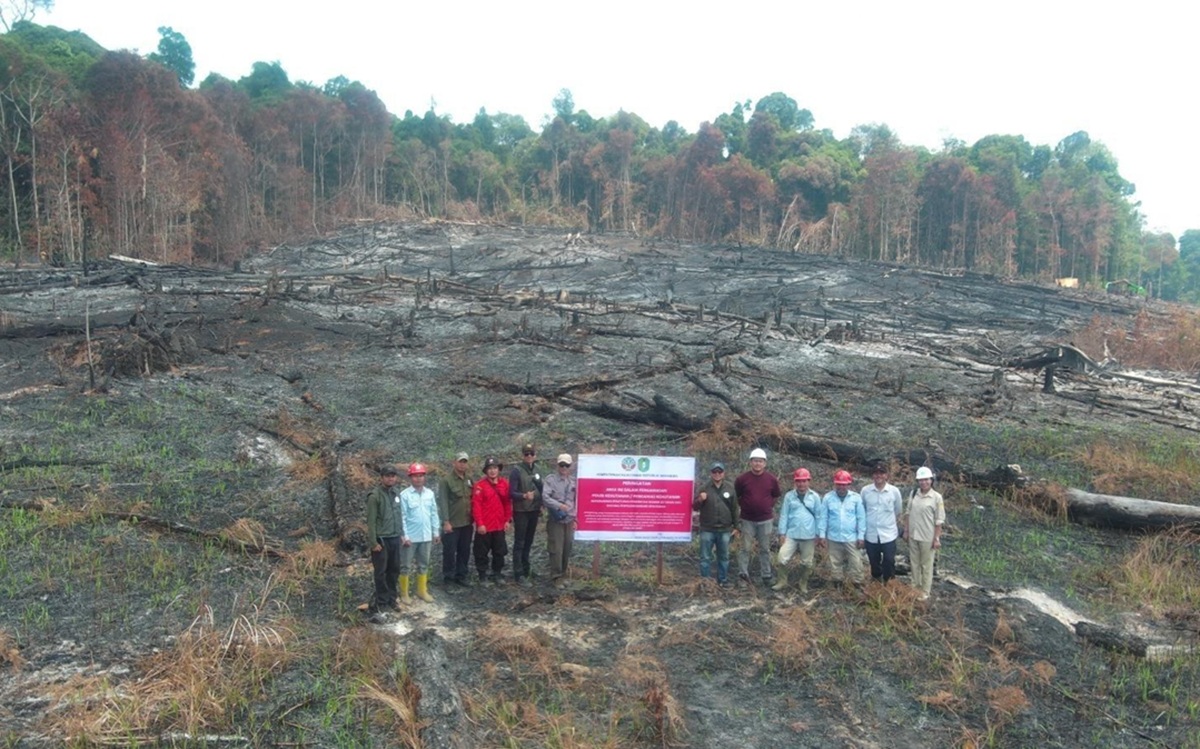
The Ministry of Forestry has imposed administrative sanctions on six companies holding Forest Utilisation Business Permits after monitoring found fires across a total area of 1,511.55 hectares in West Kalimantan, Central Kalimantan, and East Kalimantan. Five companies were subjected to Government Enforcement Orders, while PT MPK received both a freeze on its business permit and a Government Enforcement Order due to extensive and repeated fires on its concession. Under these sanctions, the companies are required to improve fire control measures and restore affected areas.
The six companies are PT WEL, PT FI, PT MPK, and PT WSP in West Kalimantan, PT NES in Central Kalimantan, and PT PSR in East Kalimantan. Monitoring results show the largest burned area was recorded at PT WEL with approximately 760.51 hectares, followed by PT MPK with 394.83 hectares, PT WSP with 107.7 hectares, PT FI with 95.87 hectares, PT PSR with 82.26 hectares, and PT NES with 70.38 hectares. The total burned area across the six companies reached 1,511.55 hectares.
The sanctions follow monitoring of company obligations to prevent and control forest and land fires within their working areas. Four companies in West Kalimantan were inspected directly by the Kalimantan Regional Forestry Law Enforcement Agency from 10 to 14 August 2026. Meanwhile, handling of PT NES and PT PSR was carried out by the Directorate of Supervision, Administrative Sanctions, and Forestry Civil Affairs.
Inspections covered the readiness of fire control teams, firefighting equipment, water sources, watchtowers, canal blocks, and early detection and response systems. In affected areas, companies may also be ordered to restore vegetation. On peatland specifically, restoration obligations include improving hydrological functions through water management, canal blocking, rewetting of peat, and monitoring of groundwater levels.
Director of Supervision, Administrative Sanctions, and Forestry Civil Affairs, Ardi Risman, explained that Government Enforcement Orders carry consequences that must be implemented and can be evaluated for compliance. “Government Enforcement Orders impose consequences on companies to fulfil established obligations, from improving fire control systems to restoring affected areas within specified time limits. For PT MPK, we imposed a freeze on its business permit as well as a Government Enforcement Order because fires occurred extensively and repeatedly. We will monitor and evaluate the implementation of all these obligations. If they are not fulfilled, sanctions can be escalated according to regulations, including up to revocation of the business permit,” Ardi stated on Tuesday.
Director General of Forestry Law Enforcement, Dwi Januanto Nugroho, emphasised that business permits carry the responsibility to protect areas and prevent damage. Administrative sanctions are used to correct non-compliance while compelling improvements and restoration. However, handling can go further if criminal offences are suspected. “Business permits grant the right to manage forest areas, but they carry the obligation to protect and prevent damage. We use administrative sanctions to compel improvement, restoration, and compliance. But when criminal elements are found, the criminal process continues. This is also a warning to anyone who deliberately burns forests or profits from fires and area damage. We will investigate and process based on evidence,” he asserted.
According to Januanto, such firmness is necessary because the consequences of forest and land fires are not only a problem for companies or the areas where fires occur. Fires and smoke can bring far wider losses to communities and disrupt various public activities and services. “Forest and land fires are not only about how many hectares are burned. There are communities whose health is affected, children whose learning activities may be disrupted, flights and transport may be affected, economic activity is depressed, and the state must deploy significant resources to control fires. No party should profit while communities and the state bear the consequences. Law enforcement must protect affected communities, safeguard public interests and facilities, while ensuring state law is enforced and responsible parties must bear the consequences of their actions,” he continued.
The Ministry of Forestry reminded all permit holders to make forest and land fire prevention part of routine business management, especially during fire-prone periods. While Manggala Agni, local governments, communities, and various other elements strengthen fire control on the ground, companies are responsible for ensuring that areas under their management remain protected. The government will continue to inspect compliance and ensure that every improvement and restoration obligation is implemented. “If other violations are found that meet criminal elements or there are losses for which accountability can be sought, criminal instruments, administrative sanctions, and civil measures remain open according to applicable regulations,” he concluded.
Source: jawawa.id (https://jawawa.id/newsitem/forestry-ministry-sanctions-6-companies-as-burned-areas-reach-1-511-hectares-1787626232)
Originally published by Media Indonesia (https://mediaindonesia.com/nusantara/925578/kemenhut-sanksi-6-perusahaan-areal-karhutla-capai-1511-hektare), translated from Indonesian