
Forestry Ministry Releases Two Javan Hawk-Eagles and Inaugurates Conservation Facilities in Megamendung
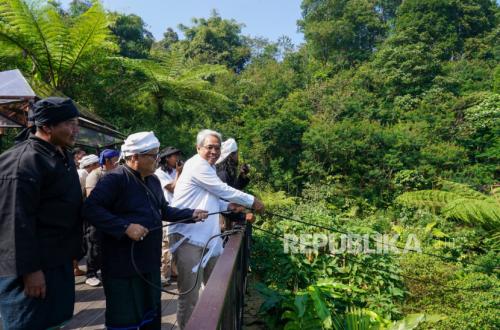
The Ministry of Forestry has released two Javan hawk-eagles (Nisaetus bartelsi) and inaugurated the Lembah Aviary Paseban and a Timor Deer Captive Breeding facility in the Megamendung Landscape, Bogor Regency, on Tuesday. The activity was carried out to strengthen biodiversity conservation and ecosystem restoration in one of Java’s important landscapes.
Represented by the Director General of Natural Resources and Ecosystem Conservation (KSDAE), Satyawan Pudyatmoko, the Minister of Forestry stated that conservation requires collaboration from various parties, including the government, communities, academics, and the private sector. “Conservation efforts need strong collaboration between the government, communities, businesses, universities, and various other stakeholders. What is being done in Megamendung shows that biodiversity preservation, ecosystem restoration, and sustainable development can proceed in harmony,” Satyawan said.
The two Javan hawk-eagles released are a female named Agni and a male named Beta. Both underwent a process of rehabilitation, habituation, and technical evaluation for about two years and six months before being deemed fit to return to their natural habitat. Agni originated from the Kamojang Eagle Conservation Centre, while Beta came from the Cikananga Conservation Foundation. To support post-release monitoring, both animals were equipped with GPS tracker devices to monitor their movements and adaptation capabilities in the wild.
The Javan hawk-eagle is an endemic animal of Java with protected status and is one of the national conservation priority species. The presence of this animal is also often used as an indicator of the health of Java’s mountain forest ecosystems.
On the same occasion, the Ministry of Forestry inaugurated Lembah Aviary Paseban, which was developed as a non-commercial ex-situ conservation facility to support the preservation efforts of various Indonesian bird species. The facility will be used for environmental education activities, research, animal breeding, and to support release programmes into natural habitats. The Timor Deer Captive Breeding facility, developed as a means of wildlife conservation and environmental education, was also inaugurated. Both facilities are expected to support efforts to restore wild animal populations and strengthen the area’s ecological functions.
The conservation initiative in Megamendung was developed by the Paseban Foundation through an approach that combines biodiversity conservation, ecosystem restoration, organic farming, environmental education, research, and community empowerment.
Paseban Foundation Patron, Andy Utama, said the various programmes run aim to support the long-term restoration of the Megamendung area’s ecological functions. “We have a simple yet grand aspiration, which is to contribute to returning Megamendung as close as possible to its ecological condition as it was known about a hundred years ago. Perhaps we cannot fully return the past, but we can restore its ecological functions, strengthen wildlife habitats, protect water sources, and bequeath a better landscape to the next generation,” he said.
Paseban Foundation Advisor, Wiratno, assessed that Megamendung has an important role in maintaining the ecological balance of the West Java region because it is connected to a wider landscape, including the Cibodas Biosphere Reserve. According to him, the area not only functions as a wildlife habitat but also plays a role in maintaining environmental functions whose benefits are felt as far as downstream areas.
The Megamendung landscape is known to still be a habitat for a number of important animals such as the Javan hawk-eagle, Javan gibbon, Javan surili, Javan lutung, Sunda pangolin, mongoose, Javan porcupine, and various types of forest birds. The existence of these various species shows that this area still has an important ecological function amid the increasing development pressure on Java.