
Forestry Ministry and Indonesian Navy Crack Down on Illegal Merbau Timber Trade
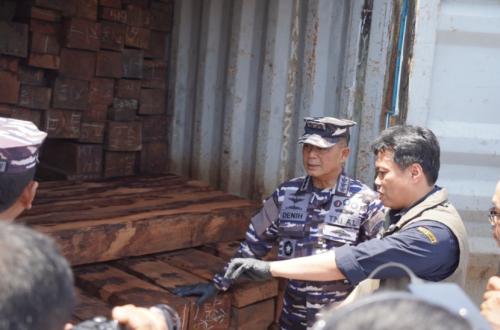
SURABAYA – Suspected concealment of the origin of merbau timber from Nabire, Central Papua, came to light after authorities secured 23 containers in Surabaya. Seven of the containers are suspected of using forged documents, while the validity of the documents for the other 16 is still being examined.
The Forestry Ministry and the Indonesian Navy are investigating the alleged timber-laundering operation. Investigators are tracing the shipping chain to establish the origin of the raw materials, the processing stages and the parties who received the timber.
Dwi Januanto Nugroho, the Forestry Ministry’s Director General of Forestry Law Enforcement, said the discovery of irregular documents indicated suspected concealment of the timber’s origin through the misuse of legality documents.
The case came to light during an operation by the Maluku and Papua Regional Forestry Law Enforcement Centre, Central Papua Police and the Indonesian Navy in Nabire Regency on 14 October 2026.
During the operation, officers inspected two timber-processing and shipping sites, CV PP and UD KM2. They found sawn merbau timber and information that timber had been shipped to Surabaya. Further enquiries led to 23 containers transported by sea.
Upon their arrival in Surabaya, the Indonesian Navy’s Naval Regional Command V (Kodaeral V), together with the Forestry Law Enforcement Centre for Java, Bali and Nusa Tenggara, secured all the containers for further examination.
An examination by civil servant investigators in Nabire found a number of administrative discrepancies in the timber-recording system. The loading location was allegedly different from the location stated in the Certificate of Legality for Processed Timber Products (SKSHH-KO).
Officers also found raw timber without legality documents. Investigators further suspect that the timber was not measured by an authorised technical officer and found scanned signatures on transport documents.
Aswin Bangun, head of the Forestry Law Enforcement Centre for Java, Bali and Nusa Tenggara, said the discovery of forged documents in seven containers had provided grounds to investigate suspected concealment of the timber’s origin.
“The discovery of forged documents in seven containers gives us a starting point for investigating suspected concealment of the timber’s origin. We are still tracing the links between the source of the raw materials, the processing, transport documents, and the recipients and ultimate beneficiaries,” Aswin said.
The recipients of the timber in 13 containers have been identified, while those receiving the other 10 containers are still being traced. Investigators are also examining the relationships between the raw-material suppliers, processors, shippers and recipients to establish each party’s role.
Based on the information gathered, investigators believe there are grounds to advance the suspected forestry crime to the formal investigation stage. The next phase will focus on securing evidence and examining the involvement of parties suspected of processing or transporting the timber.
Rear Admiral Ali Triswanto, commander of Kodaeral V, said securing the containers was part of cooperation between the Indonesian Navy and the Forestry Ministry to prevent illegal forest products from being circulated by sea.
“Safeguarding Indonesia’s seas is not merely about defending territory; it also means ensuring the nation’s natural wealth is not lost to illegal activity. Securing these 23 containers of timber from Papua is part of the service rendered by Indonesian Navy personnel in support of national defence and resilience,” Ali said.
Dwi said timber laundering involved not only document forgery but also the suspected introduction of proceeds from forestry crimes into legal trade. Such practices, he said, could cause losses to the state, undermine fair competition and threaten forest conservation.
“Law enforcement must provide certainty for compliant businesses while closing off opportunities for illegal practices. Every operation and case uncovered also provides important lessons for reviewing policy, strengthening oversight and improving forestry governance,” Dwi said.
The Forestry Ministry said the case formed part of its oversight of forest-product trade from Papua, a region with important ecological functions that is also home to local communities.
Source: jawawa.id (https://jawawa.id/newsitem/forestry-ministry-and-indonesian-navy-crack-down-on-illegal-merbau-timber-trade-1793775143)
Originally published by Republika (https://esgnow.republika.co.id/berita/tnyqro416/kemenhut-dan-tni-al-bongkar-perdagangan-ilegal-kayu-merbau), translated from Indonesian