
Forest Fires Under Control, Indonesia's Interests in Vladivostok Remain On Track
The South China Sea Council (SCSC) views the forest and land fires (karhutla) occurring in several regions of Indonesia as a serious issue. The impact of haze on both the Indonesian people and neighbouring countries must not be underestimated, and the government is obliged to control the fires, protect the public, and take action against those responsible. However, President Prabowo Subiability’s departure to the Eastern Economic Forum (EEF) in Vladivostok as an indication that the government is ignoring the forest fires is an overly simplistic conclusion.
According to the South China Sea Council, President Prabowo personally visited West Kalimantan and Central Kalimantan on 22 August 2026, leading coordination efforts, inspecting fire locations, and ordering the strengthening of both land and air operations. Furthermore, on 1 September 2026, just hours before departing for Vladivostok, the President was still receiving national situation reports and updates on fire management from the Commander of the TNI and the Chief of the National Police.
The presidential aircraft only left Jakarta around 23:20 WIB. This means the chain of command for fire management does not cease when the President leaves Indonesian territory. To date, the forest fires in Kalimantan have not been declared a national disaster. Management continues through the emergency structures of local governments and the Regional Disaster Management Agency (BPBD), supported by resources from the central government, BNPB, TNI, Polri, and relevant ministries. BNPB reports from 2–3 September show that management operations are still ongoing at the regional level across various areas of Kalimantan.
Another aspect that should not be overlooked in the news is the change in the intensity of law enforcement. The current government is demonstrating more aggressive and simultaneous action against perpetrators of forest fires, involving both individuals and corporations. As of 3 September 2026, the Ministry of Environment has sealed or taken action against 25 corporate concessions indicated to be linked to forest fires. Separately, the Ministry of Forestry has imposed administrative sanctions on six companies, including the suspension of business licences for one. Meanwhile, the National Police Criminal Investigation Agency (Bareskrim Polri) has named 89 individuals as suspects in various forest fire cases.
The occurrence of a crisis does not automatically reduce a nation’s focus on other aspects. In 2010, the United States faced the Deepwater Horizon, one of the largest environmental disasters in its history. Oil continued to flow into the Gulf of Mexico, polluting ecosystems and disrupting the lives and economies of communities along the Gulf Coast. Between 25–27 June 2010, while the Deepwater Horizon management operations were still underway, President Obama still left the United States to attend the G8 and G20 Economic Summits in Canada.
While the presence of a head of state is much needed during a domestic crisis, President Prabowo’s presence at the EEF Summit in Vladivostok cannot be equated to the visit of British Prime Minister James Callaghan, who went to the Caribbean for the Guadeloupe Summit in January 1979, while the UK was experiencing the ‘Winter of Discontent’. Waves of strikes hit various sectors, public services were disrupted, goods transport faced pressure, and even waste and bodies piled up in several cities. Callaghan even went on holiday before returning to the UK.
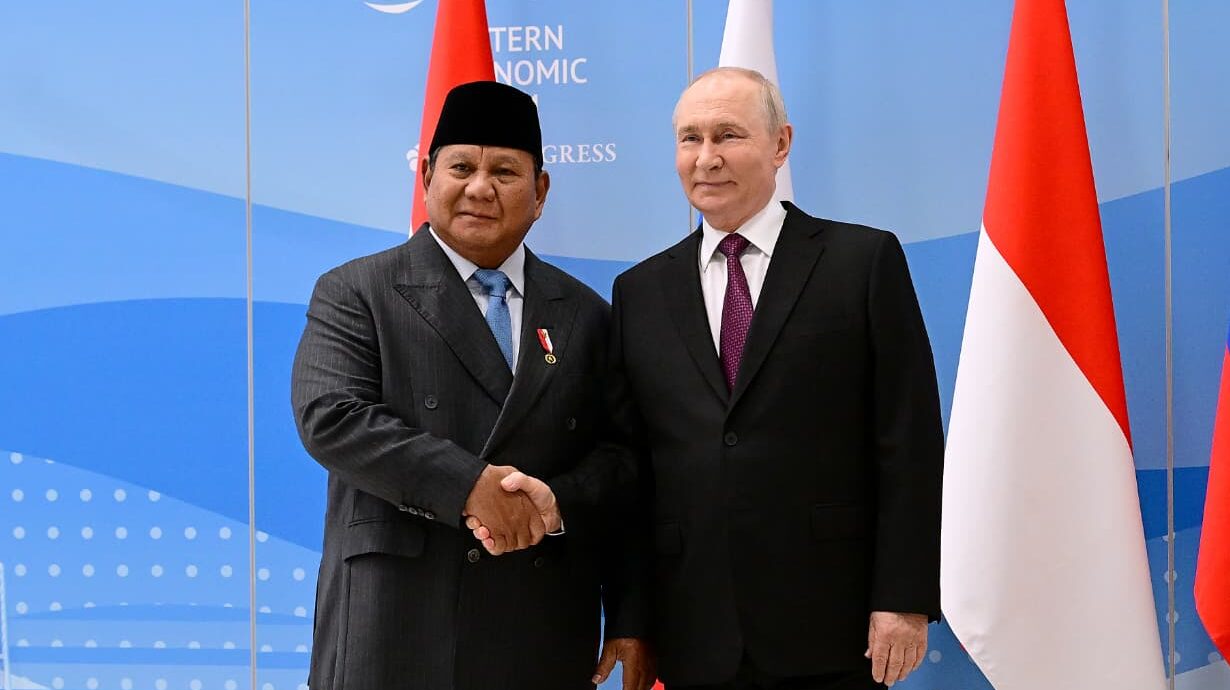
Vladivostok represents Indonesia’s interests. President Prabowo’s presence in Vladivostok is not a holiday. The President attended as the main guest of honour at the 11th Eastern Economic Forum by invitation of President Vladimir Putin, held bilateral meetings with the Russian President, and presented Indonesia’s position to governments, investors, and economic actors from various countries. Amidst increasingly fragmented global trade and supply chains influenced by geopolitical competition, Indonesia has an interest in opening as many new trade routes, investments, and connectivity as possible. President Prabowo even used the forum to reaffirm Indonesia’s open and non-aligned foreign policy principles and the importance of building economic bridges with various global powers.
According to International Relations observer, Prof. Anak Agung Banyu Perwita, Prabowo’s visit to Russia serves as a high-level diplomatic tool to advance two main strategic goals: energy security and the redefinition of Indonesia’s role in the Asia-Pacific region. This narrative transcends mere geography, involving both geopolitics and geo-economics. He stated that this reflects a vision where Indonesia and Russia are not distant powers, but natural partners connected by the Pacific Ocean, positioning Indonesia as a bridge between Russia and the wider region.
“Prabowo’s visit aligns with the main theme of the EEF while strengthening Indonesia’s ambition to become a key connector in the Asia-Pacific, utilising its growing strategic autonomy to unlock various strategic cooperation opportunities in other fields,” he said in a statement in Jakarta on Saturday (5/9).
According to defence observer Ade Muhammad, the primary goal of the state is to protect all Indonesian people; therefore, forest fires must be handled with the full capability of the state. However, the government does not depend on the physical presence of a single individual. Forest fire operations are carried out in an integrated manner by BNPB–BPBD, the Ministry of Forestry through Manggala Agni, the Ministry of Environment, local governments, TNI, Polri, and BMKG, while the President maintains political responsibility over the command, resources, and the results of the management. At the same time, energy security is the foundation of national industrialisation.
The visit to Russia brings a concrete agenda involving knowledge, investment, and peaceful nuclear technology, including modular and full-scale reactors, in line with the targets for initial operation.