
Forest Fires Threaten, Government Deploys 53 Aerial Units
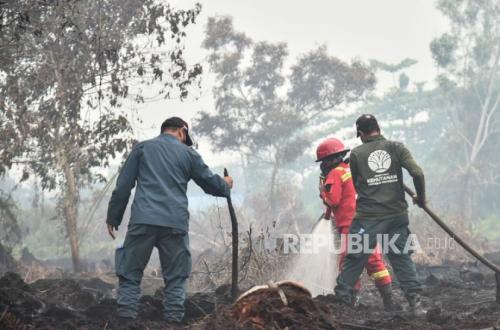
The Ministry of Forestry, alongside joint task forces, continues to strengthen the control of forest and land fires (karhutla) across six priority provinces. Although parts of West Kalimantan have begun to receive rainfall, vigilance remains high as hundreds of high-confidence hotspots are still being detected.
The Head of the Bureau of Public Relations and Foreign Cooperation at the Ministry of Forestry, Ristianto Pribadi, stated that based on SiPongi data sourced from NASA Terra/Aqua, SNPP, and NOAA-20 satellites, 818 high-confidence hotspots were detected nationally as of Friday, 4 September 202<0xC2>6, at 21:15 WIB.
“Current operational focus is primarily directed towards Central Kalimantan, South Sumatra, and West Kalimantan, as these three provinces recorded the highest number of high-confidence hotspots among the six priority provinces,” said Ristianto.
Central Kalimantan recorded the highest number of hotspots with 252 points. This was followed by South Sumatra with 165 points, West Kalimantan with 124 points, Jambi with 14 points, Riau with 13 points, and South Kalimantan with four points.
The Ministry of Forestry emphasised that a hotspot does not automatically indicate a single fire event. A hotspot is an indication of surface temperature anomalies detected by satellites, whereas a single fire event may be recorded across multiple hotspots.
Therefore, every indication must still be verified through ground checks and actual field monitoring. Such verification is necessary to confirm fire conditions and determine handling priorities.
Forest fire control is being conducted in collaboration with the TNI (National Armed Forces), Polri (National Police), BNPB (National Disaster Management Agency), BMKG (Meteorology, Climatology and Geophysics Agency), BPBD (Regional Disaster Management Agency), local governments, the community, the business sector, and various other parties. Operations include patrols, ground checks, ground-based firefighting, fire containment, mopping up, cooling, and monitoring to prevent fires from reigniting.
The government has also deployed 53 aerial units to support operations in the six priority provinces. A total of 19 units are being used for aerial patrols and to support Weather Modification Operations (OMC), while another 34 units have been deployed for water bombing.
“A total of 53 aerial units have been deployed to accelerate forest fire control, particularly in areas that are difficult to reach via ground operations,” said Ristianto.
The deployment of aerial units is being adjusted according to needs and developments in field conditions. Meanwhile, Weather Modification Operations (OMC) continue to be pursued in regions and at times that meet meteorological conditions.
Positive developments have been observed in West Kalimantan after parts of the region received moderate to heavy rainfall. The rain assists in the process of wetting the land while also supporting firefighting and cooling efforts.