
Forest Fires and Air Pollution Said to Have Killed 5,310 People in Indonesia
JAKARTA — In its latest report, think tank the Centre for Research on Energy and Clean Air (CREA) recorded a 42 per cent increase in deaths from air pollution in Indonesia, to 5,310 in September 2026. The rise was largely driven by forest and land fires, which doubled the estimated death toll compared with August.
CREA estimates that smoke from forest and land fires caused 3,560 deaths in September. Chronic air pollution from urban and industrial activity is estimated to have caused a further 1,750 deaths.
CREA said the peak of El Niño and dry conditions throughout September worsened fires in several areas. As a result, fire smoke became the leading cause of air-pollution-related deaths in several regions, particularly Kalimantan and Sumatra.
Four provinces in Kalimantan — West Kalimantan, South Kalimantan, Central Kalimantan and East Kalimantan — recorded an estimated 1,470 deaths from fire smoke. Five provinces in Sumatra — Jambi, South Sumatra, Riau, Lampung and West Sumatra — recorded a total of 1,420 deaths.
In Java, non-fire-related air pollution remained the main concern. Emissions from industry and motor vehicles, along with the burning of rubbish, are estimated to have caused 1,530 deaths in September.
“These figures show that sources of air pollution other than forest and land fires are just as dangerous as smoke from the burning of forests and peatlands,” CREA analyst Katherine Hasan said in a statement on Thursday (29 October 2026).
Hasan noted that air pollution in Java’s densely populated urban areas remained a serious threat. However, the spread of forest and land fires in Kalimantan, Sumatra, Sulawesi and Papua had shifted the main source of air-pollution-related deaths from urban pollution to fire smoke.
Deteriorating air quality also affected tens of millions of people. CREA estimates that around 14 million people, or nearly 80 per cent of Kalimantan’s population, were exposed to poor-quality air in September. This was up from 12.3 million in August.
In Sumatra, about 31.4 million people — half the population — were exposed to unhealthy or worse air. In Java, the equivalent figure was 23.8 million.
Nationwide, a total of 57.8 million people breathed air classed as unhealthy to hazardous in September.
The national average concentration of PM2.5 also rose to 36 micrograms per cubic metre. This is more than seven times the World Health Organization’s guideline of 5 micrograms per cubic metre for the annual average PM2.5 concentration.
In areas affected by forest and land fires, the average PM2.5 concentration reached 120 micrograms per cubic metre in Kalimantan and 51 micrograms per cubic metre in Sumatra. In Java, it remained relatively stable at 26 micrograms per cubic metre.
Nevertheless, Java could still be affected by fire smoke as wind patterns shift towards the end of the year, potentially carrying smoke from Kalimantan towards the Java Sea.
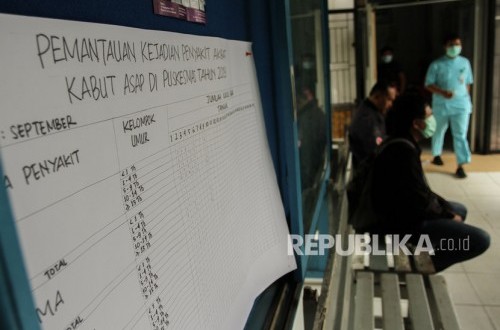
The health impact of air pollution is also reflected in the high number of acute respiratory infection (ARI) cases. Ministry of Health data up to 21 October recorded 333,470 ARI cases across seven provinces affected by forest and land fires.
South Kalimantan and South Sumatra recorded the highest numbers, with nearly 75,000 cases each. Children under five have borne a substantial health burden, with 75,172 cases — almost a quarter of all those reported.
Pulmonologist Agus Dwi Susanto, an adviser to the Indonesian Pulmonologists Association (PDPI), said air pollution was not merely a decline in environmental quality but a serious threat to human health, particularly when exposure continued over the long term.
Exposure to pollutants can affect lung function and increase the risk of respiratory disorders, from recurrent ARIs to worsening asthma and chronic obstructive pulmonary disease (COPD).
“In certain circumstances, exposure to air pollutants is also associated with the risk of pulmonary fibrosis and lung cancer,” Agus said.
He said the government therefore needed to strengthen prevention and control of pollution sources to reduce health impacts.
CREA said Indonesia’s response to forest and land fires needed to shift away from an approach focused on extinguishing fires after they start, towards prevention and peatland ecosystem restoration. Widespread peatland drainage makes these areas more vulnerable to fire.
Alongside peatland restoration, CREA called for law enforcement against illegal land clearing by burning and stronger legal accountability for concession holders to prevent environmental damage.
In areas with chronic pollution unrelated to fires, particularly Java, the government should also tighten monitoring and enforcement of emissions standards for power plants, industry and transport.
Agus Sari, co-founder and chief executive of Landscape Indonesia and a member of the Indonesian Philanthropy Association’s (PFI) expert council, questioned the government’s preparedness for recurring fires. He said forest and land fires were a disaster that could be anticipated through early preparation, including monitoring for potential legal violations.
“Indonesia should be able to prepare for what is coming. The fact that we are completely unprepared is simply a matter of a lack of will,” Agus Sari said.
CREA also highlighted cuts to the National Disaster Management Agency’s (BNPB) budget, to Rp491 billion from Rp2 trillion the previous year. The report said the funding constraint could limit the agency’s ability to respond to emergencies, contain fires and smoke, and prevent them from spreading and causing greater health impacts.
With estimated deaths rising, pollution exposure spreading and ARI cases remaining high, the CREA report calls for an integrated response encompassing fire prevention, peatland restoration, law enforcement and emissions controls for urban and industrial pollution sources.
Source: jawawa.id (https://jawawa.id/newsitem/forest-fires-and-air-pollution-said-to-have-killed-5-310-people-in-indonesia-1793317867)
Originally published by Republika (https://esgnow.republika.co.id/berita/tnoymy393/karhutla-dan-polusi-udara-disebut-tewaskan-5310-orang-di-indonesia), translated from Indonesian