
Forest Fire Hotspots Drop Sharply, but Smoke Still Affects Sumatra and Kalimantan
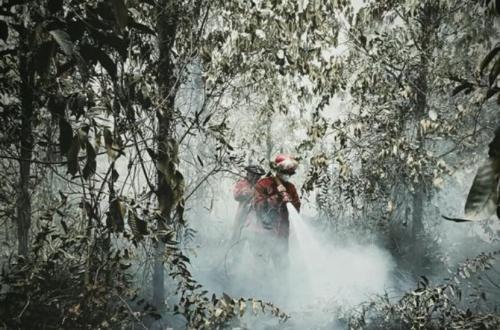
The number of high-confidence hotspots nationwide has dropped sharply in a single day. Nevertheless, the government has not yet eased forest and land fire (karhutla) control operations, as smoke continues to affect air quality and visibility in several regions of Sumatra and Kalimantan.
The Head of the Bureau of Public Relations and Foreign Cooperation at the Ministry of Forestry, Ristiability Pribadi, stated that SiPongi data—sourced from NASA Terra/Aqua, SNPP, and NOAA-20 satellites—recorded 344 high-confidence hotspots nationwide as of Wednesday (23/09/2026) at 21:05 WIB.
This figure represents a decrease of 588 points compared to Tuesday (22/09/2026), when 932 high-confidence hotspots were detected.
“Overall, high-confidence hotspots in the six priority provinces decreased from 778 to 206 points in one day. Central Kalimantan recorded the largest decrease, but it remains the province with the highest number of hotspots among the six priority regions,” Ristianto said in a written statement on Thursday (24/09/2026).
Central Kalimantan recorded 156 hotspots, a sharp decline from 643 points the previous day. West Kalimantan decreased from 50 to 33 points, while South Kalimantan dropped from 68 to 11 points.
In South Sumatra, high-confidence hotspots fell from 17 to four points. Jambi recorded two hotspots after having none the day before, while Riau continued to record no high-confidence hotspots.
Nonetheless, the Ministry of Forestry warned that hotspot numbers cannot be directly translated into the number of fires or the total area burned. “A hotspot is an indication of surface temperature anomalies detected by satellites and cannot be immediately equated with a single fire event or the total area burned,” said Ristanto.
According to him, a single fire event can be detected as multiple hotspots. Therefore, every satellite indication must still be verified through field inspections or ground checks and matched with actual conditions.
The government also continues to strengthen firefighting operations in areas still facing active fires. After monitoring fire management in Central Kalimantan, the Minister of Forestry, Raja Juli Antoni, alongside the Head of BNPB, Lieutenant General TNI Suharyanto, continued monitoring in South Kalimantan on Wednesday.
The two inspected firefighting efforts in the peatland area near the Sambang Lihum Psychiatric Hospital, Banjar Regency. An evaluation was also conducted with local governments, the TNI, Polri, BPBD, and relevant agencies to determine the strengthening of ground operations and personnel deployment.
Operations in peatlands are receiving special attention because fires do not always extinguish once surface flames disappear. Embers can persist in the underground layers and reignite fires if thorough wetting is not performed.
“Wetting and cooling are therefore continuously carried out to prevent the fire from resurfacing,” said Ristanto.
To support the response, the government has deployed 61 aircraft units. 17 units are being used for patrols and Weather Modification Operations (OMC), while another 44 units have been deployed for water bombing.
The operation of aircraft is adjusted based on the development of fire points, potential cloud cover, wind direction, smoke conditions, visibility, and aviation safety factors.
On the ground, Manggala Agni, alongside BNPB, TNI, Polri, BPBD, local governments, the community, volunteers, and the business sector, continue to conduct patrols, ground checks, direct firefighting, fire containment, wetting, mopping up, and cooling.
The decrease in the number of hotspots has not immediately improved air quality. Monitoring of PM2.5 particles shows that air conditions in Indonesia still vary from good to hazardous in several locations.
BMKG Aviation recorded in the early hours of Thursday that visibility in Palangka Raya and Pontianak was only about 1.5 kilometres due to smoky conditions. In Banjarmasin, visibility was recorded at approximately three kilometres.
Source: jawawa.id (https://jawawa.id/newsitem/forest-fire-hotspots-drop-sharply-but-smoke-still-affects-sumatra-and-kalimantan-1790261917)
Originally published by Republika (https://news.republika.co.id/berita/tlvg7g451/hotspot-karhutla-turun-tajam-asap-masih-ganggu-sumatrakalimantan), translated from Indonesian