
Forest Fire Haze Returns Thick in Pekanbaru, Visibility Drops Below 1,000 Metres
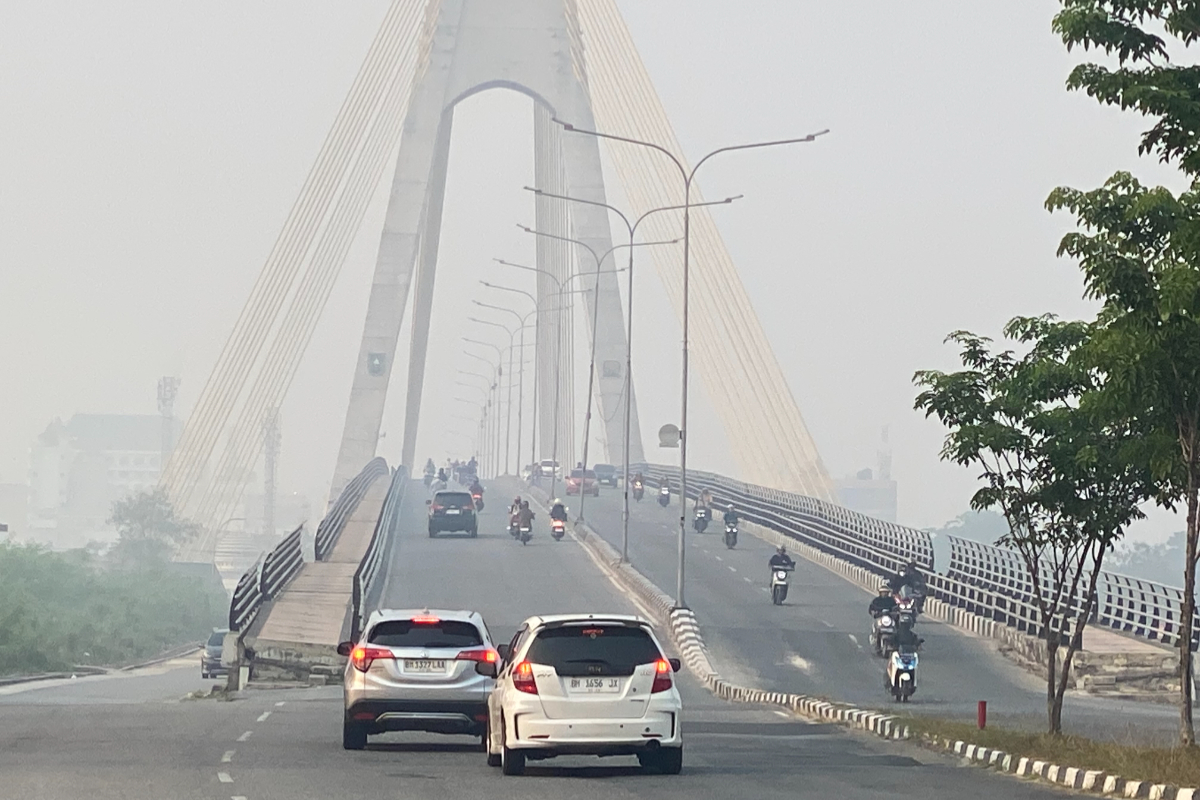
Dense haze from forest and land fires (Karhutla) has once again enveloped the city of Pekanbaru. This condition has caused visibility to decrease to less than 1,000 metres.
The Head of the Class I Sultan Syarif Kasim II Meteorology Station in Pekanbaru, Warjono, stated that the reduction in visibility is influenced by haze carried by the wind from southern regions. There are currently 29 hotspots detected in Riau.
“These hotspots are monitored in the Indragiri Hulu and Indragiri Hilir Regencies. Therefore, the haze in Pekanbaru is being carried from the south,” he said on Wednesday (16/9).
Fire conditions in regions outside of Riau are also quite significant. The Meteorology, Climatology, and Geophysics Agency (BMKG) is monitoring more than 2,000 hotspots in South Sumatra Province and over 400 hotspots in Jambi Province.
Due to these conditions, wind direction is also carrying smoke towards the Riau region, including Pekanbaru.
“The wind direction is from the southeast to the south, moving towards the north. The smoke originates from South Sumatra and Jambi,” he added.
Similar conditions also have the potential to affect air quality in neighbouring countries. The movement of smoke towards Singapore is estimated to originate from the Sumatra region, including Jambi, or even Kalimantan, depending on wind patterns.
Meanwhile, air quality in Pekanbaru remains at an alarming level. Based on BMKG monitoring, particulate concentration was recorded at approximately 220 micrograms per cubic metre.
“Regarding the ISPU (Air Pollution Index) or air conditions, BMKG recorded 220. This level has entered the dangerous category,” he stated.
While air quality experienced a slight improvement in the morning, particulate concentrations remain above the threshold of 150 micrograms per cubic metre.
“It is still in the very unhealthy category because the average remains above 150 micrograms per cubic metre,” he concluded.