
Forest-Edge School Strives for Sustainability Through Self-Reliance
About 5 kilometres towards Sekolah Pakis in Pesawahan Hamlet, Gununglurah Village, Cilongok District, Banyumas, Central Java, the road narrows. Although it is already asphalted, there is damage at several points, so vehicles must proceed slowly, especially on the uphill sections. After passing through a pine forest, Telaga Kumpe comes into view at an altitude of 700 metres above sea level. Sekolah Pakis stands on the northern side of the lake, which directly borders the forest on the southern slope of Mount Slamet. The distance from the centre of Purwokerto is about 25 km.
Initially, Sekolah Pakis was named Madrasah Tsanawiah (MTs) Pakis. The name Pakis refers to a typical mountain vegetable. Pakis is also an acronym for piety, achievement, knowledge, integrity, and sincerity. Today, Sekolah Pakis not only accepts students at the junior secondary level but also up to Kejar Paket C, equivalent to senior secondary school. The school, established in 2013, continues to strive to stand firm in serving the education of children on the forest edge.
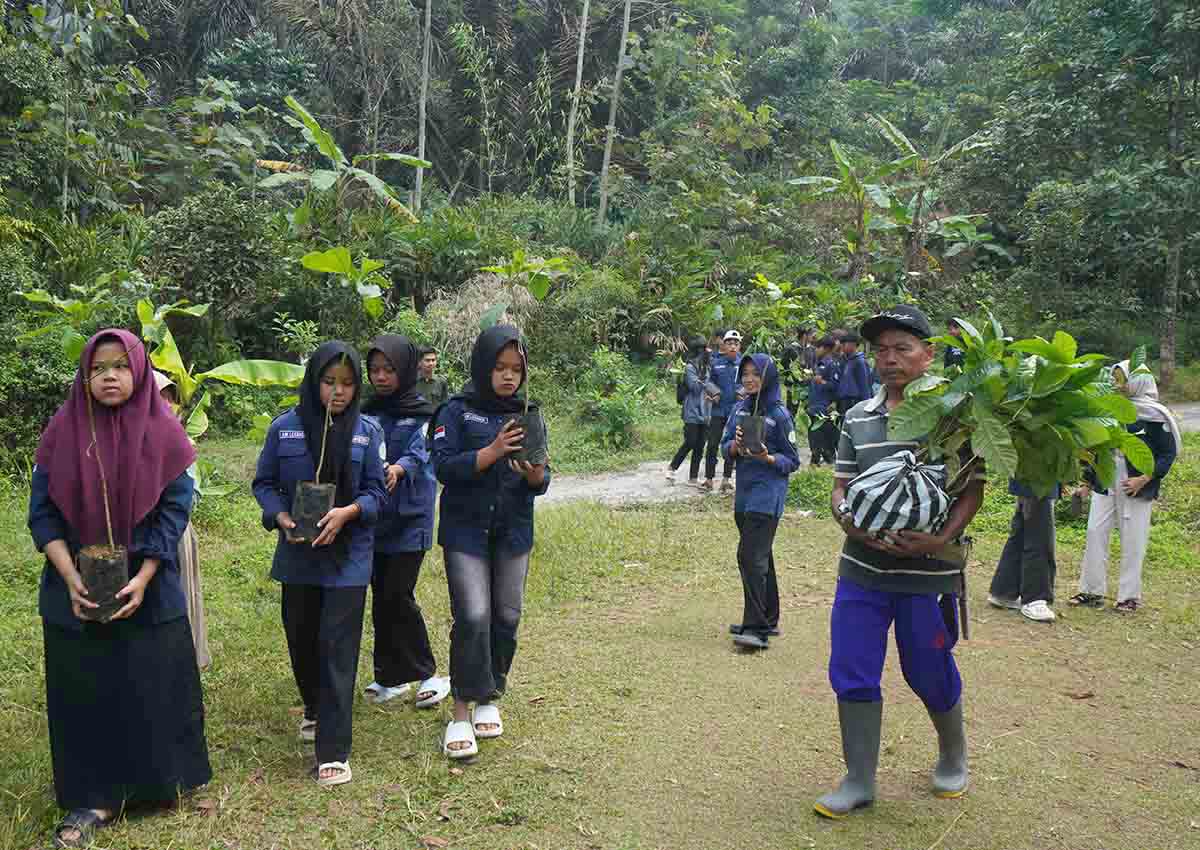
As an alternative school, classrooms are often empty. Students frequently learn outdoors, especially when the subject relates to agroforestry. This was seen in early August. After receiving lessons indoors, they went outside. Junior and senior secondary level students were around Telaga Kumpe. “Today there happens to be a lesson on coffee cultivation. We were in the classroom earlier, and now we are practising outside,” said Reza Setiawan, 14, from Karanggondang Hamlet, Sambirata Village, a neighbouring village of Gununglurah.
Not only Reza, but also Kejar Paket C student from Sambirata, Sefia Ramadhani, 18, took part in the coffee cultivation lesson. “We are taught how to cultivate coffee, starting from seeding, planting, maintenance, to harvesting. We are also taught post-harvest processing, namely processing ripe coffee beans by roasting. There are various processes, including natural, full wash, and honey,” said Sefia.
Both appeared very enthusiastic when the head of the Banyumas Coffee Training Center (BCTC), Edi Daryono, shared his experience from cultivation to marketing. “The children and residents here are quite enthusiastic because they will immediately practise in the field,” said Edi during the Sustainability Journalism Fellowship (SJF) 2026 event supported by CIMB Niaga on Tuesday (14/7).
According to Edi, after seeing the area around Sekolah Pakis, he is optimistic that coffee cultivation can be developed to support the school’s operations so that it can be sustainable. “The potential is very good because coffee can be planted among forest plants. The most suitable type to plant here is robusta coffee, because the altitude is below 1,000 metres above sea level,” said Edi.
Sekolah Pakis head Isrodin added that the school has been cultivating coffee for several years. However, the cultivation methods have not been optimal. “With Mas Edi coming here, it will add to our knowledge. Starting from cultivation methods, maintenance, to post-harvest. Especially how to process coffee into a ready-to-sell product, which we are not yet proficient at,” said Isrodin.
As a coffee practitioner, Edi sees that robusta coffee cultivation in the area around the forest has great prospects to be developed as a flagship commodity as well as a source of income. “Geographical conditions, soil texture, climate, and altitude are supporting factors for coffee plant development,” he said.
According to him, with good management, robusta coffee productivity in the area can reach about 6 kg per tree per year. In fact, robusta coffee plants that grow optimally in the highlands have the potential to produce 12 kg per tree. However, this productivity cannot be achieved from the start of planting. Coffee plants take several years to reach optimal production. “From planting until production increases to about 6 kg takes approximately 4 years. After 4 years, you can get results like that,” he said.
Edi considers coffee plants to also have advantages in terms of sustainability. Coffee can be part of conservation efforts because it has a long productive life and can be planted in areas bordering forests. “Coffee has a long lifespan, up to 125 to 150 years. So it is very suitable for conservation areas, especially forest lands,” he said.
He reminded that development is not enough just by planting coffee. The community also needs continuous assistance, from cultivation techniques, maintenance, harvesting, post-harvest, processing, to marketing. “If managed optimally or intensively, I think it is more than enough. The land is there, the human resources are there. They just need training, from planting methods, post-harvest, processing, to marketing methods,” he explained.
According to him, the economic value of coffee does not only come from coffee beans. In developing coffee plantations, the community can utilise various companion plants that have economic value. “There are many derivatives. A coffee plantation is not only coffee. There can be spices such as cardamom and cinnamon, then fruit plants, shade plants, and others,” said Edi.
He added that this pattern allows the community to obtain more diverse sources of income while maintaining the sustainability of the plantation ecosystem.
Edi said that the price of robusta coffee has now increased significantly compared to several years ago. “Robusta, which three years ago was around Rp20,000 per kg, is now Rp60,000,” he said.
The high price is inseparable from coffee’s character as a commodity with a global market.