
Forest Burning in the Perspective of Corporate Criminal Liability
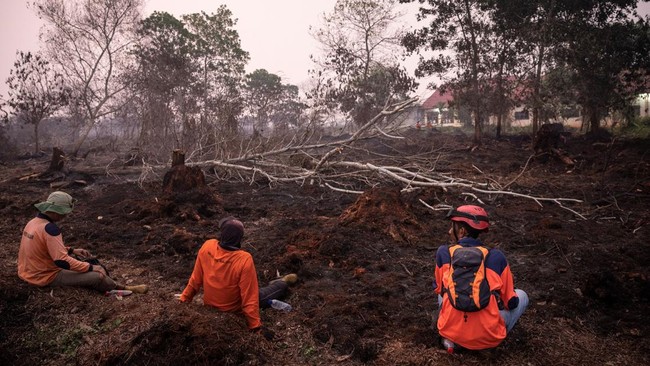
Who Lights the Fire, Who Bears Responsibility?
Whenever forest and land fires occur, public attention usually focuses on the fire itself: where it came from, who lit it, and who should be punished. These questions are certainly important. However, when fires occur repeatedly in areas controlled or managed by corporations, a far more fundamental question arises: to what extent can a corporation be held criminally liable for the occurrence of forest and land fires?
This question becomes increasingly important when fires occur in company concession areas. It is not always easy to prove that a corporation directly ordered someone to burn. The fire may have been lit by workers, communities, contractors, or other parties. However, stopping at the person who physically lit the fire can cause the law to lose the broader dimension of corporate crime.
In the corporate context, criminal acts do not always manifest as explicit orders. They can emerge through decisions, policies, omissions, weak supervision, the absence of prevention facilities, or even a corporate culture that places economic interests above the obligation to protect the environment.
Therefore, the issue is not merely who lit the fire, but also who had the duty to prevent it and who benefited from the situation.
Riau and Kalimantan provide an important space to examine this issue. Both regions have vast expanses of forest and peatland, while also being areas with large-scale plantation and forestry activities. When fires occur in these regions, the law cannot simply stop at identifying who lit the fire.
The law must also be able to answer broader questions: whether the fire is related to corporate policy, business activities, profits obtained, or the corporation’s failure to control its business risks.
This is where the issue of corporate criminal liability becomes important. Corporations are no longer viewed merely as legal objects, but have been recognised as subjects of criminal law. The problem then becomes more complex: how to establish corporate fault when the corporation does not physically hold a match, yet its structure, policies, and activities can create, amplify, or permit the risk of fire?
This question becomes increasingly relevant as forest and land fires (karhutla) once again occur on a large scale in various regions of Indonesia, particularly Riau and Kalimantan. Various mass media outlets have reported on the situation.
CNBC Indonesia, for example, on 24 August 2026, in an article titled ‘200,000 Hectares of Indonesian Land and Forest Burned This Year, Worst Since When?’, cited data from the National Disaster Management Agency (BNPB) which recorded that throughout 2026 there had been 454 forest and land fire incidents in various regions of Indonesia.
From Individual Perpetrators to Corporations
The issue is evident in the handling of forest and land fire cases by law enforcement officials. Kompas.com, on 23 August 2026, reported that the Criminal Investigation Agency (Bareskrim) of the Indonesian National Police had named 72 suspects in forest and land burning cases in areas from Kalimantan to Sumatra. The suspects allegedly carried out the burning to clear plantation land with the aim of reducing operational costs.
The Director of Specific Crimes (Dirtipidter) of Bareskrim Polri, Brigadier General Pol. Moh. Irhamni, stated that the cases were handled through investigation and inquiry processes in nine regional police jurisdictions. The modus operandi generally involved land clearing by deliberately burning in order to make plantation operational costs cheaper.
The fact that the 72 suspects are individuals is interesting to examine from the perspective of corporate criminal law. The question then becomes: is the burning purely an individual act, or is there a connection to corporate interests, policies, or activities?
This question is important because in corporate crime, the perpetrator visible in the field is not necessarily the only party that must be held accountable. The person who burns may merely be the executor on the ground, while the decisions, economic interests, or management systems that create the risk originate from the corporate structure.
However, it should be noted that not every fire occurring in plantation or concession areas can automatically be attributed to a corporation. Corporate criminal liability must still be based on facts and evidence demonstrating a connection between the criminal act and the corporation, including the corporation’s actions, policies, omissions, or failure to fulfil its risk control obligations.
In this context, the development of law enforcement by the Ministry of Forestry is noteworthy. Through Press Release Number SP.451/HKLN/08/2026 dated 24 August 2026, titled ‘Ministry of Forestry Uncovers Motives Behind Forest and Land Fires, From Area Trading to Encroachment, Corporations and Individuals Named as Suspects’, the Ministry of Forestry stated that the investigation of forest and land fire cases has expanded to include not only individuals but also corporations.
The handling of these cases includes alleged area clearing by burning, trading of forest areas in the Bukit Rimbang Baling Wildlife Reserve, encroachment uncovered through hotspot tracking in Mempawah and Ketapang, and a fire case involving a corporation in South Tapanuli that has been declared complete or P-21. A number of individual and corporate suspects have been named, while other cases are still being developed based on evidence.