
Forest and Land Fires Spread to Papua as UGM Expert Explains the Causes
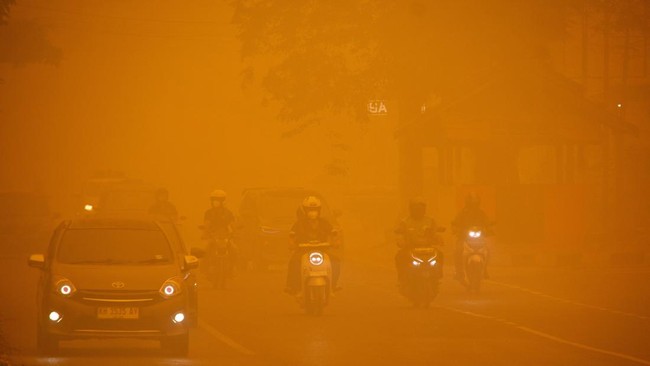
Jakarta, CNBC Indonesia — Forest and land fires that have struck parts of Sumatra and Kalimantan show no sign of abating, despite ongoing efforts to extinguish fires at numerous locations. Hotspots have reportedly spread to other islands, including Merauke in Papua.
The effects of the disaster are being felt beyond local communities. Dense smoke has crossed national borders, blanketing Malaysia and Singapore. Air quality in both neighbouring countries has deteriorated sharply, prompting a rise in acute respiratory infection cases. In several Malaysian states, authorities have been forced to close schools and suspend face-to-face lessons.
Fiqri Ardiansyah, a forest and land-fire expert at the Faculty of Forestry of Gadjah Mada University (UGM), said a prolonged El Niño was the main factor worsening this year’s fires in Indonesia. The lack of rainfall has left vegetation and land, particularly peatlands, at their most vulnerable.
“Rainfall is extremely low, and we have entered a more intense El Niño period. Rainfall is close to zero, making fuel such as peatland far more vulnerable to catching fire,” Fiqri said in a statement cited on Thursday (15 October 2026).
However, Fiqri stressed that drought alone cannot trigger fires. A fire requires an ignition source that interacts with fuel and oxygen.
“It is not the peat itself that suddenly causes a fire. Fires occur through an interaction between the ecosystem and a heat source. The main difference between peatland and non-peatland lies in the characteristics and behaviour of the fire when it burns,” he explained.
In non-peat ecosystems, fires generally burn the surface and spread to the plant canopy. In peatlands, however, fire can burn not only above ground but also penetrate and consume the soil beneath the surface. This makes detection and suppression much more difficult because the source of the embers is often invisible.
A key risk of peat fires is that embers can remain underground even after flames on the surface appear to have been extinguished. If water is applied only to the upper layer, the underground embers may persist and reignite later.
“Signs of this subsurface burning include drying vegetation, curled leaves and thin smoke, even when no flames are visible,” Fiqri added.
Logistical and geographical challenges are also hindering firefighting efforts. Many fires are in remote, hard-to-reach locations, and the situation is compounded by limited water supplies, personnel and firefighting equipment in local areas.
Indonesia is supported by early-detection technologies, including FIRMS, Sipongi and data from the Meteorology, Climatology and Geophysics Agency (BMKG). But Fiqri said the biggest challenge is the effectiveness of suppression methods on the ground, particularly in reaching embers below the soil.
“Technologies such as injecting water into peat layers (grout injection) and using fire-insulating materials are being developed. However, these approaches still need to be improved to ensure the fire is extinguished at its source,” he said.
Given the complexity of the fires’ effects, which are influenced by wind direction and local topography, Fiqri said the government could not rely solely on rain as an immediate solution.
Prevention efforts, including education and stricter enforcement of the ban on clearing land by burning, must be strengthened. At the same time, managing forest and land fires requires coordination across agencies, with priority areas identified according to their ecological and economic risks and their social impact on communities.