
Forest and Land Fires Are Not Inevitable
Forest and land fires are not inevitable
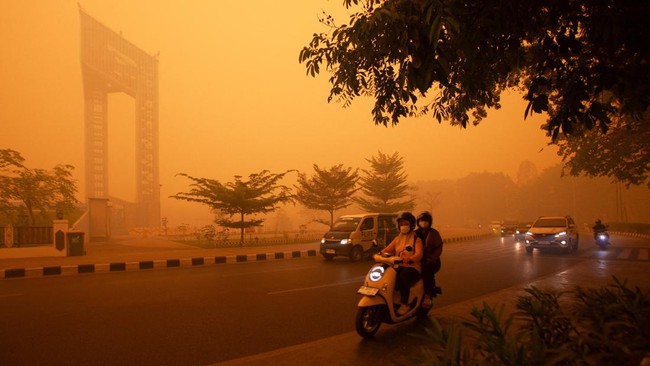
Whenever the dry season arrives, Indonesia once again faces the threat of forest and land fires. Skies that were once blue are covered by haze, clean air becomes a health risk, and people’s daily activities are disrupted.
Fires not only destroy forests and wildlife habitats, but also affect the lives of communities that depend on the environment. Health, education, livelihoods and economic activity all suffer when fires spread.
Forest and land fires should not be treated as a normal occurrence every dry season. Weather conditions can increase the risk of fires, but human activities and irresponsible land management also contribute to these disasters.
For this reason, tackling forest and land fires cannot rely solely on the government and firefighters. Public awareness, responsibility from businesses and the involvement of various stakeholders must all form part of prevention efforts.
This perspective is in line with the discussion on Focus ISKA 4, Episode 1, on the YouTube channel of the Indonesian Catholic Scholars Association (ISKA Channel), entitled “A Just Carbon Economy: Restoring the Earth and Upholding Human Dignity”. The discussion, featuring Dr Antonius Budi Susilo and Dr Jalius Slebbay, invites us to consider environmental issues through the connections between economic activity, social justice and responsibility for life.
Negative externalities and ecological justice
Focus ISKA 4 explained that a negative externality occurs when an economic activity causes harm to other parties who are not directly involved. Businesses may receive the profits, while the resulting damage to the environment and public health is borne by many others, including neighbouring countries.
This problem highlights the importance of ecological justice. Economic activity should be assessed not only by the profits it generates, but also by its effects on communities and the environment. Those responsible for damage must be held accountable, while communities that protect forests and peatlands need tangible support.
A just carbon economy must ensure that environmental protection benefits communities, rather than merely producing figures showing reduced emissions. In this way, economic activity can continue without disregarding people’s right to a healthy environment.
Laudato Si’: the Earth as our common home
Forest and land fires can also be viewed through the lens of the Catholic Church, particularly the encyclical Laudato Si’, issued by Pope Francis in 2015. In this document, the Pope calls on all humanity to care for the Earth as our common home.
The Earth sustains human life and that of all other living beings. Environmental damage is not only about the loss of trees or the destruction of ecosystems; it also affects the people whose lives depend on nature. When forests burn, communities can lose clean air, good health, educational opportunities, productivity and sources of income. These impacts show that the environmental crisis cannot be separated from social problems.
In the spirit of Laudato Si’, economic activity needs to take account of community wellbeing and the preservation of nature, rather than focusing solely on short-term profit. Caring for the Earth means protecting life, especially that of communities most vulnerable to environmental damage. Concern for nature is part of humanity’s moral responsibility to safeguard the life entrusted to us.
Ecological conversion: turning awareness into action
One of the key messages of Laudato Si’ is ecological conversion: a change in the way people think, in their habits and in how they treat nature. Concern for the environment cannot be limited to expressing sadness when forests burn. It must be reflected in real choices and actions.
In the context of forest and land fires, ecological conversion means abandoning land clearing by burning, developing habits that protect the environment, and rejecting activities that sacrifice nature for short-term gain. Businesses must also adopt responsible land management and prioritise fire prevention.
This responsibility cannot be placed on the government alone. Businesses and communities need to work together, in a spirit of mutual cooperation, to meet their environmental obligations. In addition, environmental education on peatland management and forest conservation needs to be delivered inclusively across all parts of society.
Putting ecological conversion into practice is a call to bring faith into everyday life. Caring for creation is expressed not only through prayer and religious celebrations, but also through the courage to stand up for affected communities, support policies that protect the environment, and develop more responsible ways of living.
Practical collaboration to prevent forest and land fires
Preventing forest and land fires requires cooperation among the five elements of the pentahelix: government, businesses, universities, civil society organisations and the media. Early-warning systems need to be strengthened so that fire risks can be identified before flames spread. Stakeholders should also work together with local communities to emphasise education on land management without burning.
Communities need support to protect the environment without losing their livelihoods. Assistance, access to knowledge and the development of sustainable businesses are all important parts of this effort. Community-based initiatives such as Social Forestry and the Climate Village Programme (ProKlim), run by the Ministry of Environment, need consistent support so that their benefits are genuinely felt by communities and the environment.
The carbon economy must also be directed towards real change. Emissions-offset mechanisms must not become a justification for business practices that damage the environment. Emissions reductions need to begin at source, through forest protection, fire prevention, ecosystem restoration and responsible land management.
Success should not be measured solely by emissions-reduction figures. Community protection, the fair distribution of economic benefits and ecosystem conservation must also be considered important measures. With this approach, the carbon economy can support fairer and more sustainable development.
Conclusion: restoring the Earth, upholding human dignity
Forest and land fires are not a fate we must accept every year. Rather, they reflect a collective responsibility that demands practical cooperation among communities, businesses and the government.
Ultimately, preventing forest and land fires—starting with awareness, strengthened by moral commitment and realised through collective action—is about more than putting out individual fires. It is a vital effort to sustain life, protect one another and ensure that future generations inherit an Earth that is safe and fit to live on.