
Forest and Land Fires and the Personal Accountability of Corporate Owners
Note: This article reflects the personal opinion of the author and does not represent the views of the CNBC Indonesia editorial team. This article was also written together with Sheila Noor Baity and Mhd. Zakiul Fikri.
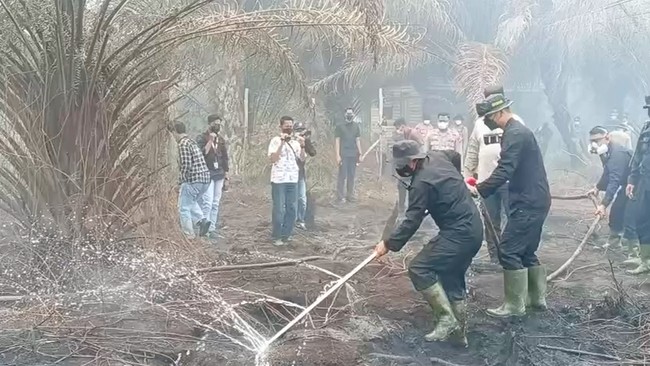
Between January and August 2026, a total of 202,010 hectares of Indonesian forest and land were burned, an area equivalent to three times the size of Singapore. The situation is deeply troubling, as the national fires occurring in Kalimantan and Sumatra are located on peatland, which naturally absorbs and retains far more emissions than ordinary forest. The fires therefore risk damaging global confidence in the Indonesia Carbon Exchange, which has been operating since 26 September 2023.
Moreover, the flames sweeping through the forests of Kalimantan and Sumatra are nothing new. In 2014, the Tesso Nilo National Park Foundation reported that forest and land fires had occurred in Riau, Sumatra, since 1997, and continued in 1999, 2005, 2013 and 2014. The same fires recurred in 2020, 2023 and again in 2026. This pattern indicates that forest and land fires (karhutla) in Indonesia, particularly in Kalimantan and Sumatra, do not occur purely naturally; human agency plays an active role in igniting these hotspots.
Forest fires and the threat to the carbon economy
According to data from Madani Berkelanjutan, the burned area within permits and concessions covers 338,459 hectares (about 50.7%), while areas outside permits and concessions account for 328,675 hectares (around 49.3%). By sector, oil palm plantation business permits are the largest contributor with 131,331 hectares, followed by the forestry sector through PBPH (Forest Utilisation Business Permit) at 69,016 hectares. WALHI (the Indonesian Forum for the Environment) reports that the highest number of hotspots was found on company-owned oil palm plantations, at 165 hotspots, and on company forestry permit areas, at 326 hotspots.
The Ministry of Forestry, through Press Release No. SP.452/HKLN/08/2026 dated 25 August 2026, reported that sanctions had been imposed on six companies linked to forest fires in Kalimantan. Meanwhile, the Ministry of Environment/Environmental Control Agency (KLH/BPLH) reported that 42 companies were indicated as actors behind the forest fires throughout August 2026. On 27 August 2026, KLH/BPLH supervisors even sealed one company following findings of hotspots that burned 1,500 hectares of land within the company’s concession area.
If law enforcement and ecological restoration for karhutla cases are not promptly handled properly, the burden of losses borne by Indonesia will continue to grow. The Center of Economic and Law Studies (CELIOS) calculates that total economic losses caused by forest and land fires in 2026 reached Rp123.1 trillion, equivalent to 49.1 per cent of the projected gross regional domestic product of Central Kalimantan in the same year. Beyond that, as the owner of one-third of the world’s tropical peatlands, with carbon reserves of 28.1 gigatonnes, karhutla threatens to destroy the economic value of carbon derived from preserving the remaining forest ecosystem.
As of August 2026, the Indonesia Carbon Exchange recorded a trading volume of more than 1.9 million tonnes of CO2e with a transaction value of Rp93.8 billion across 10 projects listed on the carbon exchange, with 159 entities using its services. The Indonesia Stock Exchange (IDX) has also just launched the IDX Green Equity Designation to boost investment in green sectors and the transition of listed companies. This means tangible economic incentives now exist for conducting business in environmentally friendly ways.
When sanctions are no longer enough: holding corporations to account
From the perspective of business owners, burning forests can be a rational choice. Beyond being cheap, Indonesian law often pursues only criminal, administrative and civil damages without considering whether those sanctions effectively bring about ecological restoration. As of 2025, of 18 final and binding court rulings that imposed damages or fines on companies responsible for forest fires, only two companies have complied. Two others are paying compensation in instalments, while for the remaining 14 companies the process remains unclear.
This includes companies already sanctioned with damages and environmental restoration fines through district court rulings. Those rulings were never successfully executed until the companies were declared bankrupt by the Commercial Court. The operating principle is simple: burn the land and forest first, pay the sanction, and business resumes as usual. When a company cannot pay the sanction, it takes the bankruptcy route to escape the grip of the law.
In light of the above, law enforcement against companies responsible for forest fires should go further than sanctions that are difficult to execute. Companies can, in fact, be held fully accountable. The law recognises them as entities that can hold rights, perform legal acts, and therefore be held answerable for their own actions. Bankruptcy does not extinguish a company’s legal liability; it merely transfers management of its assets to a curator for the repayment of debts to creditors. As long as there are assets that can be seized, or parties proven to have abused the company—including directors, shareholders and parent companies—accountability can still be pursued even after a company has been declared bankrupt.
A company is a legal subject separate from its owners, in this case its shareholders. Therefore, liability for the company’s actions fundamentally falls on the company itself, and losses are charged to the company’s assets rather than the personal wealth of shareholders. This is known as the doctrine of separate legal entity.
However, this separation is not a shield. Article 3 paragraph (2) of Law No. 40 of 2007 on Limited Liability Companies provides an exception: where shareholders use the company for personal interests or participate in unlawful acts, the separation of liability lapses. In such circumstances, shareholders can be held accountable to the point that their personal assets, and not merely the company’s assets, are at stake.
Furthermore, where the shareholder is the parent company, this provision can ensnare the parent company into sharing liability. Thus, there should be no more stories of workers or small subsidiaries being ‘forced’ to take the blame while owners and parent companies enjoy the proceeds after the fires occur. The role of environmental supervisors and relevant law enforcers becomes crucial in gathering evidence of the parent company’s involvement as a shareholder in the burning of forests by its subsidiaries. Without this, Article 3 paragraph (2) of Law No. 40 of 2007 cannot yet serve as a basis for prosecution.
From accountability to restoration
Karhutla should not be viewed merely as a forest fire problem, but as a test of the Indonesian Government’s seriousness in building an economy that is sustainable and fair for present and future generations. Future law enforcement therefore needs to be directed not only at punishing perpetrators, but also at ensuring all ecological losses are restored, preventing repeat violations, and guaranteeing that economic benefits are not built upon environmental destruction. Corporate accountability must be enforced fully and proportionally, including by tracing the involvement of those behind the corporate structure where they are proven to have played a role.
At the same time, the state needs to strengthen oversight, improve transparency in concession governance, and integrate forest and peatland protection with the development of Indonesia’s carbon market. That way, the carbon market becomes not just a new economic instrument, but part of a mechanism that encourages companies to protect the ecosystems that are the source of their economic value. Ultimately, Indonesia’s success should be measured not by the size of the sanctions imposed after fires occur, but by its ability to ensure that forests remain protected, perpetrators are held accountable, losses are restored, and economic activity can grow without sacrificing the environment and the interests of future generations.
Source: jawawa.id (https://jawawa.id/newsitem/forest-and-land-fires-and-the-personal-accountability-of-corporate-owners-1788850312)
Originally published by CNBC Indonesia (https://www.cnbcindonesia.com/opini/20260908130429-14-766149/karhutla-dan-pertanggungjawaban-pribadi-pemilik-korporasi), translated from Indonesian