
Forest and Land Fires and the Failure of Environmental Governance
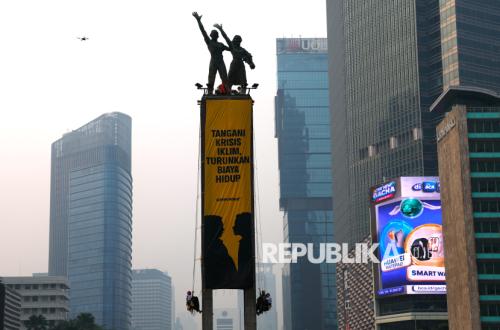
JAKARTA — “Disasters are getting worse, life is getting harder — what is the government doing?” This criticism from Greenpeace Indonesia resonated through a giant banner installed at the Hotel Indonesia Roundabout in Jakarta on 20 October 2026. The slogan expressed frustration with the government and questioned the state’s responsibility for environmental damage that threatens people’s lives.
The question is pertinent to the recurring problem of forest and land fires. Data from the Ministry of Forestry’s SiPongi+ system show that fires affected more than 200,000 hectares between January and July 2026, an increase of around 70 per cent compared with the same period in 2025. The weather has indeed been dry and there is an El Niño, but blaming the weather only obscures the government’s failure to manage the environment.
Forest and land fires are not purely natural disasters. Dry weather can trigger and spread fires, but the vulnerability of the land and the way people manage resources also determine the scale of the damage. Peatlands drained by canals are more prone to burning. Land clearance by fire, land-tenure conflicts, weak monitoring and inconsistent law enforcement can all heighten the threat.
It seems we are not short of rules, institutions, prevention programmes or monitoring tools. There are peatland protection policies, patrols, firefighting operations, law enforcement and ecosystem restoration programmes. Yet the government may appear busy tackling fires while, in reality, they continue to recur.
Research by Jefferson et al. (2020), which examined 60 fire-management interventions in Indonesian peatlands, shows that interventions should be tailored to the sources of risk and the socio-ecological context. Similarly, Carmenta et al. (2021) emphasise that prevention requires a combination of interventions suited to local conditions. Education alone is not enough if clearing land by burning remains cheaper. Law enforcement will not be effective if monitoring is weak or responsibility for fires is not traced to its roots.
Governance failures are evident in at least three gaps. First, there is a gap between rules and implementation: policies exist, but prevention and monitoring do not reduce risk. Second, there are gaps in coordination and accountability: data on fires, land cover, concessions and land tenure are not linked in a way that makes it possible to identify who is responsible. Third, there is a gap between programme outputs and real outcomes: budgets are spent, patrols are carried out and facilities are built, yet fires continue to recur. Together, these gaps show that government action is not producing meaningful results.
Brazil offers a lesson. In 2024, it enacted a law establishing an integrated fire-management framework that emphasises coordination and prevention. Australia has developed fire management adapted to ecosystem characteristics and local conditions. Indonesia can adopt these principles of coordination, preparedness and risk-based management.
The government therefore needs to shift from reactive firefighting to measurable prevention. First, it should integrate data on fires, concessions, land cover and land tenure so that repeatedly burned areas can be audited transparently. Second, it should assess the responsibility of permit holders and monitoring officials, backed by impartial law enforcement. Third, it should restore peatland hydrology and provide farmers with practical support to manage land without burning. Fourth, the performance of ministries, local governments and relevant agencies should be assessed by reductions in the area and frequency of fires, ecosystem recovery and lower exposure to haze — not simply by the number of activities undertaken.
The government cannot control the weather. But it is responsible for controlling risk factors within the reach of its policies. If fires continue to recur in the same areas, drought cannot absolve the government of responsibility.
Greenpeace’s slogan should be answered with evidence, not rebuttals or new programmes. Environmental governance fails when the state has rules and resources but cannot turn them into real protection for the public. Government success should not be measured by how quickly a fire is extinguished, but by its ability to stop the fire from starting again.
Source: jawawa.id (https://jawawa.id/newsitem/forest-and-land-fires-and-the-failure-of-environmental-governance-1793076738)
Originally published by Republika (https://opini.republika.co.id/berita/tnjsg3393/karhutla-dan-kegagalan-tata-kelola-lingkungan), translated from Indonesian