
Foreigners in the Indonesian Archipelago from the Fifth to Fifteenth Centuries: They Set the Rules, Rather Than Being Ruled
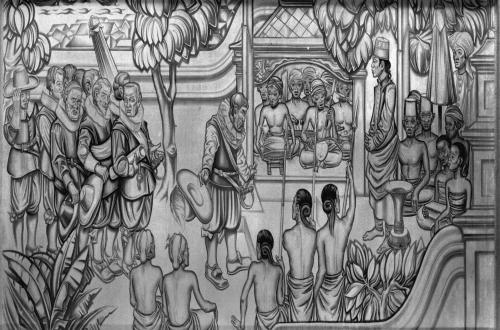
The presence of foreigners inevitably had consequences for the political and economic life of kingdoms. The busier trade became, the greater the need to regulate relations between newcomers and local residents.
The issue was not only how to welcome traders, but also how to ensure their activities did not conflict with the kingdom’s interests.
In this context, taxes and administrative obligations were important. Tax was not merely a source of revenue, but also an instrument for regulating economic activity. Through such systems, rulers could identify the groups within their territories, determine their obligations and ensure that trade took place within the framework of governance.
We should be careful not to equate taxation in the Old Javanese period directly with modern concepts such as immigration, residence permits or trade representation. Administrative terms and categories at the time had their own context. However, inscriptional evidence shows that kingdoms could distinguish between social groups and assign specific obligations according to their status.
This shows that foreigners were not always the ones setting the rules. They had to engage with rulers, communities and local economic systems. The relationship was reciprocal: foreigners needed access to commodities, markets and trade routes, while kingdoms gained economic and political benefits, as well as diplomatic ties.
Openness, therefore, did not mean unconditional acceptance. It was a policy shaped by political considerations and interests.
Nusantara Was Not a Blank Page in World History
Revisiting the presence of foreigners in the Indonesian archipelago between the fifth and fifteenth centuries brings an important realisation: global history should not always be written from the perspective of nations that came from elsewhere.
Historical narratives have often portrayed India as the source of civilisation, China as a centre of trade, and peoples from West Asia as carriers of religious and economic networks.
Nusantara has consequently appeared as a recipient. Yet relations between regions were never one-way. The peoples of Nusantara were able to choose, adapt, reinterpret and create new cultural forms through each encounter.
The presence of foreigners did not automatically turn Nusantara’s societies into foreign ones. Instead, newcomers interacted with social systems and cultures that had already developed. Some elements were adopted, others adapted, and still others rejected. This process made Nusantara’s history dynamic.
Foreigners in Nusantara’s history should therefore be understood not only as bearers of influence, but also as part of networks of relations built together with local communities. They arrived as traders, sailors, religious figures, envoys or newcomers seeking economic opportunities. But their lives unfolded in a space with its own rules, interests and identity.
This historical lesson remains relevant today. In an increasingly connected world, openness is often set against sovereignty. Yet Nusantara’s historical experience shows that the two need not cancel each other out. A society can remain open to the world, build relations with many peoples and still retain the authority to determine the direction of its own life.
Nusantara has long been home to people from many parts of the world. They came, traded, settled and interacted. But this home was not an empty space waiting to be filled. It had inhabitants, a history, rules and a culture that had grown long before their arrival.
The world did indeed come to Nusantara. But Nusantara was not merely a place where the world stopped over. It was one of the places that helped shape world history.
Source: jawawa.id (https://jawawa.id/newsitem/foreigners-in-the-indonesian-archipelago-from-the-fifth-to-fifteenth-centuries-they-set-the-rules-rather-than-1795571553)
Originally published by Republika (https://analisis.republika.co.id/berita/tp1a9c475/orang-asing-di-nusantara-abad-v-xv-mereka-yang-mengatur-bukan-diatur), translated from Indonesian