
Foreign Students Introduce Traditional Sports from Their Home Countries at ASEAN Sports Day 2026
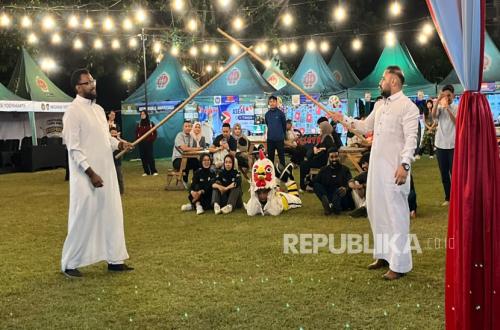
ASEAN Sports Day (ASD) 2026 was not merely a joint sporting event but also a space for foreign students to introduce traditional games and arts from their home countries on Saturday evening (5 September 2026). A number of international students studying in Yogyakarta took part, presenting the sports and cultures of their countries in a series of activities organised by the Ministry of Youth and Sports (Kemenpora).
Loman Park Hotel Yogyakarta served as the main venue for this year’s ASD. Students from various countries, including Pakistan, Egypt, India and Timor-Leste, mingled with other participants through traditional sports performances, cultural arts and recreational activities. Their presence demonstrated how sport can serve as a means of encounter and cultural exchange between nations.
Representatives from Egypt, Marwan Ashraf and Mohamed Saied, for instance, performed Tahtib, a traditional sport played by two people using sticks. Marwan explained that Tahtib has been known since ancient Egyptian times and is now more commonly performed at various Egyptian celebrations, accompanied by music and dance.
“Tahtib dates back to ancient times, to the era of the Pharaohs in ancient Egypt. It is performed by two people carrying sticks. It is like combat, but nowadays it is used for celebrations of events in Egypt,” Marwan said in an interview with Republika on Saturday evening (5 September 2026).
Tahtib was chosen for introduction at ASD because it is one of Egypt’s traditional sports that received UNESCO recognition as an intangible cultural heritage of humanity in 2016. He explained that Tahtib in the past was linked to martial skills and was used in warfare situations. The tradition subsequently developed into part of Egyptian celebrations and culture.
“Its philosophy was that it was used in war. Something like that. If there was a war, it was also for self-defence. So that is its philosophy — the value one can take from it is courage,” he said.
For Marwan, the opportunity to perform at ASD was also an experience of meeting students and participants from various countries. He felt the event opened opportunities for mutual acquaintance while broadening knowledge of other nations’ cultures.
“This event is really exciting because we get to meet and show traditional sports to all the participants from various ASEAN countries. So for me, this is an extraordinary opportunity to get to know friends from abroad,” he said.
Not only Egypt, but students from India also brought their traditional games. Akhil Srivastava, together with two of his friends, introduced kho-kho and kabaddi.
Akhil explained that kabaddi is a traditional Indian game connected to stories in the Mahabharata, including the tale of Abhimanyu being trapped in the chakravyuha formation. Meanwhile, kho-kho has developed over more than a century and has become a team game requiring speed, coordination and cooperation between players.
“We have to work together to win the match. In addition, players are also required to run and act quickly,” said Akhil.
He said he was delighted to be part of ASD 2026 because he had the opportunity to introduce traditional Indian games to participants from other countries. According to him, activities like this not only raise the profile of traditional sports but also serve as a means of getting to know the cultures of other nations.
Meanwhile, from Timor-Leste, Timotio Wusgusmao introduced the Tebe-tebe dance together with his team. He said the dance is an important part of Timorese culture that continues to be preserved to this day.
According to Timotio, Tebe-tebe serves several functions in the lives of the Timorese people, including welcoming officials or important figures, opening an event, and expressing gratitude.
“This dance is to express gratitude in events like this. So these dances have two functions. One, to give thanks. Two, to open an event,” he said.
Timotio viewed ASD as an important opportunity to strengthen relations between the people of Indonesia and Timor-Leste whilst introducing Timorese culture to a wider audience.
“Timor-Leste only separated from Indonesia 27 years ago. These relations are still very warm. So we are very grateful, and events like this we will use to introduce Timor-Leste going forward,” he said.
Previously, the Deputy Assistant for Community Sports at the Ministry of Youth and Sports of the Republic of Indonesia, Yayat Suyatna, said that ASD was deliberately designed as more than just a sporting activity. This year’s theme was ‘Active Youth, Healthy Future’, carrying the main message that the younger generation should know sport not only as competition but as part of daily life.
A number of programmes were held, ranging from the ASEAN Fun Run, Tour de Prambanan, School Hub, a job fair, a traditional sports festival, a pencak silat workshop, and various other sporting and cultural activities.
“The success of ASD will be seen not only during the event itself, but afterwards. After the event, the question is whether the public, for instance, becomes more regularly active in sport or not, whilst also introducing traditional sports,” said Yayat.
Beyond being a space to encourage the public to be more active, ASD is also directed at strengthening sports diplomacy. Participants from ASEAN countries and several other nations such as China, Japan and South Korea mingled with the people of Yogyakarta through various activities.
“There are also non-ASEAN countries such as Egypt and others. So sport is a universal language for uniting nations,” he said.
The General Manager of Loman Park Hotel Yogyakarta, Handono Suyatno Putro, said public enthusiasm for this year’s ASD was considerable. Besides yoga and wellness activities such as sound healing, the involvement of young people, high school students and foreign students made the series of events even livelier.
“International students studying in Yogyakarta also enlivened this event with cultural arts and entertainment activities. There were several traditional sports performed by students from Timor-Leste, as well as vocal arts activities from Pakistan,” he said.
Handono felt Yogyakarta was the right location for ASD because it was able to bring together sport, culture, local communities and the international community in one space. He hoped the momentum would continue to encourage the younger generation to be active whilst getting to know cultural diversity.
“So the tagline of this year’s event is how to activate young people, the young generation who will become the assets of a healthy generation in the future. Active youth, healthy future. This is a very good momentum. So Yogyakarta is indeed a very suitable, very appropriate location for the annual ASEAN Sports Day. We at Loman fully support this event as the venue, as the place for the ASEAN Sports Day to take place,” he said.
Source: jawawa.id (https://jawawa.id/newsitem/foreign-students-introduce-traditional-sports-from-their-home-countries-at-asean-sports-day-2026-1788774965)
Originally published by Republika (https://rejogja.republika.co.id/berita/tkzko3291/mahasiswa-asingkenalkanolahraga-tradisional-negara-asal-di-asean-sports-day-2026), translated from Indonesian