
Foreign Net Selling Surpasses 2008 and 2020 Crises as Global Investors Await OJK and SRO Action
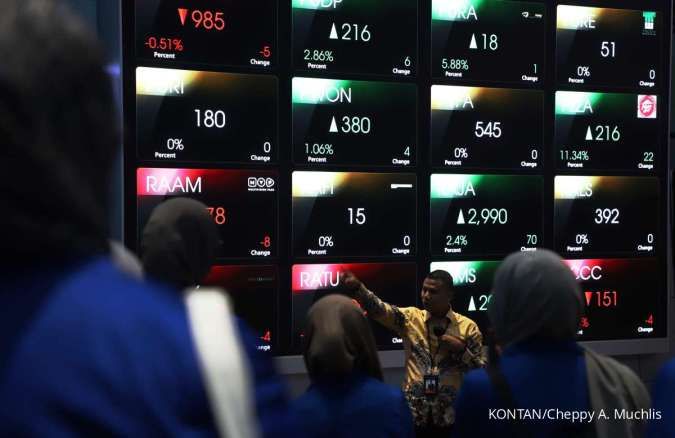
KONTAN.CO.ID – JAKARTA. Foreign investors’ net selling has continued to accelerate. So far in 2026, they have recorded net sales of Rp84.99 trillion, as of the market close on Friday (9 October 2026).
That figure exceeds the levels recorded during several crises in recent years. During the Covid-19 pandemic, foreign net selling reached Rp53.84 trillion over the course of 2020. In 2008, it totalled Rp50.17 trillion.
Budi Frensidy, a capital market observer at the University of Indonesia, said this year’s foreign investor outflows reflected a combination of external factors and global investors’ specific concerns about Indonesia’s stock market.
“Vietnam offers high economic growth as well as reforms to foreign investor access. Indonesia, meanwhile, remains relatively concentrated in banks and commodities,” Budi told Kontan last weekend.
RHB Sekuritas President Director Thomas Nugroho added that foreign selling reflected both global pressures and domestic confidence issues. A stronger US dollar and high US yields are weighing on emerging markets, he said.
Domestically, Thomas said, investors are also concerned about transparency of share ownership, free float, policy certainty and reviews by global index providers.
“This year’s pressure also has a domestic structural dimension. The authorities’ clean-up measures are positive, but investors need evidence of consistent implementation before increasing their exposure again,” he said.
The selling pressure emerged after global index provider MSCI froze changes to Indonesia’s stock market indices on 27 January 2026.
Another blow came in May 2026, when MSCI removed six Indonesian stocks from its Global Standard Index and 13 from its Small Cap Index.
Investors and market participants are now awaiting MSCI’s review in November 2026. The provider is scheduled to announce the results of its latest rebalancing on 11 November 2026.
MSCI is still freezing increases to the foreign inclusion factor and number of shares. It has also continued to flag concerns about ownership transparency and free float.
In a clean-up effort, the Financial Services Authority (OJK), together with the Self-Regulatory Organisations (SROs), launched eight action plans to accelerate reforms to the integrity of Indonesia’s capital market.
Earlier, on 6 February 2026, OJK imposed administrative sanctions and/or written orders on PT Repower Asia Indonesia Tbk (REAL), PT Multi Makmur Lemindo Tbk (PIPA) and related parties.
At the end of February 2026, OJK also fined a social media personality Rp5.35 billion for price manipulation involving the dissemination of information on social media in connection with several stock trades during 2021–2022.
OJK also imposed administrative fines on three parties in connection with trading in PT Impack Pratama Industri Tbk (IMPC) shares between January and April 2016.
According to a source cited by Kontan, OJK will release the results of investigations into several renewable energy stocks and a coal mining issuer that also operates as a holding company, with fines amounting to hundreds of billions of rupiah.
Kiwoom Sekuritas Head of Research Liza Camelia Suryanata said a more transparent market would give investors reason to reconsider Indonesia. However, investors still need attractive profit prospects before buying.
Liza said reforms announced by OJK and the SROs—including disclosure of shareholdings above 1%, announcements of ownership concentration, more detailed investor classifications and a minimum free float of 15%—were positive progress.
“The next step is to demonstrate that the data is accurate, that public shares are genuinely available for trading, and that the rules are enforced consistently,” she said.
She said foreign investors would return to Indonesia’s stock market when the rupiah stabilises, pressure from the dollar and US yields eases, companies’ earnings improve, fiscal policy becomes more certain, and index providers recognise the reforms.
“Market confirmation would be sustained net buying over several weeks, spread across a range of liquid shares and accompanied by healthy trading,” Liza said.
Budi added that four main indicators could bring foreign investors back to Indonesia’s stock market: a combination of rupiah stability, a weaker US dollar or lower US Treasury yields, upward revisions to corporate earnings, and fiscal policy that is predictable and supportive of the public.