
Foreign Minister Urges South-South Cooperation to Expand Creative Economy Markets
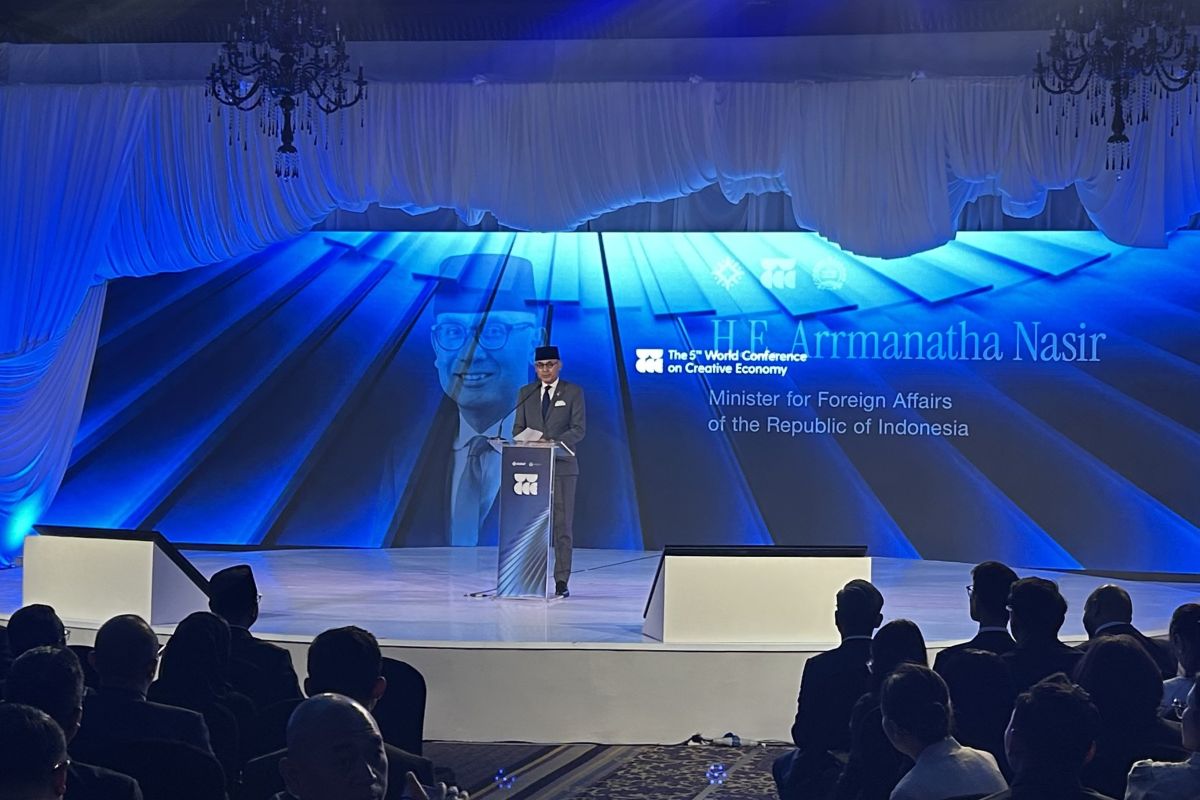
Jakarta (ANTARA) – Indonesian Foreign Minister Arrmanatha Nasir has called for stronger South-South and trilateral cooperation to broaden global market access for creative economy businesses and empower creators.
He made the remarks in a speech at the 5th World Conference on Creative Economy (WCCE) 2026 in Jakarta on Thursday.
“Through South-South and trilateral cooperation, we can share knowledge, build skills and help creative businesses grow and cross borders. Going viral is not the same as breaking into global markets,” he said.
Arrmanatha said economic instruments were increasingly being politicised and weaponised amid deepening uncertainty and a continued slowdown in global trade.
For developing countries, he added, this uncertainty was not abstract: they experienced it through exchange-rate volatility, fluctuations in commodity prices, and the effects on jobs and people’s livelihoods.
Arrmanatha said, however, that the creative economy would become Indonesia’s next source of economic growth.
“In a world full of uncertainty, creativity is one of our most renewable resources,” he said.
Alongside cooperation with countries in the Global South, Arrmanatha stressed the importance of protecting creators through intellectual property rules that are fair, enforceable and relevant to the AI era.
He also called on governments to connect creators by establishing trade agreements and economic cooperation arrangements that deliver broad benefits to the creative economy.
Through the Jakarta Vision, due to be adopted at WCCE 2026, Arrmanatha reaffirmed Indonesia’s readiness to help protect creators’ ideas, connect creators with the world and support their continued growth.
“Today, a nation’s wealth is determined not only by what is extracted from the earth, but also by what is created in the mind. Let us protect creativity. Let us invest in it. And let us take our creative works to the world stage,” he said.
WCCE 2026 is themed “Inclusively Creative, Collective Continuity” and has four pillars: technology, artificial intelligence and digital transformation; sustainability and the circular economy; intellectual property and creative rights; and inclusion, creative ecosystems and community empowerment.
These four pillars will form the basis of the Jakarta Vision on Creative Economy, which is expected to strengthen the direction of creative economy development globally.
Through the forum, Indonesia is advocating recognition of the creative economy not only as part of the cultural sector, but also as a source of economic growth, job creation and business opportunities for developing countries.