
Foreign Journalists Impressed by Role of Science and Technology in China's Development During Shenzhen Visit
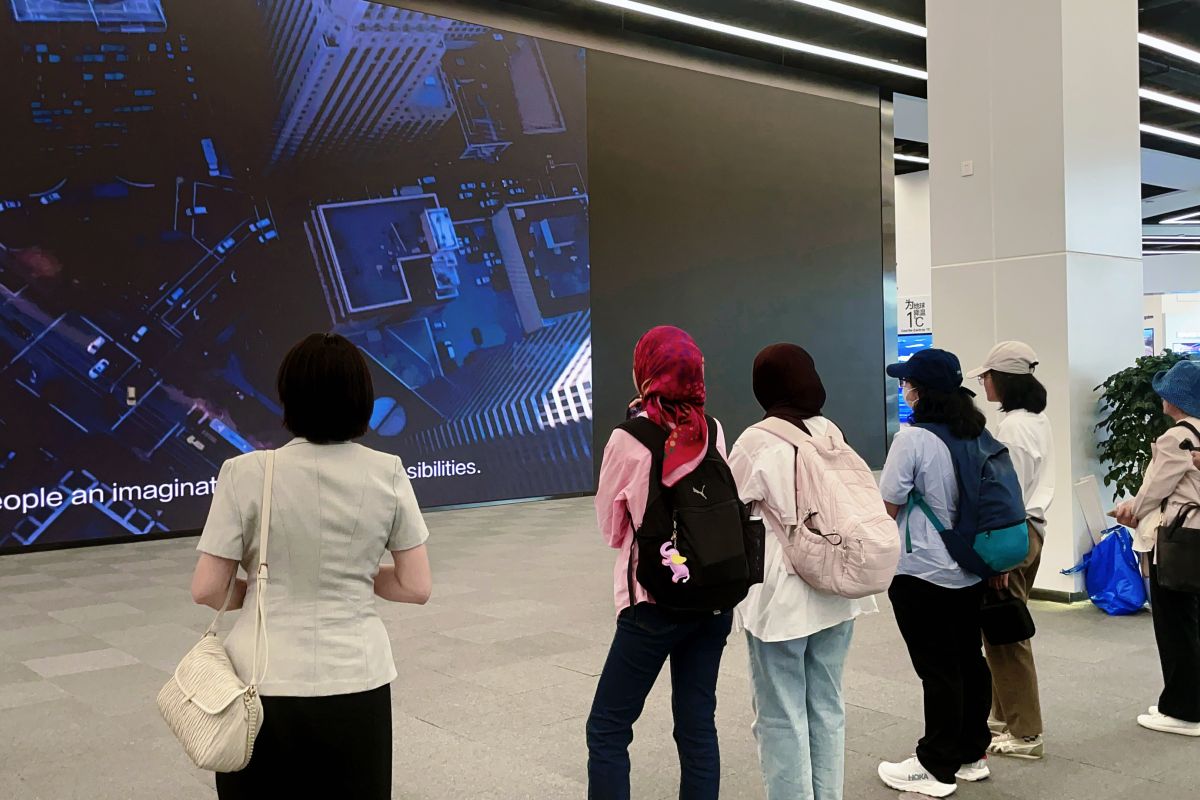
Shenzhen (ANTARA) - For Mecca Yumna Ning Prisie, a journalist from ANTARA news agency, a recent visit to the southern Chinese metropolis of Shenzhen proved to be a highly impressive experience. During the visit, she witnessed first-hand Shenzhen’s development as a major technology and economic hub oriented towards innovation, featuring a blend of technological breakthroughs, industrial chain development, and comprehensive economic growth.
At Shenzhen InnoX Academy, Mecca was fascinated to see a smart hardware prototype developed by a local incubation team. The device can accelerate the product development process from concept to physical form by speeding up continuous testing and enabling timely technological iterations.
‘I saw a system that integrates various suppliers here, so the work efficiency is extraordinary,’ said Mecca, impressed by the quality of service the academy provides to entrepreneurs.
Mecca’s visit was part of a tour for journalists from several APEC member countries and regions visiting Shenzhen from 21 to 24 July. The aim was to observe the development of science and technology in one of China’s main economic growth engines and the role of science and technology in the country’s socio-economic development.
During the visit, the journalists also toured a low-altitude economy technology zone and witnessed the application of drones and eVTOLs in various scenarios, including unmanned logistics, urban transportation, and aerial patrols. While observing the talent chain, value chain, and industrial chain related to the low-altitude economy, they discussed the potential application of such technologies in their respective countries.
At a Qianhai exhibition booth, Malaysian journalist Nadzirah Binti Yazid enthusiastically interacted with a humanoid robot named Oli from LimX Dynamics. The 165 cm tall robot, which has 31 degrees of freedom, can complete various tasks such as welcoming guests, making introductions, and conducting real-time multilingual dialogue, making it a highlight of the exhibition.
For Lee Chee Yang, the InnoAI translation device developed by a Qianhai company was a particularly useful tool. Without requiring an internet connection, the device can perform real-time, cross-application multilingual translation and even mimic the speaker’s voice. Lee curiously inquired about the device’s price and market share from the staff while trying out its functions.
The journalists also visited the Dongguan-Hong Kong water supply project. Built in the 1960s, the project was designed to address Hong Kong’s freshwater scarcity by relying on water sources in Guangdong Province.
As a traditional water supply infrastructure at the start of its operation, the project has undergone several rounds of optimisation and expansion from the 1970s until 2003. Currently, the quality of the water supplied exceeds China’s national secondary standards, and the annual supply volume has reached 2.423 billion cubic metres, a 35-fold increase from the project’s initial operation.
The project is now equipped with unmanned patrol vessels capable of inspecting water quality, screens displaying real-time water quality data, and various other advanced technologies to ensure the quality and efficiency of the flowing water.
‘From this project, I see China’s determination and capability in building infrastructure for the well-being of its people and how technology empowers it. We not only gained material for news coverage but also saw how concepts can be realised in the Guangdong-Hong Kong-Macao Greater Bay Area. Here, we saw the future,’ Mecca said.