
Foreign Investors Still Hesitant to Buy Shares: Where Should the JCI Be Now?
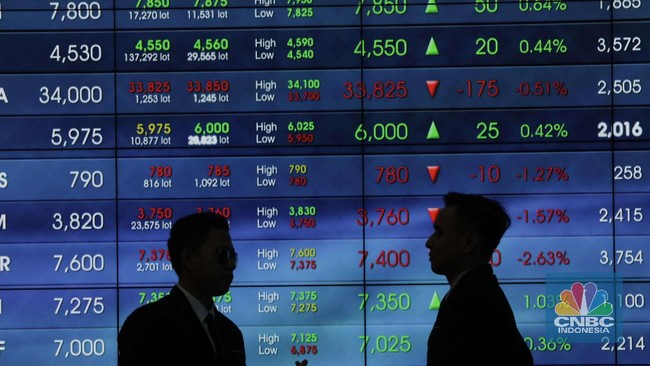
Jakarta, CNBC Indonesia – Foreign investors have begun buying Indonesian shares, despite reversing direction in trading on Wednesday (14 October 2026). Their purchases from 9 to 13 October have opened the possibility of improved sentiment for the Jakarta Composite Index (JCI).
Foreign investors recorded net buying on three days—9, 12 and 13 October 2026—before switching to net selling on Wednesday.
From 9 to 13 October, foreigners recorded net buying of Rp743.55 billion, but reversed course with net selling of Rp1.1 trillion on Wednesday (14 October 2026).
The foreign purchases from 9 to 13 October offer the prospect of improved sentiment, while valuation comparisons with ASEAN countries produce a scenario in which the JCI could be aligned at around 6,500–6,800.
To reach that level, the market still needs broader support from foreign buying, resilient corporate earnings and reduced uncertainty over MSCI policy.
Net foreign buying on 9 October 2026
PT Indonesian Paradise Property Tbk (INPP) led with foreign net purchases of Rp119.2 billion. PT Mitra Adiperkasa Tbk (MAPI) followed with Rp67.0 billion, ahead of PT Energi Mega Persada Tbk (ENRG) at Rp34.9 billion.
EMAS and ARCI completed the top five, with net buying of Rp17.3 billion and Rp16.0 billion respectively.
Net foreign buying on 12 October 2026
PT GoTo Gojek Tokopedia Tbk (GOTO) ranked first, with foreign net purchases of Rp134.3 billion.
PT Bank Rakyat Indonesia (Persero) Tbk (BBRI) was second at Rp80.3 billion, narrowly ahead of PT Astra International Tbk (ASII), which recorded Rp79.3 billion. VKTR and TINS completed the top five.
Net foreign buying on 13 October 2026
ENRG surged to the top spot, with foreign net purchases of Rp592.5 billion. This was far ahead of ASII in second place, at Rp44.7 billion.
TINS followed at Rp35.3 billion, then BRMS at Rp34.4 billion and BBCA at Rp30.1 billion. ASII, TINS, BRMS, MEDC and VKTR remained among the top ten for two consecutive sessions.
ASEAN valuations leave room for recovery
Valuation comparisons with Malaysia, Thailand and the Philippines offer an indication of the Indonesian market’s potential room for recovery.
According to MSCI data as at 30 September 2026, the three markets had a simple average historical PE ratio of 13.95 times and PBV ratio of 1.73 times. They were selected for comparison because all are ASEAN emerging markets.
To translate the comparison into a JCI level, the simulation uses the index’s position at the end of September, at 6,071.14, alongside the IDX Market PER of 12.42 times and Market PBV of 1.62 times.
Assuming earnings and book value remain unchanged, aligning the index with the average of the three countries produces results in the range of 6,500–6,800, or around 9.6%–15.1% above the JCI’s 13 October close of 5,925.98.
These figures are a ratio-alignment simulation, not a definitive fair value. The calculation uses the average of three selected markets, rather than the official valuation of the MSCI ASEAN index. Differences in share composition, profitability, risk and IDX-MSCI aggregation methods still need to be taken into account.
Nevertheless, the comparison provides a basis for viewing the JCI’s upside potential as more than simply a hope for a rebound. There is room for recovery if investors are willing to narrow Indonesia’s valuation discount.
Foreign flows are emerging, but a market-wide pivot needs confirmation
Foreign buying in a number of shares is a positive development. However, the size of transactions across the whole market does not yet fully demonstrate the strength of demand in the regular market.
According to data from a securities firm, foreign net buying across the All Market reached Rp561.6 billion on 13 October, but amounted to only Rp5.9 billion in the regular market. Most of the buying came from the negotiated and cash markets.
The data also show ENRG net buying of Rp592.5 billion in the All Market, while regular-market net buying was only Rp20.0 billion. Foreign investors continued to be net sellers of several large-cap shares, including BMRI, TLKM and BBRI.
Selective buying is therefore evident, but a broad market pivot has yet to be confirmed. The signal would be stronger if foreign buying in the regular market continued, spread to large-cap shares and was accompanied by a growing number of shares gaining ground.
MSCI could provide an additional catalyst
Developments in MSCI policy are another factor to watch. If the freeze on certain index changes is lifted, the possibility of increased weights and the inclusion of Indonesian shares could reopen for eligible issuers. Such changes could support demand from index-tracking funds.
The November 2026 review is an important agenda item for the fourth quarter, but it is not a scheduled date for lifting the freeze. MSCI is still seeking evidence of improved transparency and sustained effectiveness of reforms. If progress is insufficient, MSCI has also left open the possibility of consulting on a downgrade of Indonesia’s market classification.
Expectations about the timing also vary. In research dated 12 October, Mirae Asset forecast that the freeze would remain in place in November and said the second half of 2027 was a more realistic timeframe for resolution. That is an analyst’s view, not an MSCI decision.
ASEAN valuations provide a scenario for the JCI to reach 6,500–6,800; fund flows and progress on reforms will determine whether that potential can be realised. The foreign buying already seen could mark the start of a recovery, particularly if support strengthens in the regular market and uncertainty over MSCI diminishes.
Source: jawawa.id (https://jawawa.id/newsitem/foreign-investors-still-hesitant-to-buy-shares-where-should-the-jci-be-now-1792032634)
Originally published by CNBC Indonesia (https://www.cnbcindonesia.com/research/20261014125117-128-776093/asing-masih-ragu-borong-saham-berapa-seharusnya-level-ihsg-saat-ini), translated from Indonesian