
Foreign Investors Reduce Exposure in Emerging Markets, Here's Why
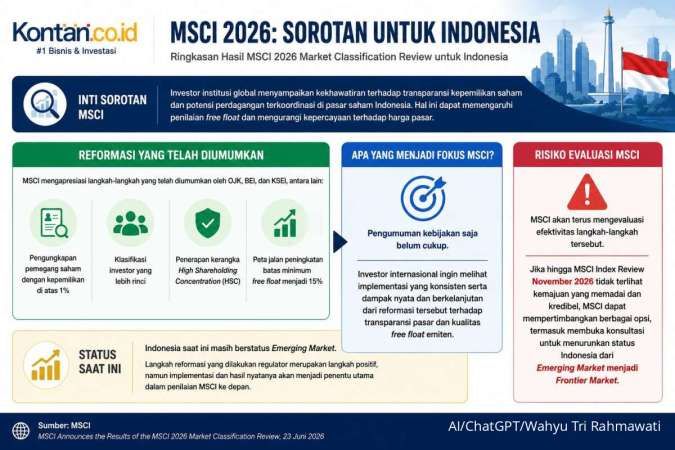
Foreign investors are reducing their exposure to a number of developing countries or emerging markets. This phenomenon is reflected in the increasing outflow of foreign capital in various countries, including India and Indonesia. India is one of the countries that has recorded a significant reversal in capital flows. The country posted a net capital outflow of US$2.4 billion in May 2026, a stark contrast to the net inflow of US$3.7 billion in May 2025. One of the triggers for this massive capital outflow was selling by foreign portfolio investors (FPI). Throughout May 2026, FPIs recorded net sales of US$4.7 billion. Meanwhile, India’s net foreign direct investment (FDI) was also negative at US$0.1 billion, indicating that the pressure has spread to long-term investment flows. A similar phenomenon is looming over Indonesia’s financial market. Foreign capital outflows remain one of the main pressures in the domestic market, reflected in the rising yield of Government Securities (SBN). The yield on 10-year SBN was recorded at 7.37% as of 24 July 2026, up 1.89% in the past week and surging 13% year-on-year (yoy). This increase in yield indicates that foreign investors are demanding higher returns as compensation for the risk of entering the Indonesian market. Firstly, the stance of the US central bank, The Federal Reserve, which appears more hawkish. Secondly, energy price shocks due to the escalating conflict in the Middle East. Thirdly, a risk-off sentiment amid high global geopolitical uncertainty. Foreign funds flowing out of emerging markets are heading to several regions and instruments considered safe-haven assets or benefiting from new structural trends. These include the US financial market, the artificial intelligence (AI) infrastructure sector, and a rotation into energy and raw material commodities. The outflow pressure is expected to continue in the short to medium term. The causes are the increasing fiscal burden and State Budget (APBN), as well as the depreciation of the rupiah exchange rate which is eroding growth prospects. However, foreign investors still have the opportunity to return (capital inflow) if there is a shift in several global macro turning points. For example, the emergence of deflation signals and a policy pivot by The Fed, such as a drop in world oil prices or easing inflation in the US that encourages The Fed to soften its monetary policy towards an era of interest rate cuts. Furthermore, domestic fiscal discipline is crucial. Concrete steps by the Indonesian government are needed to mitigate the APBN deficit, maintain subsidy stability, and comply with capital market regulations, including MSCI index criteria, to restore long-term investor confidence. Separately, Capital Market Analyst and Co-Founder of PasarDana, Hans Kwee, said that the outflow of foreign capital from emerging markets is driven by strong global investor interest in the artificial intelligence (AI) and semiconductor sectors. Unfortunately, Indonesia and India are countries that lack a base of AI and semiconductor companies, making them less attractive compared to other countries with strong exposure to these sectors. In addition to global factors, domestic pressures are also weighing on the Indonesian capital market. Index provider MSCI had threatened to downgrade Indonesia’s status to a frontier market. At the same time, rating agencies Fitch and Moody’s also threatened to lower Indonesia’s debt outlook, which further pressured the market and triggered capital outflows. Hans explained that in the initial stage, capital outflows mostly occurred in the stock market. This condition is considered normal as part of a common asset rotation. Meanwhile, in the bond market, the outflow was not significant and has even started to reverse, with foreign funds returning to the SBN market. Some of the funds exiting the domestic stock and bond markets are parked in Bank Indonesia Rupiah Securities (SRBI). Hans predicts that the capital outflow trend will not continue significantly. There are two reasons behind this projection. First, Indonesian bond yields are considered quite attractive, so foreign funds are starting to re-enter the SBN market. Second, concerns about a potential bubble in the AI sector are prompting global investors to rebalance their portfolios towards more defensive and value stocks. In this context, Indonesia is considered one of the undervalued markets, thus potentially benefiting from this investment strategy shift. However, Hans reminded that global uncertainty is rising again along with the heating up of the conflict between the United States and Iran. This situation poses a particular challenge for Indonesia, which is a net oil importer and still provides subsidies for Pertalite fuel. There are two main impacts to watch out for. First, pressure on the rupiah exchange rate due to the strengthening of the US dollar index amid the escalating conflict, coupled with high fuel prices, has the potential to boost imports and widen the trade balance deficit. Second, the burden of energy subsidies is likely to increase due to higher purchase prices and a shift in public consumption from Pertamax to Pertalite following the Pertamax price hike. This causes our budget deficit to widen, which in turn causes foreign investors to move out.