
Foreign Investor Compliance with Labour Law Remains Under Scrutiny
The government’s continued push for foreign investment must be accompanied by compliance with labour law, experts have warned. However, various issues persist in the implementation of worker protections at foreign investment companies (PMA), ranging from the fulfilment of social security obligations to the enforcement of legally binding court rulings.
Ahmad Ansyori, Chairman II of the Indonesian Association of Labour Law Lecturers and Practitioners (P3HKI), stated that Indonesia indeed requires foreign investment to drive economic growth. Yet, this need should not become a reason to neglect workers’ rights guaranteed by law.
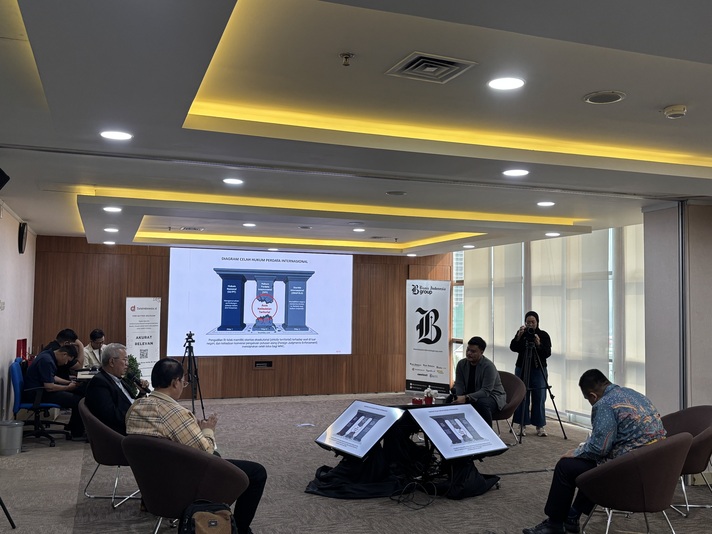
“Indonesia, and indeed any country, invites, calls, requests, and pleads for investment to come in. But how can we ensure they do not only see the financial perspective of investment, then ignore other things that we might call a denial or disregard of legal principles in Indonesia,” Ansyori said during a discussion titled ‘Foreign Investor Compliance with Labour Law in Indonesia’ held at Wisma Bisnis Indonesia, Jakarta, on Tuesday (9/6).
He also highlighted the ongoing tolerance of labour norm violations on the grounds that a company is still in the early stages of investment. According to Ansyori, the pattern of ignoring workers’ rights also manifests in unilateral termination of employment, disregard for Collective Labour Agreements (PKB), and the suppression of trade unions. He assessed that a recurring pattern exists in several foreign investment cases.
“We would like to call it deliberate, because it is not new, there are cases, and there are patterns. But to this day, some major cases, let alone the minor ones, clearly remain unresolved,” he added.
To strengthen investor compliance with labour law, P3HKI proposes introducing a labour compliance requirement for every corporate action. “Why don’t we introduce, for example, a mechanism where if there is to be a corporate action, merger, or acquisition, there is a requirement we call a Certificate of Labor Compliance,” Ansyori explained. According to him, the fulfilment of all labour obligations should be a prerequisite before a company undertakes a merger, acquisition, or divestment.
Meanwhile, Arnando Jujur Pardamean Siregar, Director of Industrial Relations Dispute Settlement at the Directorate General of PHI and Social Security at the Ministry of Manpower, stressed that healthy investment must go hand in hand with worker protection. “We hope investment drives economic growth while simultaneously creating jobs that will impact public welfare,” Arnando stated.
Arnando emphasised that compliance with labour regulations is a crucial part of creating harmonious industrial relations. He noted that investors also have a responsibility to ensure knowledge transfer to Indonesian workers. “Knowledge transfer from foreign workers to local workers. This is what we must jointly emphasise, so that the foreign workers brought in truly possess special expertise and specific skills,” Arnando elaborated.
Nevertheless, Arnando acknowledged that the biggest challenge in worker protection remains at the stage of enforcing court rulings. According to him, the successful execution of rulings is a measure of the authority of law and the state. “If that succeeds, the law is authoritative, court rulings are authoritative, the state is authoritative,” he asserted.
On the other hand, Public Policy Expert from Trisakti University, Trubus Rahardiansah, assessed that the state must be actively present whenever a dispute arises between workers and a foreign company. According to Trubus, the central and regional governments must collaborate to ensure every legal decision can be executed. “The central and regional governments should collaborate synergistically to execute it, to execute that decision,” Trubus stated.
Trubus also viewed that foreign investment indeed makes a significant contribution to job creation and regional economic growth. However, these benefits must be accompanied by compliance with applicable rules. He cautioned that legal certainty is an important factor in building public trust in the investment climate. Therefore, Trubus believes the government needs to reorganise the governance of foreign investment so that compliance with labour regulations can run more effectively.