
Foreign Investment Under Pressure as Indonesia’s Appeal Fades
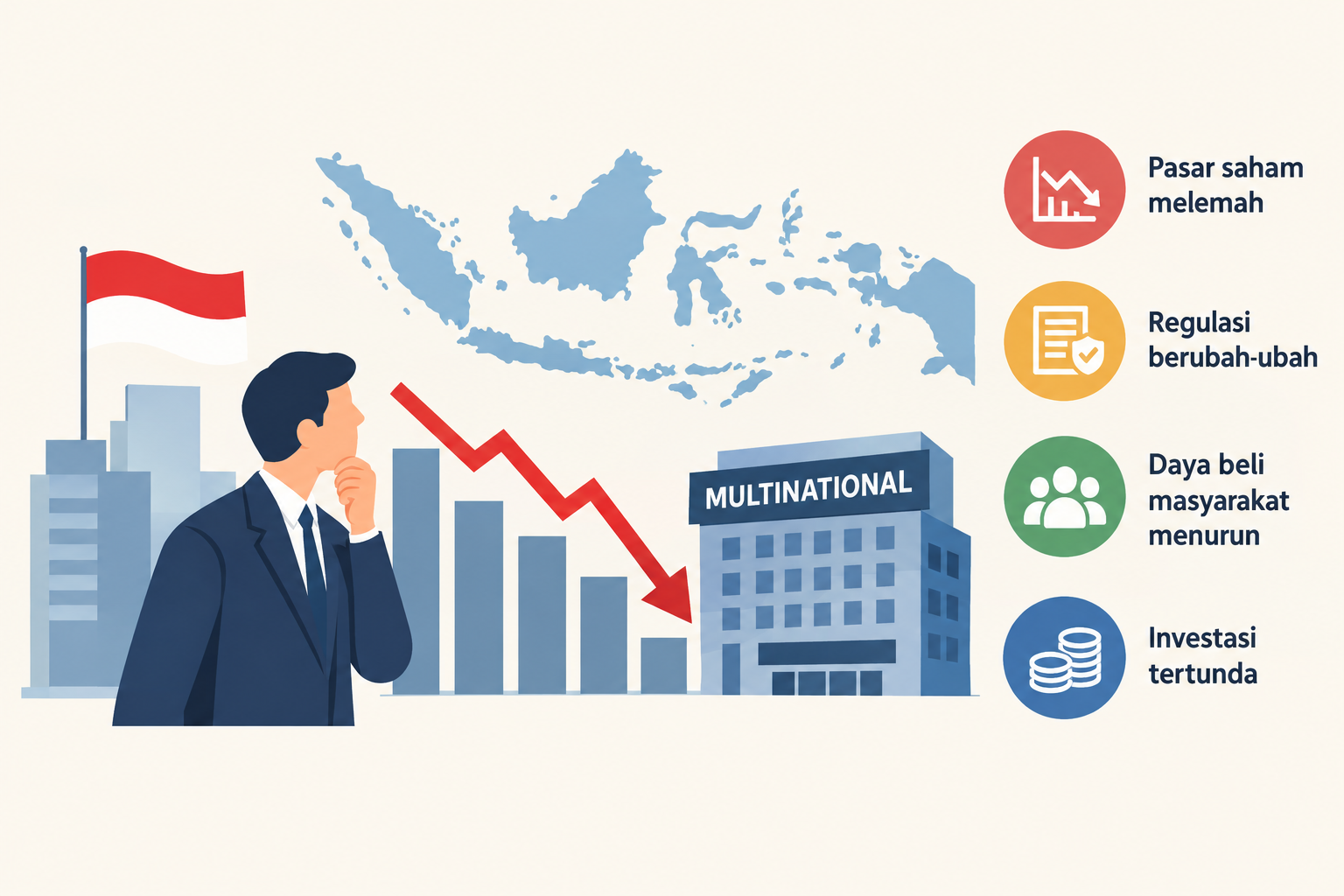
Indonesia has a combination that many other countries would struggle to match: abundant natural resources, a large population, a broad domestic market and substantial investment needs to build higher-value industries. Yet these advantages do not automatically guarantee investor confidence. When regulatory uncertainty coincides with weaker consumer purchasing power and declining corporate performance, the country’s economic potential can become a source of frustration for multinationals that have invested here.
That picture was highlighted in The Economist’s 24 October 2026 article, “The Archipelago of Broken Dreams”. It examined the worsening perceptions among some foreign companies of Indonesia’s business environment under President Prabowo Subianto. The issue is not only changes to regulations, but also how government policy affects investment certainty, smooth operations and companies’ ability to make a profit. A large market remains attractive to global investors, but that appeal diminishes when business risks become harder to predict.
One indicator highlighted in the article is the performance of Indonesia’s stock market. It said the value of Indonesian shares in US dollar terms had fallen by about 50% in 2026. MSCI has also threatened to reclassify Indonesia from an emerging market to a standalone market. The potential change is linked to concerns about the transparency of share listings and alleged price manipulation. This matters because investors’ perceptions of the integrity of capital markets can affect their allocation decisions, although share-price movements do not always reflect the condition of the entire economy.
Three pressures changing investors’ calculations
Pressure on multinational companies can be understood through three interconnected factors. First, policy uncertainty raises the risks and costs of doing business. Second, weaker purchasing power means that a large consumer market does not necessarily translate into sales growth. Third, delayed investment and falling profits suggest these problems could affect companies’ decisions about expanding their operations in Indonesia.
Table 1. Economic and business-performance indicators putting pressure on multinationals
Source: The Economist, 24 October 2026
These figures show that pressure on foreign companies does not come from a single source. New investment faces uncertainty, while companies already operating in the country must contend with a market that is increasingly price-sensitive. The falling share of middle-class workers is particularly concerning because this group is important to demand for cars, personal-care products, packaged food and other consumer goods. When household incomes are under pressure, consumers may postpone purchases, switch to cheaper products or reduce consumption.
This helps explain why Indonesia’s large population does not necessarily equate to a market in which it is easy to make a profit. Multinationals consider not only the number of people, but also disposable income, demand stability, distribution costs and their ability to maintain profit margins. A market with many consumers can still disappoint if sales growth does not keep pace with the costs of operating there.
Regulatory uncertainty adds to the burden
Another concern is regulatory certainty. In natural-resource industries, changes to production quotas, export requirements, land control and licensing procedures can affect investment decisions that are typically made for the long term. Mining, smelting, plantation and mineral-processing projects require substantial capital and have long payback periods. Before deciding to build production facilities, companies must assess operating conditions over many years.
If rules change too frequently or their application is difficult to predict, companies face greater risks. Investors may delay capital expenditure, demand higher returns to compensate for risk or choose another country that offers greater certainty. This does not mean the government should never change policy. Restructuring industries, protecting the environment and increasing the value added to natural resources are legitimate aims. But their effectiveness depends heavily on transparency, consistency and transition arrangements that allow companies to adapt.
Table 2. Policies and business obstacles that could disadvantage multinationals
Source: The Economist, 24 October 2026
The table shows that business obstacles vary by sector. Food and beverage producers need a stable supply of raw materials, while mining companies require certainty over quotas, licensing and asset ownership. Cosmetics and supplement companies must ensure their products meet applicable requirements. As a result, even changes that appear administrative can affect costs, production schedules and distribution strategies if they are not anticipated properly.
The impact of policy is not always immediately visible as a loss in financial statements. A company may maintain sales in the short term but incur additional compliance costs, hold larger inventories, seek alternative suppliers or postpone building new facilities. Over the long term, these costs and uncertainties can undermine Indonesia’s competitiveness against countries that offer a more predictable business environment.
This challenge is becoming increasingly important as the government promotes downstream processing and greater value added from natural resources. The strategy requires companies willing to build processing facilities, develop technology, train workers and connect local suppliers to global supply chains. If companies consider policy risks too high, the drive to add value could be hampered because the necessary investment never materialises.
Major companies face different pressures
The article illustrates the impact of business conditions on multinationals through several examples. Xinyi and LG Energy Solution face problems with new investment plans, while Toyota and Unilever face pressure in markets they already serve. Freeport-McMoRan faces a different issue related to its shareholding structure. These distinctions matter because companies do not all experience losses in the same way.
Table 3. Multinationals and the forms of business pressure they face in Indonesia
Source: The Economist, 24 October 2026
The examples show why difficulties with new investment should be distinguished from problems affecting existing operations. A project that loses momentum or is cancelled indicates that an investment plan may change before production facilities are built. Falling sales and profits, by contrast, signal pressure already being felt by operating businesses. Both situations matter, but they have different economic consequences.
The cancellation of a project worth billions of dollars means more than the loss of potential foreign capital. If it concerns battery or solar-panel manufacturing, the effects can also reach raw-material suppliers, contractors, logistics providers, workers and local companies hoping to join its supply chain. Falling sales at an established company, meanwhile, can affect recruitment, marketing expenditure, production capacity utilisation and the development of distribution networks.
Unilever illustrates the pressure in the consumer-goods market. The article reported that sales had fallen by about 20% since 2019, alongside a drop of more than half in operating profit. These figures show that pressure on profits is not simply a matter of lower sales. Changes in costs, selling prices, product mix and the need to remain competitive can also affect earnings. The article does not explain the contribution of each factor, so the decline in profit cannot be attributed to a single government policy.
Purchasing power will shape the domestic market’s future
Indonesia has long appealed to multinationals because of its large population and diverse consumer needs. But market size must be considered alongside people’s ability to spend. As consumers become more price-sensitive, companies need to adapt their product strategies, offer smaller pack sizes, expand lower-priced ranges or optimise distribution to reduce costs.
Changing consumer behaviour also affects competition. Cheaper products can gain market share, including goods sold through informal channels or without meeting tax obligations. Formal businesses may face additional pressure from this competition, as they still have to cover production, distribution, compliance and tax costs. Fair and consistent enforcement is therefore important to maintaining healthy competition.
Nevertheless, weaker purchasing power does not mean Indonesia’s market has lost all its potential. Its large population, urbanisation, digital-economy growth and continuing demand for industrial products all offer opportunities. The central question is whether those opportunities can be converted into effective demand and sustainable profits. Companies will remain interested in a large market if they can understand consumers, manage costs and predict business conditions with a reasonable degree of certainty.
Restoring confidence requires certainty
Competition between countries for investment is determined by more than tax incentives or access to natural resources. Investors also assess institutional quality, market transparency, legal certainty, policy consistency, labour availability and the government’s ability to resolve administrative problems. For long-term investment, certainty about the rules can be as important as the potential returns.
The Indonesian government must balance two priorities. On the one hand, the country wants its natural wealth to deliver greater benefits to the domestic economy. On the other, industrial development requires capital, technology and market access, some of which can come through partnerships with multinationals. Policies that are too permissive risk reducing the economic benefits for Indonesia, but policies that change unpredictably can also deter the capital the country needs.
The answer is not simply to offer more concessions to foreign companies. The government needs to ensure that policy changes have clear justifications, are applied consistently and include reasonable transition arrangements. Licensing processes should also be transparent, while oversight should be carried out without discrimination. This would allow national interests to be advanced without creating unnecessary uncertainty for businesses.
The warning to draw from The Economist article is that natural-resource wealth and a large domestic market are not enough to ensure Indonesia becomes a leading investment destination. Investor confidence is built through the practical experience of doing business, from obtaining permits to selling products and making a profit. If regulations are difficult to predict, investment is delayed and consumers come under greater pressure, it will become harder to translate Indonesia’s advantages into sustainable industrial growth.
Conversely, if the government can improve regulatory certainty, protect the integrity of financial markets, strengthen purchasing power and create fair competition, Indonesia still has a strong opportunity to remain an important investment destination in Asia. What is at stake is not merely whether foreign companies invest, but also whether domestic industries, workers and local suppliers can grow alongside that investment.
Source: jawawa.id (https://jawawa.id/newsitem/foreign-investment-under-pressure-as-indonesias-appeal-fades-1793123463)
Originally published by vibiznews.com (https://vibiznews.com/index.php/2026/10/27/investasi-asing-tertekan-daya-tarik-indonesia-memudar/), translated from Indonesian