
Foreign Funds Fleeing? Indonesia Could Use BPJS Ketenagakerjaan to Support the JCI
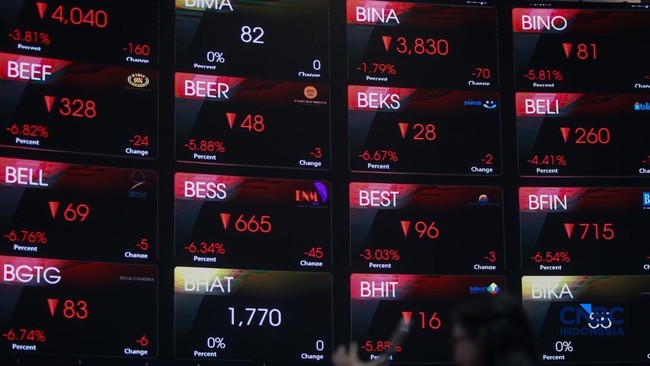
Jakarta, CNBC Indonesia — UBS Global Research projects that a possible downgrade of Indonesia to standalone market status by MSCI could trigger around US$16 billion in outflows from Indonesian equities held by foreign investors. This comprises about US$13 billion from active funds and US$3 billion from passive funds.
The bank stressed that this estimate is well below its previous worst-case scenario, which put outflows at more than US$30 billion. This reflects reduced foreign ownership and significant price corrections in affected shares.
The downgrade would therefore likely represent a transfer of share ownership from foreign to domestic investors, rather than a permanent withdrawal of capital from the Indonesian stock market. UBS consequently expects domestic funds could replace some foreign investment.
“However, in our view, discussion should focus less on the size of the outflows and more on the market’s ability to absorb them,” UBS analyst Joshua Tanja said in a research note entitled Indonesia Market Strategy MSCI: Domestic Fund Capacity, cited on Thursday (22 October 2026).
UBS identified the insurance and pension fund industries as the most significant potential source of absorption. These industries manage around US$125 billion in assets, but currently allocate only 9% of those assets to equities.
Its calculations suggest that each one-percentage-point increase in equity allocations could generate about US$1 billion in potential inflows to shares. Raising the allocation from 9% to 15% could bring an additional US$7 billion into the stock market. At 20%, the additional funds available would reach US$14 billion, equivalent to around three-quarters of the projected MSCI-related outflows.
The key point is that Indonesia does not need to create new sources of funding. It only needs to redirect a small portion of existing domestic funds into the stock market.
“We estimate the potential inflows from domestic investors into MSCI constituents if equity allocations increase from the current 9% to 10%, 15% and 20%,” he said.
Under these assumptions, additional domestic inflows could reach US$1 billion to US$10 billion with equity allocations of 10% to 20%. That would be enough to absorb around 6.5% to 63.7% of potential foreign investor outflows.
Can domestic investors take over?
UBS also measured potential outflows in terms of the number of days of average daily value (ADV)—the average daily transaction value—to assess market liquidity. Its calculations indicate that it could take around 14 to 112 days for the market to absorb the selling pressure fully.
Its simulations suggest that assets managed by domestic institutions may not be enough to absorb the impact of outflows from shares in PT Bank Central Asia (BBCA) and PT Bank Rakyat Indonesia (BBRI). This is mainly because domestic institutions already have substantial allocations to both shares.
Even if equity allocations were increased to 20%, MSCI-related selling pressure in BBCA shares would take around 82 trading days to absorb, while the equivalent period for BBRI would be about 32 trading days.
“We expect the impact on other shares to be smaller,” he said.
BPJS Ketenagakerjaan’s participation
BPJS Ketenagakerjaan managed assets worth Rp913 trillion as of June 2026, but allocated only 11% of them to equities. Domestic institutions collectively manage assets of around Rp1,700 trillion.
UBS estimates that domestic pension funds and insurance companies alone could potentially absorb US$1 billion to US$14 billion in outflows. This is based on the assumption that the Financial Services Authority (OJK) targets an increase in equity allocations to 20%, while maintaining the current limit of around 10% exposure to any single share.
Retail investors could also provide additional support, as they are not required to sell shares solely because of a change in index classification. Domestic investor participation could therefore act as a significant buffer against the impact of MSCI-related outflows.
“In our view, the main constraint is not the availability of capital, but how quickly funds can be deployed into the stock market,” he said.
Source: jawawa.id (https://jawawa.id/newsitem/foreign-funds-fleeing-indonesia-could-use-bpjs-ketenagakerjaan-to-support-the-jci-1792651857)
Originally published by CNBC Indonesia (https://www.cnbcindonesia.com/news/20261022110126-4-778510/dana-asing-kabur-ri-bisa-gunakan-bpjs-ketenagakerjaan-jaga-ihsg), translated from Indonesian